A research project has discovered a way to use sound as a harmless deterrent to keep cats away from nesting native birds.
Senior scientist at the Bioeconomy Science Institute (formerly known as Manaaki Whenua - Landcare Research) Patrick Garvey told RNZ the aim was to create a non-lethal deterrent for cats - both feral and domestic.
Feral cats were recently added to the Predator Free 2050 target species list, but domestic cats remain a treasured part of many New Zealand households.
There is no official estimate of how many feral cats live in New Zealand. While 2.4 million is often cited, some believe the true number is far higher.
Garvey said the idea for the research was born from a similar trial by a collaborator in Canada in 2016, who used the sound of dogs barking to successfully deter raccoons.
Garvey's own group was granted funding many years later, through the Ministry of Business, Innovation and Employment, to carry out similar tests here, targeting cats.
Through trial and error, they found feral cats were most averse to the sound of human voices and domestic cats were most averse to the sound of other cats.
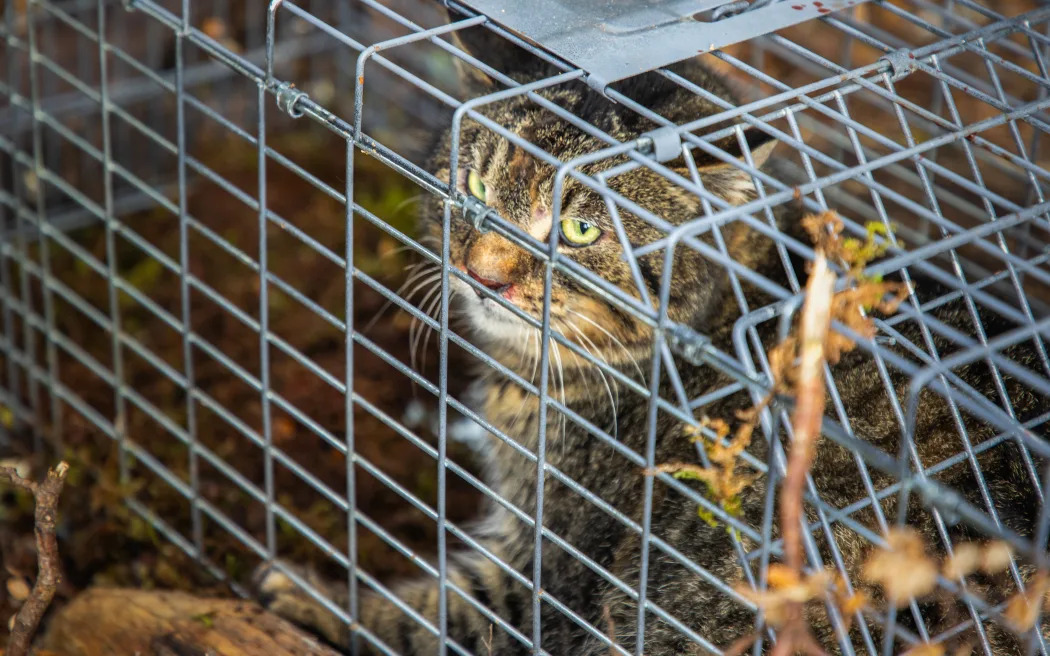
The tests involved placing 22 feral cats - all caught by the research group from the wild - inside a fenced enclosure, along with four samples of mince, one in each corner. One would be randomly selected to be 'protected' by a specific sound and when an approaching cat was detected by a camera, a sound played through a speaker.
Garvey said the results showed 40 percent of cats avoided food protected by the sound of other cats and dogs barking, but 70 percent avoided the sound of human voices.
By contrast, testing in urban environments showed domestic cats were most averse to the sound of other cats and didn't mind human voices.
The sounds were played at 60 decibels - for a human, Garvey said, you'd need to be about 20 metres away, before you heard anything - and featured non-aggressive human speech, including a storybook reading and an interview with famed jazz musician Dizzy Gillespie.
Anything too aggressive or controversial might alarm passers-by, Garvey said, as well as becoming quite grating for the person charged with setting it up.
The next step for the researchers was to try to protect colony breeding birds near braided rivers from feral cats and they also worked with Auckland Council to put out speakers in another reserve.
More research was needed to determine just how effective it could be in practice.
"It's a tool in the toolbox," Garvey said, a way to engage the community and educate them on the damage roaming cats could do.
"The sound cues will deflect a proportion of the cats - it'll be more than a third of them, but it's not going to do all of them," he said.
"It can provide a tool to engage with the community and show people what's happening, and maybe they might consider when they let their cats out at night."