

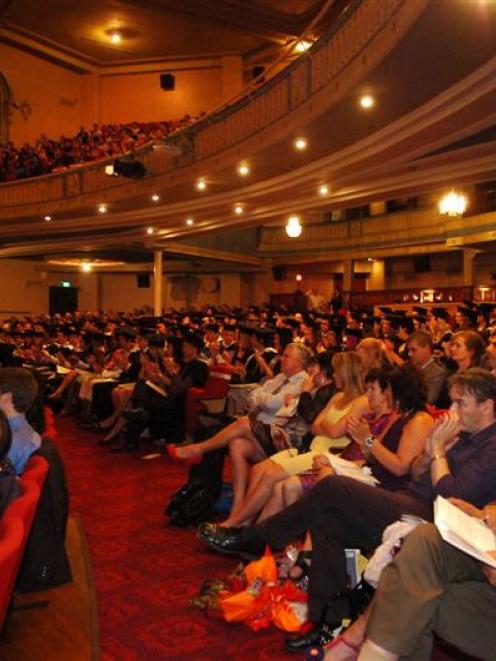
The university held two ceremonies, at 1pm and 4pm, at the Regent Theatre on Saturday instead of the usual single ceremony at the larger Dunedin Town Hall, because of redevelopment work there.
Otago University development and alumni relations director Dr Dave Gerrard told about 250 medical and medical laboratory science graduates at the first ceremony that, in an Otago medical class in 1973, he had been asked to nominate the medical scientists who had most influenced his choice of career.

Dr Gerrard recently repeated the exercise by asking a small group of Otago first-year health science students to name the greatest influences on their career choice, and had been surprised to be told House, MD, Grey's Anatomy and ER were, for current health science students, the "most influential determinants of career pathway".
Enlightened by this research, Dr Gerrard had since become "an unashamed, passionate devotee of House, watching 12 episodes in succession on a recent long-haul flight.

"Every treatment plan, whether you're a dental technician, dental therapist, physiotherapist or dentist, has certain limits. Our goal as clinicians is to perform excellent procedures rather than perfect ones."
"Commit yourselves to excellence but never to perfection. Too often we aspire to be perfect and we get bogged down in the downward spiral of destructive thinking."
"Too often we aspire to be perfect, in our work and our relationships and our assignments and our theses, and instead of enjoying the journey, we actually go nowhere.
"There is a war between thinking and action, and thinking is the enemy. Thinking can freeze us into inaction."


