Let me finish one more mouthful ..."
Don McGlashan is having lunch in the inner-city Auckland suburb of Grey Lynn when his fuel stop is interrupted by this phone call. He seems unperturbed, happy enough to disengage to chew the fat.
"As long as it doesn't rain I'll be able to talk at the same time as I wander round the car park," he says.
It's been a while since we last spoke - 2002, in fact - back when McGlashan's former band, the Mutton Birds, had just put out a best-of album complete with tracks Nature and Dominion Road. In the seven years since, he's been pretty busy, soundtrack work for television series and films helping to pay the bills.
McGlashan still lives in the same house, too, a place in Kingsland (another inner-city suburb). He says he's not savvy enough to know how to sell a house and buy another one. Self-deprecation aside, you get the feeling he just can't be bothered moving. To do so would mean packing up a home studio into which he has poured much time.
Despite all his DIY efforts, there are some frequencies that defy soundproofing. The noise from nearby Dominion Rd - the thoroughfare, not the song, though the two are obviously connected - still leak in. Listen carefully to McGlashan's latest album, Marvellous Year, and you might just hear a faint engine accompanying his backing vocals or acoustic guitar.
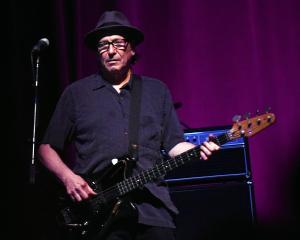
Then again, you might not: most of the album was recorded at Roundhead, the Auckland studio of Neil Finn, who provided the occasional vocal cameo on Warm Hand but largely left the work to McGlashan and his band, the Seven Sisters, who actually comprise four musicians: guitarist John Segovia, multi-instrumentalist Dominic Blaazer, bass, cello and accordion player Maree Thom and drummer Chris O'Connor.
Sean Donnelly, aka SJD, the prolific and talented writer of pop songs, was also present, in the guise of co-producer, asking the "what if?' questions that stretched, or at least pushed, McGlashan's songs to outcomes that might otherwise have remained unrealised.
McGlashan likes to discuss music. But he's also aware of the danger of over-analysing, or of attempting to second-guess what an audience might like.
That hasn't always been the case; in the days of the Mutton Birds, much time was spent discussing the songs rather than playing them.
"The thing with the Mutton Birds was that what we all arrived at was a sense that nobody was going to overplay. Because we listened to a lot of music and we argued about music a lot and we all had different tastes in music, the intersection was a bit like one of those maths diagrams you did as a kid: the intersection of all those sets is not a very big place.
"In a sense, the Mutton Birds ended up a fairly conservative band. I think it was great band but it was a case of communicating an idea precisely and with a minimum of fuss rather than relaxing and showing off and having fun. But with this band there is more freedom. It has a slightly more relaxed quality to it."
To make his point, McGlashan reaches for the stars, Comet McNaught, to be exact. He has named a song after its astronomical designation of C2006P1, a track that features "crazy transvestite falsetto backing vocals with Neil Finn, Sean Donnelly and me".
He believes such an approach wouldn't have passed the early committee stages in the Mutton Birds.
It is put it to him that perhaps he is more relaxed these days.
"You mean older?" he chimes in, a little too quickly.
How about more confident in your own skin, your craft?
McGlashan, despite his obvious distaste for a music industry he believes is besotted with youth, does disclose his age. The married father of two teenagers, Louis (17) and Pearl (14), will turn 50 this year. And, yes, he is happy with his lot.
"I think the best stuff comes from people who are at peace within themselves. When I sit down with the band and have a good rave about how a song may go, that's enough opinion. If you're trying to guess what an audience is going to like or what a record company is interested in, by the time you make those guesses you might as well stop because you're already hamstrung.
"The biggest kick I get is when you play a song to an audience and they immediately react. We've already had that feeling from a few of the songs on this record because we've played a few of them live.
"That's the beauty of doing something like songwriting. You can write a song and play it that night to a bunch of people in a pub. If you're a novelist, you might wait years from the impulse of the pen going to paper before you get a reaction from somebody.
"Telling stories that resonate with us and make me feel like I've described a little bit of my world, a little piece of my day, then tinkering with them with the band and them getting a kick out of it ... there's not much better than that, I think."
McGlashan took plenty of time over his 2006 solo debut, Warm Hand, and it showed in a largely reflective album on which songs unfolded like short stories.
This time around, with the benefit of a band that wasn't pulled together specifically for a recording project, the process has been both quicker and easier.
"Warm Hand was the product of quite a few years of tinkering, wondering what I had to say as a solo artist. I was experimenting as to what kind of vehicle would work best for the songs.
"With this one, because I had been playing with the same band for a couple of years, we were really comfortable with one another.
''It's quite effortless to bring a song along to the band. In some cases the songs play themselves because I'll have written them with the players in mind. I hear a line in my head and think, 'John's going to play that beautifully or that's a rhythm that Chris will play really well'.
''There are other songs that I might bring along to the band and we will really pull them apart and deconstruct them.
"Marvellous Year, the song itself, was quite a full-on rocker when I brought it to the band and we gradually pulled it down and realised that a whole lot of people playing quietly was a good approach for it; glockenspiel, vibraphone, 12-string guitar and a theremin all contributed to an otherworldly, interstellar atmosphere to it.
"That was partly the band all experimenting and Sean Donnelly and I working on it. He had a lot of input into it as co-producer."
McGlashan began exchanging ideas with Donnelly when he returned from England in 1999 following the Mutton Birds' decision to turn down the volume on four years of graft in Europe.
As well as bouncing songs off each other, the pair collaborated on the soundtrack to the television series Orange Roughies, "which they are screening repeats of now", he enthuses.
On the topic of repeats, Bathe In The River, written for Toa Fraser's 2006 feature film No 2 and originally performed by Hollie Smith, has found its way on to Marvellous Year, McGlashan giving the Silver Scroll award-winning track a falsetto treatment.
He likes doing film work, evidenced by a growing list of recent projects, including No 2 , Anthony McCarten's Show Of Hands and Dean Spanley, the score of which was played by the New Zealand Symphony Orchestra.
McGlashan is currently working on a gospel song for another feature film, Matariki, for which he'll also begin work on a soundtrack in September.
In the meantime, McGlashan begins rehearsing for a new Crowded House album in a couple of weeks before embarking on a national tour to promote Marvellous Year.
Last year, he joined Neil Finn and company in the United States and Europe, both as a support act and as a member of the band, playing acoustic guitar, mandolin, horns, backing vocals. He has parts on several new songs.
Oh, acclaimed American band Wilco has also invited him to open some concerts in the US this year.
You wonder if McGlashan sometimes finds it all a bit of a head-scratcher. After all, there is quite a contrast between battling for recognition on the tour circuits of England and Europe in the '90s and performing a decade later with artists whom promoters would term "A-listers".
"I'm at the stage now where I'm not too fussed about the music business any more. I don't stop to consider my place in it.
"The nice thing, the constant, is I'm still doing the work I want to do, which is writing songs and enough people are getting to hear them to allow some of these cool things to happen. Also, I'm free enough."
Yes, but isn't there something ironic in all this?
"You mean, when you're not trying it all happens?"
Exactly.
"Yeah, possibly. I guess the difference is ... I think things have changed in that I'm not part of a gung-ho, knocking on every door, ever-expanding business, which is what a band is.
''A band has to be really dedicated and uni-directional and somebody like me . . . now I work with my band the Seven Sisters, but I can't work with them all the time.
''At the moment I'm writing a piece of instrumental music for the Auckland Museum so while I'm doing that I can't be on the road with my band.
"I'm kind of a ..." he pauses. "I'm not ... how should I put it? ... I'm not so much part of a community of business plans; I'm part of a community of ideas. And that feels to me a lot more comfortable. I don't have to really worry about how many records I'm selling or whether I'm on the cover of this or that magazine. I was never any good at worrying about that stuff anyway."
McGlashan describes the process of writing a song, often with guitar and pencil in hand, as more than an enjoyable habit. Call it an addiction.
Long after he began penning those cinematic, slightly mournful pieces with Blam Blam Blam in the early '80s, moving on to the more quirky output of the Front Lawn, then the pop distillation of the Mutton Birds and now his solo career, the rush remains.
"If I didn't do it I'd get sick. I think if you are not getting to the end of a song and putting your pencil down and playing it to yourself on guitar and then jumping around the room, punching the air ... if you're not that elated about it, then maybe you should get another job, go and find a car dealership to work for or something."
Among the 11 songs on Marvellous Year, there is one that holds a particular punch. The Switch is about McGlashan's eldest child, Louis, 17 and growing up fast, perhaps faster than he'd like.
The lyrics are full of love, with concern following a close second. Though teenage growing pains are nothing new in pop lyricism, parental perspective is less common.
McGlashan is pleased with this observation. It suggests he's not repeating someone else's line.
"I guess the good thing about broadcasting songs from your own frequency is that you describe things in your own life and with any luck they won't be the same as someone else has described."