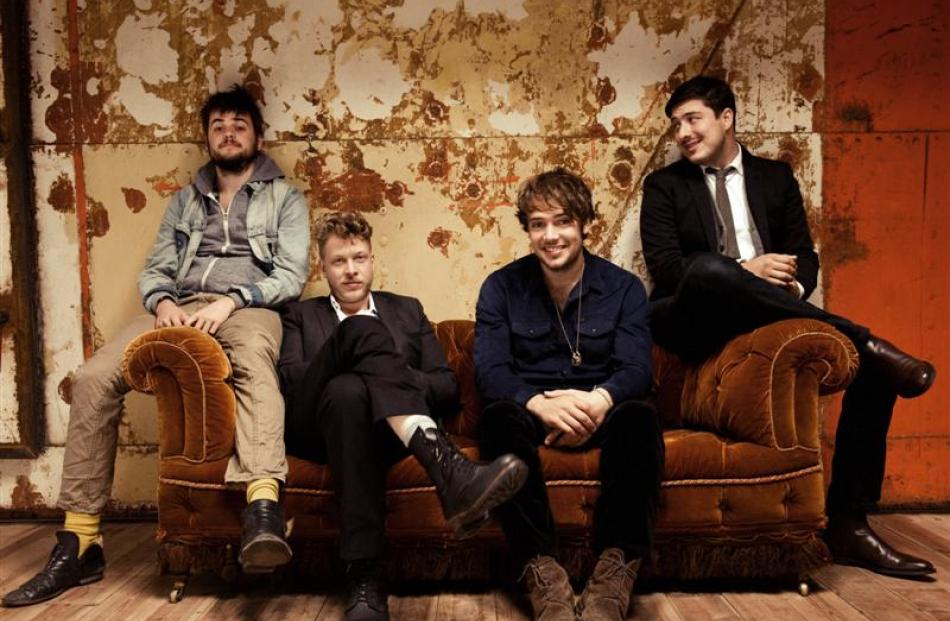
The Mumford and Sons handmade aesthetic is rocking the music world, reports Mikael Wood, of the Los Angeles Times.
Describing the latest album from his band Mumford and Sons, Ben Lovett sidesteps much of the language artists often use to talk about their music. He doesn't, for instance, refer to Babel as a bit of creative risk-taking, or as the product of divine inspiration.
Instead, the 26-year-old keyboardist says the record was "forced out of this internal desire to prove that we have many more songs in us."
Mumford and Sons released its debut, Sigh No More, in 2009 and immediately set about touring the world, playing concerts that grew steadily to a scale Lovett called "crazy." (Last year it performed before an audience of about 75,000 people on the main stage at Coachella.) Before long the London group - which also includes singer-guitarist Marcus Mumford (25); bassist Ted Dwane (28), and banjo player Winston Marshall (25) - had all but exhausted the tunes on Sigh No More. For 2012 it needed some new songs.
"And I'm sure the third, fourth and fifth records will happen the same way," Lovett continued, speaking recently after a show in Cairns.
"There was absolutely zero calculation (with Babel). No-one ever came into the studio and said, 'Turn that banjo up and we'll make you into pop stars!'."
Yet pop stars are precisely what the band's members have become. In October, Babel entered Billboard's album chart at No. 1, scoring what was then the year's biggest sales week - bigger than Justin Bieber and Madonna - with more than 600,000 copies sold, according to Nielsen SoundScan.
(This month, Taylor Swift broke Mumford and Sons' record with 1.2 million copies of her new album, Red.)
To date Babel has sold 992,000 albums, while Sigh No More is at 2.54 million. Right now both discs - which together have yielded a string of hit singles, beginning with Little Lion Man and extending through the new album's I Will Wait - sit in the top 25 of the Billboard 200. "With Little Lion Man, let's face it: You kind of have had to ask, 'Is there more?'," says Lisa Worden, music director at the influential Los Angeles modern-rock radio station KROQ-FM.
"And there was: We had success with three tracks from the first record. I knew then that this wasn't a one-hit wonder. This band truly has something."
That something is spreading, too: Following Mumford and Sons up the charts are acts such as the Lumineers, the Civil Wars and Of Monsters and Men - proudly old-fashioned roots-oriented outfits that seem to share little with the sleekly modish likes of Rihanna and Maroon 5.
"What they've achieved gives a lot of hope to bands like us," says Taylor Goldsmith of the folky LA group Dawes, which was to open for Mumford and Sons at two sold-out Hollywood Bowl shows.
"It's four guys playing acoustic guitars and banjos and everything I feel like wouldn't allow a stable career for a young band in 2012. But here they are."
So how did these London lads carve out such an impressive space singing original songs about struggle and redemption?
Their strategy - not that they'd ever call it that - begins with touring, and lots of it. As Lovett suggests, he and his bandmates more or less live on the road, performing crowd favourites and honing new material in a variety of settings across the globe.
The band has been careful, too, with exposure, limiting interviews and television performances but encouraging easy access to its music. During the first week of Babel's release, Mumford and Sons allowed listeners to stream the album free on Spotify - something the online service said happened more than 8 million times.
Lovett singles out the group's performance with Bob Dylan at the 2011 Grammy Awards as a pivotal moment, and he's certainly not wrong: Sigh No More enjoyed its biggest sales week in the days following the telecast.
"I think it introduced us to people who watch (awards) shows the way we grew up watching music on TV," he said.
"It makes sense that it would widen our audience.
"But we weren't thinking about that at the time."
Indeed, all of this manoeuvring seems secondary to the powerful sense of belonging the band's songs engender among its fans. Not unlike Adele, whose 21 was last year's best-selling album, Mumford and Sons offers a chance to stand up for hand-played music in an age of machine-made pop; it embodies the feel-good realism of people singing and playing instruments on stage.
And yet the group isn't didactic about its position, vastly increasing its appeal for listeners with no horse in the authenticity race. In a recent interview with National Public Radio, Marcus Mumford declined to describe the band's music as bluegrass or any other traditional form, saying, "We just call ourselves a rock band, really."
It's a refreshingly anti-purist mindset audible throughout Babel, on which acoustic guitars mingle with spacey sound effects and Mumford's often-sensual vocals act as more than a lyric-delivery device.
And with its period-picture wardrobe and foot-stomping singalongs, Mumford and Sons openly embraces a spirit of big-tent showmanship.
With Babel out for only a little more than a month, it's too early to say how much higher Mumford and Sons might fly - or how much further the band's influence might extend. "We'll have to wait and see if any of these other bands end up being more than just a song," says KROQ's Worden. "I'm not quite ready to put my money on the folk revival."
Nor, truth be told, is Lovett.
"We haven't got very lofty aspirations when it comes to all that," the keyboardist says.
"We're not trying to restart any movement." The way he tells it, the band's motivation is more immediate.
"It's pretty much, 'Oh, you've got a song? That sounds good. I feel the exact same way. Let's play that tonight'. "