




There is a new air of grim determination among tens of thousands of qualification-focused, job-hungry tertiary students beginning classes this week. But qualifications are not the only measure of potential, writes Bruce Munro.
When Minister for Tertiary Education, Skills and Employment Steven Joyce said students choosing subjects should remember doctors earn three times as much as performing arts graduates, 19-year-old Olivia Lynch said, ''Thank you.''
She did not say, ''How dare you?'' or ''Where are your values?'' or ''What about my interests?''No, it was, ''Fair enough. I want to know I haven't wasted several years and a lot of money.''
It is a brave new world out there.
Since late last year there has been an avalanche of statistics, quotes and interactive websites out of Wellington urging young people to get more qualifications and choose careers with bigger pay packets. It began with a report on the tertiary education system released on December 6 by Mr Joyce. He said the report showed for the first time the majority of New Zealanders had tertiary qualifications.
This was a step in the right direction because people with a bachelor's degree or higher earned on average 65% more than those without qualifications, he said.
That equates to median hourly earnings of $27.81 for graduates, compared with $16.88 for those with no educational qualification.
Signalling what was to come, Mr Joyce said the Government was ''committed to increasing achievement ... improving quality and better matching education to the skills needed in the New Zealand economy''.
It was no surprise, therefore, when, on January 22, Mr Joyce released figures detailing what New Zealand students earned after studying different subjects and at different levels.
Five years after completing their studies, those with a medical degree were earning about $110,000 a year, he said.
''This is nearly three times as much as a performing arts graduate,'' Mr Joyce said.
Civil engineering graduates were also given a tick compared with their language, literature, sport and recreation compatriots - $67,653 a year as opposed to $32,473.''
This report will be useful for students of all ages considering their career options,'' Mr Joyce said.
Prime Minister John Key then gave the barrow a push in his Waitangi Day speech.''
Regardless of ethnicity, young people with higher educational qualifications generally end up with better incomes through their working lives,'' Mr Key said.
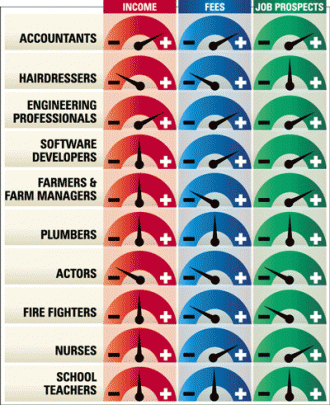
The next salvo was Occupation Outlook. Launched last week, it is an online Ministry of Business, Innovation and Employment report on the incomes, training fees and job prospects of 40 common occupations.
At a glance, young people and their parents can see, for example, that prospective pilots and air traffic controllers can expect high incomes to match the high fees they will pay to become qualified, but that their job prospects are poor; while budding automotive technicians and electricians will pay low fees, get good incomes and have good job prospects; and future accountants can expect high fees, high incomes and excellent job prospects. Clicking on any occupation on the list reveals the two-page report on which its summary is based.
And the campaign is not over, Mr Joyce says.
He will be asking government agencies to ''dig further into the data'' and produce more information that will ''help young people make more informed choices about their careers''.
It can all seem rather ''capitalist nanny state'' - a high-handed attempt to keep young people off the dole, lured to chase qualifications by dreams of big incomes rather than job satisfaction.
But careers advisers, business representatives and young people themselves say it is a largely reasonable and responsible reaction to 21st-century realities.
Today, the skills gained at secondary school are rarely sufficient on their own to gain employment, Phil O'Reilly says.
The Wellington-based chief executive of BusinessNZ, the country's largest business advocacy group, says more pervasive and cheaper technology, increasing job specialisation and a globalised labour market have all made tertiary qualifications vital for job-seekers.
''What was acceptable in terms of skills for a school leaver 10 years ago would mean they were much less likely to get a job now,'' Mr O'Reilly says.
''And skill levels are increasing globally. So there are plenty of well-qualified people competing for the job you want.''
Careers adviser Glenys Ker says qualifications tell a prospective employer more than just that the job-seeker has certain knowledge.
''It also tells them you're capable of sticking at something long-term and capable of a certain level of thinking,'' Mrs Ker, of Dunedin-based CareerFit, says.
Add to that the fact employers swamped with job applications often look primarily at qualifications to select a shortlist for interviews, and that bit of paper becomes extremely important, John Scandrett, chief executive of the Otago Southland Employers Association, says.
It is a message that young people, whether by instinct or constant parental and school reinforcement, seem to be taking to heart.
This week, Miss Lynch begins the second year of a double degree at the University of Otago - a bachelor of commerce (BCom) in marketing and economics and a bachelor of arts (BA) in politics.
She wishes she could drop the commerce, but does not feel she can.
Plenty of her friends are in the same boat.
For Miss Lynch, an ideal career would be in foreign affairs, a competitive field of work.
''I would love to just major in politics, but that's not good enough,'' Miss Lynch says.
''So I'm putting in some business papers because you don't want to end up with just a BA.
''Among her wider friendship group of about 50 students, she cannot think of any who are doing just an arts degree. Although several wish they could.
''BA and LLB [law degree] or BA and BCom ... A lot are doing a BCom because they think that's where the money is.
''It's so expensive, there's no point wasting it on interest subjects.''
Miss Lynch has several friends who are studying finance, accounting and surveying who do not really enjoy it, ''but there's money at the end of it''.
Others she knows of are doing law degrees, not because they want to practise law but because it will look good on their CV.
She is taking nine papers this year rather than the normal eight for a full-time course. It will be hard work, particularly given that she also works part-time as a waitress. But she hopes it will help show prospective employers she can manage her time and work hard.
''People aren't sure whether jobs will be there, so they're doing double majors to keep their options open.
''They want a good income, but the focus is on getting a good job and not having to go back to working in a cafe.''
A note of warning about choosing, or promoting, qualifications on the basis of potential income is sounded by Alan Geare, of the Otago Business School at the university.
''That's a ludicrous way to choose,'' Prof Geare said.''
I'd hate to think we were training people to be doctors and that they were doing it simply to earn more money, but that their heart and soul was in performing arts.
''It is a point reinforced by Mrs Ker, who advises people to study ''what you are genuinely interested in and good at'' because ''then you are likely to do well''.
While statistics clearly illustrate that higher qualifications often lead to better employment opportunities and bigger incomes, that is not the whole picture.
Employers may cull job applications based on qualifications, but qualifications and potential are not synonymous - as the statistics also reveal.
The top 5% of earners in New Zealand are pulling, on average, $3214 per week, Statistics New Zealand says. That is 288% higher than the average incomes of people with a bachelor's degree or higher. And what qualifications do this high-flying, top-earning group have? Well, 49.9% of them have less than a bachelor's degree.
They knew their potential, or were driven by a passion, and they went for it - qualifications be damned.
We should celebrate those distinctive individuals and their successes, but they will become fewer and further apart, Mr O'Reilly believes.
It is so much harder these days to get your foot on the first rung without qualifications, he says.
''If I was a young person thinking of taking that risk - thinking I'm going to go out and be a Graeme Hart or Richard Branson - I think it would be a poor choice,'' Mr O'Reilly says.
''I'd say get your qualification first, then pursue it, so you've got the qualification to fall back on.''
Which is exactly how Jono Aldridge did not do it.
Mr Aldridge left high school at the end of 1998 without doing year 13.
Now he could comfortably retire in four years' time - when he turns 35.
Growing up in Timaru with his parents and three siblings in a house full of computers, Mr Aldridge says he was never particularly interested in traditional learning.
After leaving school, he also dropped out of a polytechnic computing course, went on the dole and did seasonal potato harvesting.
His real passion at that time was buying, doing up and selling cars.
After moving to Dunedin in 2002, he worked at Anngow Motors cleaning vehicles, before getting a job at Otago Polytechnic providing IT phone support to students and staff.
In eight years at the polytech, he has moved up through the ranks to become a systems engineer and now a systems architect, helping the organisation get the technology it needs to pursue its goals.
In 2006, Mr Aldridge and his wife bought their first home - a former state house which they spent 18 months completely renovating.
''Then we sat back,'' he said.
''But we found ourselves going to cafes and wasting money. We were bored.''
So they put tenants in that house and bought another one to do up.
Today, they live on a rural lifestyle block and have seven investment properties including two blocks of flats.
The lack of qualifications have never been a problem, Mr Aldridge said.
''All my colleagues at polytech have degrees ... When I used to fill out forms, they asked for qualifications and it bothered me a little that I didn't have anything to put in the box.
''After a while it didn't really bother me any more. I knew I was capable. I worked out I was a little bit different and I was pleased to be different.''
When it came to approaching banks for money, ''making sure the deals stack up'' and ''selling it to them'' were the key criteria.
His schooling experience left him feeling ''a bit of an under-achiever''. But his parents' support, his own passion to succeed and the opportunities offered by the polytech all combined to show him his potential.
''The more you do something, and see you can do it, the more confident you get in your abilities,'' he says.
In the past year, Mr Aldridge has started working towards a bachelor of applied management degree through Otago Polytechnic's New Zealand Centre for Assessment of Prior Learning.
The qualification is to ''prove to myself I can do it'' and to ''make my dad proud''.
''Also, I understand that if the worst came to the worst and I had to apply for a job, having a degree would help put me to the front of the list so I could get an interview and sell myself,'' he said.
Not that Mr Aldridge is planning to do that.
His goal was to retire at 35. While that is still possible, he has decided he would quickly tire of playing golf all day.
Instead, he plans to use the passive income from his property investments to free up his time to focus on other enterprises.
''It's worked out quite well. And it will only get better as time goes on.''


