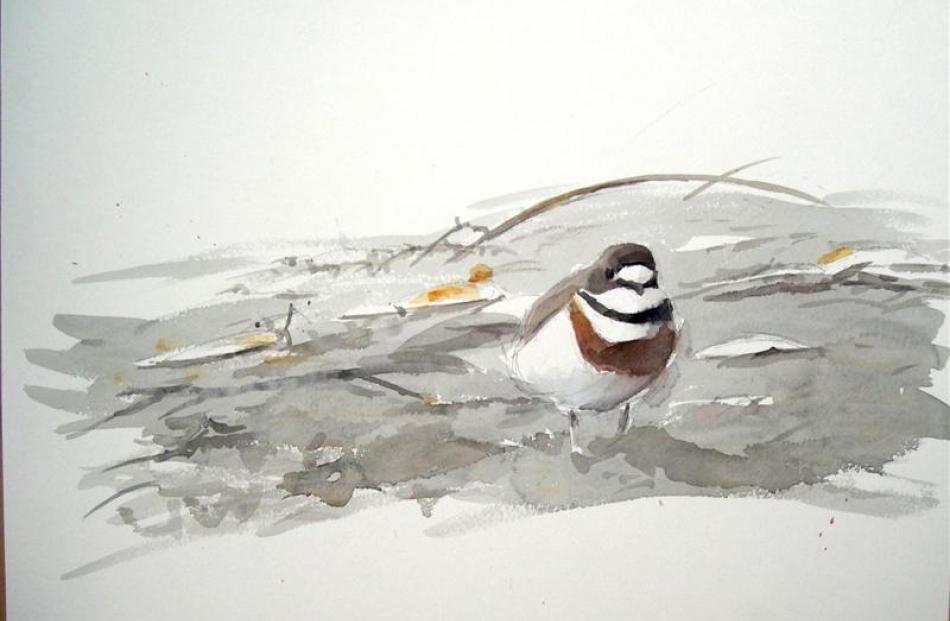
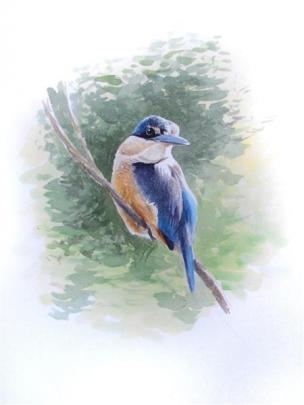

In the world of ornithological art, Derek Onley flies high, writes Shane Gilchrist.
John James Audubon, the American naturalist and painter whose colour-plate book The Birds of America (1827-39) is considered one of the finest examples of ornithological art, used more than a brush to capture his subjects. He used to shoot them.
Derek Onley doesn't do that, although he occasionally uses dead birds as reference material for his delicately rendered, anatomically correct paintings.
Sometimes, the 67-year-old need only look out the windows of his Waitati home to get inspiration.
Other times, he has to jump on a boat (not ideal given he's prone to seasickness) to indulge his interest in seabirds.
Occasionally, he travels further afield, including to South America, where he has been researching a guide to Paraguayan birds.
Quietly-spoken, Onley certainly isn't the type to boast.
Yet his illustrations have appeared in field guides worldwide, on the walls of Te Papa as part of special exhibitions and in private homes.
He has also done fieldwork on the Poor Knights, Campbell, Auckland and Chatham islands, among other places, his experience leading to invitations to various national and international conservation forums.
Recently, he has been busy adding 35 new watercolour paintings to a recently revised version of The Hand Guide to the Birds of New Zealand.
Written by Hugh Robertson and Barrie Heather, the book has become a trusted reference for those interested in New Zealand's feathered fauna since its publication in 1999.
Born in England, Onley's interest in birds began when he was an 8-year-old living on a council estate in Southampton, England.
He recalls sharing outdoor adventures, fishing in particular, with his grandfather, who lived in a ''much nicer place''.
''I have always painted. Well, ever since I left school. I did bits and pieces but nothing very scenic.''
Thus painting birds combines two key interests for Onley who, having graduated with a bachelor of arts degree in geography from Cambridge University, worked in the field of ornithology at Oxford University before emigrating to New Zealand in 1972.
After spending two decades on the West Coast, Onley moved to Waitati, where he lives with his partner, Rosemary Penwarden, and continues to study birds while growing vegetables and roses and, more recently, planting trees on a 5ha block of land along the road.
''Rosemary still works but I'm officially retired,'' Onley says, adding his main source of other income is derived from illustrating.
''Occasionally, I make a reasonable amount of money from it, but some of the projects take three or four years and, basically, you get paid at the end.
''On the other hand, I have very few expenses. I don't have a mortgage and I don't go on expensive overseas holidays. That's not to say I don't like travelling.''
Onley's images may seem delicate, yet his subjects' path from air, sea or land to the page requires a measure of scientific robustness.
Asked if he used a ruler to ensure the anatomic accuracy of an image, he replies: ''Not any more''.
Still, his research is rigorous.
Take, for example, the New Zealand storm petrel, rediscovered in 2004-05.
Given the rarity of the species, he based his illustrations on specimens he found in a British museum.
''The research and the first drawing usually take the most time,'' Onley says.
''I do lots of photography. I use photos, drawings, even dead birds as sources.
''People ask me why I still draw birds, given that photography has become so good over the past 10 years. However, a photo can't get all the bits of the bird required for a guidebook. There might be an angle or a bit of a shadow.''
Significantly, many of Onley's images are drawn side-on, thus largely eliminating the need for dramatic foreshortening.
He is also wary of shadowing, and attempts to make a bird's body appear round by other means, including playing with colour tones and feather details.
''You can actually be reasonably accurate with watercolours, once you've been doing it a while. I also use coloured pencils,'' he explains.
Painting birds has its pros and cons.
Though some are boldly coloured, such as the (non-native) eastern rosella, others offer variations on a theme, i.e. brown and grey.
''When I did my seabirds book [Albatrosses, Petrels and Shearwaters of the World, by Derek Onley and Paul Scofield, 2007], the only colours I used were a couple of browns, a black, a bit of blue and yellow. That made the process quite cheap.
''However, when I did Paraguayan birds, I had to go out and buy a huge range of colours. And sometimes it's more difficult to paint the brightly coloured birds because it's harder to make them look round.''
Yet the biggest challenge of all lies in the printing of his pictures.
Onley points to a large watercolour: ''That took five or six attempts to print,'' he says.
Should he ever adopt a bird-like name, it could well be ''stickler''.
The book
The Hand Guide to the Birds of New Zealand, by Hugh Robertson and Barrie Heather, illustrated by Derek Onley, is published by Penguin.