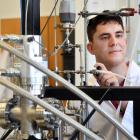
Reflecting on a textbook written by them and other physics
staff are (from left) University of Otago physics senior
teaching fellow Dr Terry Scott and professional practice
fellows Kirsten Franklin and Paul Muir. Photo by Peter
McIntosh.
They may have started small, but bigger things might be
to come.
A textbook, written by University of Otago physics staff,
began life in 1999 as an in-house publication for 1400 Otago
health sciences first-year students taking a biological
physics paper.
Last year, about 1700 copies of the biological physics book
were printed because staff at the University of Queensland
also decided to use the work titled Introduction to Physics
for the Health and Life Sciences.
A major United States-based international publisher, Wiley,
recently begun producing the book, which has already been
adopted for use in Ireland, Australia, and the United States.
One of the authors, Otago physics senior teaching fellow Dr
Terry Scott, said he had been encouraged by the international
interest.
The book's quality also reflected the strength of the Otago
first-year health sciences teaching programme, and input from
health sciences staff had been beneficial, he said.
The book's authors include Kirsten Franklin, Paul Muir, Lara
Wilcocks, Paul Yates, and other Otago physics staff.
Former physics head Emeritus Prof Gerry Carrington said the
authors had done a "brilliant" job in clarifying the
important role of physics in human biology.
Physics was involved in many aspects of the operation of the
human body, as well as in related fields such as medical
diagnosis through magnetic resonance imaging (MRI).
Production of the book had revealed a big "gap in the market"
and it was likely to be widely adopted overseas, he said.
• One recent positive British review gives the book a
five-star rating in all categories and concludes it "shows
physics is really fun".
- john.gibb@odt.co.nz
A name, residential address, and (preferably residential) telephone number is required from readers who comment on ODT Online. These details will not be visible to site visitors.