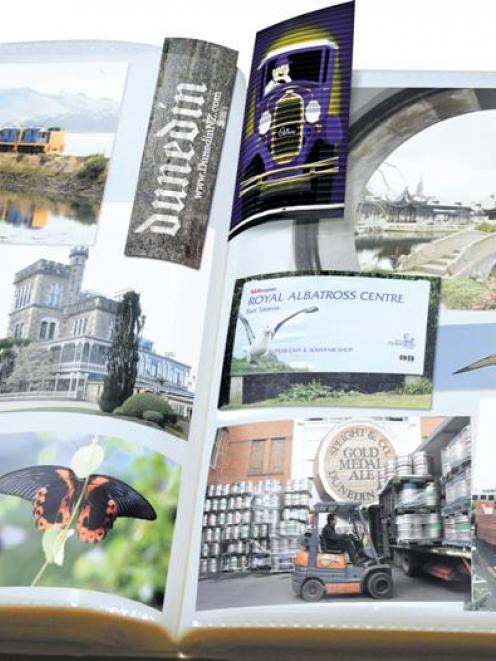
Visitor numbers have been declining since a peak about four years ago, and those in Dunedin's tourism industry do not expect an increase any time soon.
Many were happy to have maintained annual visitor numbers in 2012, given the previous year's Rugby World Cup.
But some were not so lucky.
Taieri Gorge Railway chief executive Murray Bond said business was declining and he did not expect an improvement until at least 2014.
''A lot of people are avoiding Dunedin at the moment for reasons related to Christchurch and the lack of accommodation in Christchurch, as well as the general economic situation and the high dollar.
''The numbers we get off cruise ships are slightly up, but general tourist numbers are significantly down because the market is extremely difficult at the moment,'' he said.
The company limited its trips, and the number of carriages, to ''minimise any financial damage'', Mr Bond said.
In the year to June 30, 2012, it carried 79,958 passengers - an increase of 3.2% on the previous 12 months.
But numbers had since declined and in the six months to December 31, 2012, they were down 9% on the previous corresponding period.
Mr Bond said numbers for the year to June 30 would be 5% or 6% less than in the previous 12 months.
Larnach Castle had also noticed a decline of about 5%.
Actual numbers were not disclosed, but sales and marketing manager Deborah Price said last year was tough and it was hoped visitor numbers in the 12 months to June 30 would rival those of the 2011 financial year.
To date, there was a 1% increase on the corresponding time last year, she said.
Royal Albatross Centre manager Annie Villiers said visitor numbers had trended ''slightly'' downward since 2007.
''There may be reasons for this other than a drop in visitor numbers to Dunedin generally, as other tourist operators for example have been established on the peninsula during that time, which may influence the spread of visitors to each attraction,'' she said.
Otago Museum collections research and experience director Clare Wilson said visitors to the Tropical Forest attraction remained steady.
Last year, 87,586 people went through, slightly more than the 85,847 in 2011.
In 2010, the forest had 87,600 visitors, and 98,000 in 2009.
''We are confident the forest has embedded itself as a popular experience and that's why we are seeing a stable visitor base,'' Ms Wilson said.
Speight's Brewery tour manager Chris Snow said there had been less than a 1% change in visitor numbers since 2011, which pleased him considering the ''tough'' tourism market.
''We had about 31,000 people on the tour both in 2011 and 2012, which is an improvement on 2010 when we had about 29,500.
''We've been really lucky to have Contiki coming back to Dunedin and to be included in those tours, which keeps our numbers steady,'' he said.
He had noticed ''a bit'' of growth in the cruise ship market recently and expected overall tour numbers to remain static this year, Mr Snow said.
Cadbury World had 116,000 visitors last year and the same number in 2011, up from the 2010 figure of 114,500 but down from 119,000 visitors in 2009.
Dunedin Chinese Garden manager Margo Reid was ''extremely happy'' with the results for the six months to December 2012, visitor numbers being almost 3000 higher than the previous corresponding period.
The garden had 14,156 visitors between July and December last year, and 11,454 visitors between July and December 2011.
But bad weather for last year's Chinese New Year celebrations had affected visitor numbers overall, Ms Reid said.
There were 662 fewer visitors to the Chinese garden last year (30,945) than in 2011 (31,607), and both those figures were a drop from the 34,900 visitors in 2010 and 47,000 in 2009.
''Over the last six months, our revenue streams have been good and that will be because our numbers are up on this time last year, but comparatively they should be higher if people are spending the same amount of money on extras like merchandise.
''The visitors aren't doing this and we are hearing the same from other operators and retailers as well,'' Ms Reid said.
Tourism Dunedin chief executive Hamish Saxton said the ongoing global financial crisis meant the continued decline of ''traditional'' markets which the local visitor economy was reliant on, including the United Kingdom, Europe and North America.
''The lack of quality accommodation in Christchurch, coupled with the increase in short-stay visitors from new markets, is resulting in growth to the North Island,'' he said.
But Dunedin was seeing more cruise ship and coach tour passengers than previously, as well as a slight increase in the average length of stay, Mr Saxton said.
More Christchurch and Canterbury residents were visiting Dunedin, which was becoming the South Island's ''premier urban experience'', he said.
''Dunedin offers a compelling holiday experience and, in spite of the economic conditions, I consider that the visitor economy is doing a really fine job in demonstrating its resilience and adaptability,'' he said.