Significant cut in stadium losses; DCHL profit up

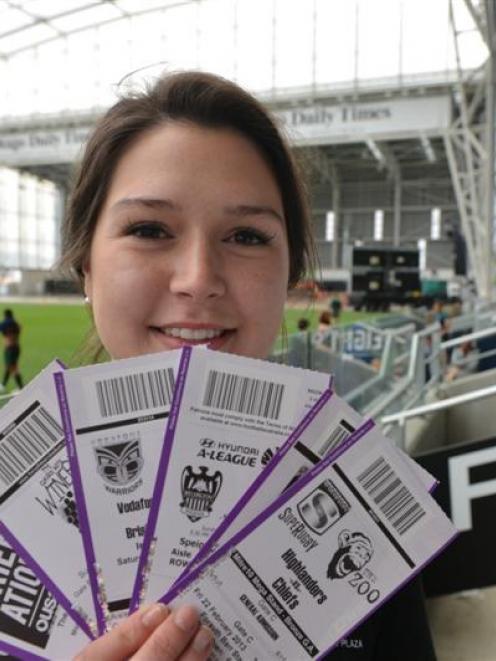
Ticketing assistant Whitney Kooman with tickets for events at Forsyth Barr Stadium. Photo by Stephen Jaquiery.
More events, more members, reductions in overhead costs and staff cuts contributed to a significant cut in losses in the first six months of this financial year for Dunedin's Forsyth Barr Stadium, its operator reports.

The Dunedin City Council's holding company also reported improvements, with a ''marked increase'' in after-tax profit to $7.87 million from the first half of the year, a 57% increase.

For the six months to December 31, 2012, Dunedin Venues Management Limited, which operates the stadium, reported a net loss of $690,000, compared to a net loss for the same period last year of $1.2 million.

The stadium's revenue was up 58% on the same period last year, from $2.53 million to $4.02 million, its half-year report said.

After operating expenses of $2.80 million, a $2 million payment to landlord, Dunedin Venues Ltd, for six months' rental and a subvention payment from the council of $91,000 to cover interest on money advanced by the council, the company was left with a $690,000 loss.

The report said the period was one of consolidating the business model following the stadium's 11-month start-up period to June 30, 2012, in which the stadium recorded a $3.2 million loss.

The increased operating revenue reflected a better appreciation of the event market, and work done on building relationships with promoters was starting to show results, with major events like the Paul Simon and Aerosmith concerts confirmed, and more in the pipeline.

It noted a potential annual event fund from the council would provide an excellent resource to attract more events. The results also reflected a continued growth in membership and a ''major focus'' on cost control, resulting in a reduction in overheads and staff costs.

DVML chief executive Darren Burden said he was pleased with the improvement despite ''challenging conditions''. With the number of events at the stadium in the current second half of the financial year, he expected DVML would meet its forecast $300,000 loss for the 2012-13 year.

This financial year the council will contribute $7 million to the stadium in one form or another.

That figure is set to increase in the next financial year, subject to consultation on the draft 2013-14 annual plan, to $9.12 million, with the extra money largely funded from operational savings made at council. The money is allocated for accelerating stadium debt repayments.

With the financial boost from the council, DVML is forecasting small profits from 2014-15.

Denham Shale, the chairman of Dunedin City Holdings Ltd, the holding company for seven other council-owned companies, said that group's first half had been promising, with a ''marked increase'' in after-tax profits from $5 million in the same period last year, to $7.87 million, and revenue increasing 2% to $124.9 million.

The improvements were largely due to a relatively stable period in the normally volatile forestry sector, with City Forests Ltd reporting an after-tax surplus of $2 million, compared with $400,000 for the same period last year.

Aurora Energy Ltd traded well and showed a slight increase in surpluses after tax, while Delta Utility Services Ltd's after-tax surplus was down on the back of lower spending on infrastructure by local authorities in the South Island, with the exception of Christchurch, which had meant the company had to downsize its civil operations.

Taieri Gorge Railway Ltd's first-half loss increased to $488,000 on the back of constrained tourism growth in the South Island. A 4% increase in international passengers resulted in an after-tax profit increase for Dunedin International Airport Ltd, from $500,000 last year to $1.4 million.

Mr Shale said DCHL expected to be able to make its end-of-year dividend to council, cash and subvention payments, totalling just over $15 million.

He repeated the company would not be borrowing to pay the dividend this year, as per a new policy.

A report on a review of the company assets of the group, instigated after a multimillion-dollar shortfall in DCHL's planned dividends to the council was revealed in 2011, would be going to council in May, he said.
DVL losses

The black sheep of the family of stadium companies is Dunedin Venues Ltd (DVL) which is the owner of the FB Stadium. DVL is a lot more important than DVML because it consumes a lot more ratepayer money. The 6 monthly report for DVL shows that it suffered a $5.0 million loss during the period. This is a very large loss, especially when combined with DVML's loss and various other costs and subsidies paid for directly and indirectly by ratepayers.

relevant example please

MikeSTK is that supposed to be a relevant example of 'stadiums around the world' being demolished? Can you give an example of a modern day stadium that hosts a variety of codes, concerts and events? Also, you might like to also enlighten us on stadiums that run at a strong profit? You possibly won't, as stadiums are built to make money, but to make money for the city ... and it does. Yes, you pay for it in your rates, but you pay for all the other city assets as well so you cant pick and chose what you wish to pay for and what you don't. None of us can.

Not joking

Both are stadia that were completed with the aim of attracting a singular event to a city, both funded by the local council and both costing those councils money as they continually operated at a loss. But I'm sure you will enlighten me as to why there are other comparisons that make the above claims wrong. Your call.

No, not fair

It's probably not a fair comparison - it was built for a city 4 times the size of Dunedin so it had a better chance of making money - and now that it's been demolished it costs the city a lot less money every year than the Dunedin rugby stadium does.

Mind you demolishing underperforming stadiums is happening the world over

Forsyth Barr Stadium Closure

jcwilson, the case for demolishing the DCC's FB Stadium is much stronger than for the Don Valley Stadium in Sheffield. The reason for that is that the ratepayer saving from closing the DCC stadium is very large (over $6 million per year) compared to the Don Valley Stadium which will save their ratepayers a modest £0.7 million. The DCC has not yet told us the total ratepayer impact of their stadium (thought to be over $20m/year), but it is easy to see that the reduction in ratepayer impact would be over $6 million each year if the stadium was demolished. More savings would result from disbanding DVML

Your stadium will be demolished sooner or later. Sooner would be better.

Is this a joke?

Nightimejohn: Are you seriously comparing Forsyth Barr to Don Valley Stadium?

A word from Sheffield

In the UK, the City of Sheffield (pop. 551,000) has just chosen to close and demolish the Don Valley Stadium which has sustained losses to the city since it was built in 1991. Will it take over 20 years for us to do the same?


Good news everyone

This is great news - it means that the ratepayers will be paying less to prop up the rugby stadium. But let's be clear - DVML is still losing money quarter on quarter and still plans on losing money for the year. Despite what some keep saying here it is not making a profit, and that's after all the various subsidies paid for by the ratepayers. Cheap rates and subsidised rent are just the start here - it's going to be a long time before the stadium genuinely starts paying for itself.

ODT/directory - Local Businesses

CompanyLocationBusiness Type
Nokomai HelicoptersYour TownHelicopter & Aeroplane Flights
Alltech Garage DoorsAlexandraDoors & Door Fittings
Plunket Car Seat RentalsDunedinBaby & Nursery
JTV ServicesDunedinAppliances