Stadium piles plunging 10m into earth (+ video)

Click photo to enlarge
A contractor checks the level of an 18m, 12-tonne concrete pile before it is driven into the ground.
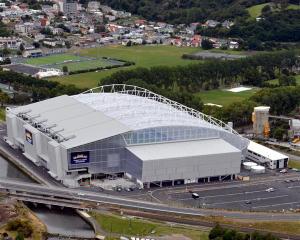
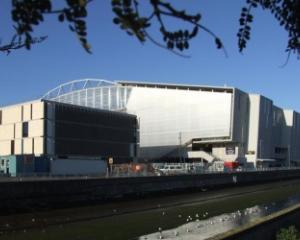
Massive concrete piles needed for the Forsyth Barr Stadium are plunging up to 10m into the earth before hitting solid ground.

The Otago Daily Times watched two of the about 18m-long solid concrete piles being hoisted by crane and then punched into the ground by a hydraulically activated pile-driver yesterday afternoon.

In each case, the piles appeared to drop silently about 10m straight down into the ground in a matter of moments, before the pile-driver was needed to ram them the rest of the way down over 30 minutes.

However,a construction source - who did not want to be named - said, despite them appearing to drop, the piles were actually being driven into the ground by their 12-tonne weight and the force of the 14-tonne pile-driver.

Each pile was cutting through a layer of soft marine silt initially, before reaching firmer ground beginning about 12m down.

Five hundred and thirty piles are to be driven into the site to support the weight of the stadium, which is being built on reclaimed land beside the Water of Leith.

The piles were expected to reach an average depth of 18m, with some as shallow as 15m and others as deep as 25m.

The piling work is being carried out by Daniel Smith Industries, of Christchurch, overseen by main contractor Hawkins Construction.

chris.morris@odt.co.nz.

A lesson from history

Before some bright spark came up with the title 'Reclamation' away back in Dunedin's past, the foreshore area, as I understand it, was more of a convenient dumping-ground for topsoil, rock and clay which had been displaced by removal to provide a 'platform' for much of present-day downtown Dunedin. Contemporary photographs from such viewpoints as the lower part of Mornington, show one or more steam-powered 'bucket-excavators' at work in the background. Much of the work would have been done by horse-and-cart initially, although I have an idea that latterly there may have been a narrow-gauge railway used for carting spoil to the site and dumping it where previously there had been harbour bottom. Therefore, for the purposes of constructing sizeable buildings, especially those of multi-storeys, the land, as such, could be considered to be as reliable for building construction as, (say) 'Weetbix'. I worked in the area for seven years, and at times, I couldn't work at my drawing-board, due to vibrations transmitted through the earth by a 200 tonne press, operating quite some distance away. The one saving feature of the site, is that with the proximity of the ancient volcano which was filled to become Lake Logan, (and later the 'Logan Park' area), is that down underneath there, somewhere there is bound to lie basalt, (consolidated volcanic magma), which would provide a reasonable foundation. The jury has been out for some , on how far down the basalt is and 'opinion', informed or otherwise, plus much speculation, has revolved around that question. Those professing to know all the answers, try to instill public confidence by, once again, indicating that they do, in fact, 'know all the answers'; others, looking at the way the project is being financed and certain other rather 'Mickey-Mouse' matters of detail, have their suspicions. All of which proves absolutely nothing, one way or the other; but were I to attend any function at the stadium (which I can assure you, I won't) and hear a deep rumbling from an unidentified source, which might possibly be underground, I wouldn't be hanging around. I'd be scarpering at a great rate-of-knots, because Otago Harbour represents the full extent of the last major blow-out, with vents as far away as the 'Pyramids' at Victory-Beach. 'Tennis anyone?'

ODT/directory - Local Businesses

CompanyLocationBusiness Type
Your Business Team LtdDunedinConsultants
Fabric CollectionsQueenstownClothing
Community MissionDunedinCommunity Groups
Alpine Agriculture LtdClydeAgriculture