

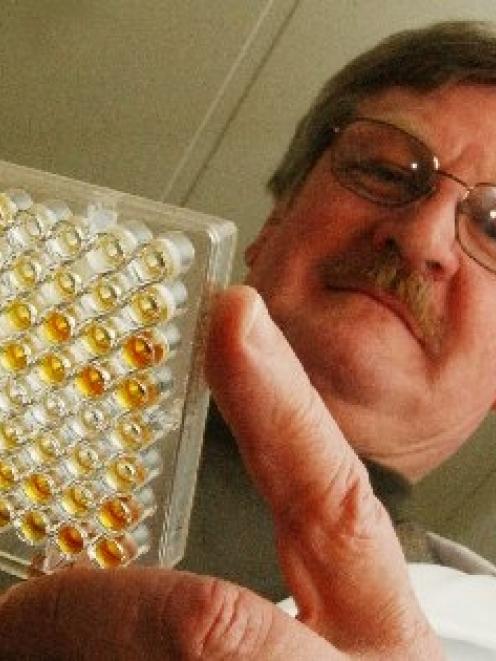
Prof Griffin, who heads the university's microbiology and immunology department, received the medal at an annual research honours celebration ceremony hosted by the Royal Society in Christchurch last week.
It is the first time this award, for "excellence and innovation in the practical application of technology", has been won by an Otago University researcher.
Award organisers noted Prof Griffin had for three decades led an Otago University-based research team devoted to solving animal health problems in the deer industry.
The award was for his "contribution to work in developing diagnostics tests" for detecting two major bacterial diseases of New Zealand deer, bovine tuberculosis and Johne's disease, and a vaccine for the prevention of yersiniosis in deer, society officials said.
The products and services were estimated to have saved the deer industry between $80 million and $90 million in production that would otherwise have been lost to the diseases, officials said.
Prof Griffin was "very humbled" by the recognition provided by his scientific peer group.
The medal reflected the supportive approach to research taken by New Zealand's innovative deer industry, including key early financial support by James Innes, a former owner of Haldon Station, near Fairlie, and a leading deer industry entrepreneur.
Prof Griffin also paid tribute to strongly collaborative work by AgResearch scientists over the past 30 years.
Award officials noted Prof Griffin had inspired and led a group which had developed a series of diagnostic tests for tuberculosis in deer that were more sensitive and specific than the skin test used to screen deer.
These tests had been available for farmers since 1990 and had "helped reduce the incidence of the disease to very low levels in New Zealand deer".
A vaccine to protect young deer from yersiniosis had been developed by Prof Griffin in collaboration with Dr Colin Mackintosh and Dr Bryce Buddle of AgResearch.
The vaccine had been registered in 1992 and its use had eliminated the disease as a major economic constraint to production for farmers.
Over the past decade, Johne's disease had become the largest single constraint to increased productivity in the national deer herd.
The development by Prof Griffin's laboratory of a series of tests meant infected animals could be identified early and removed from the herd.
Prof Griffin's advice on livestock diseases and their control was widely sought overseas, including by authorities at the Kruger National Park in South Africa, who had wanted to help combat the spread of bovine tuberculosis from buffalo to lions and other wildlife species.