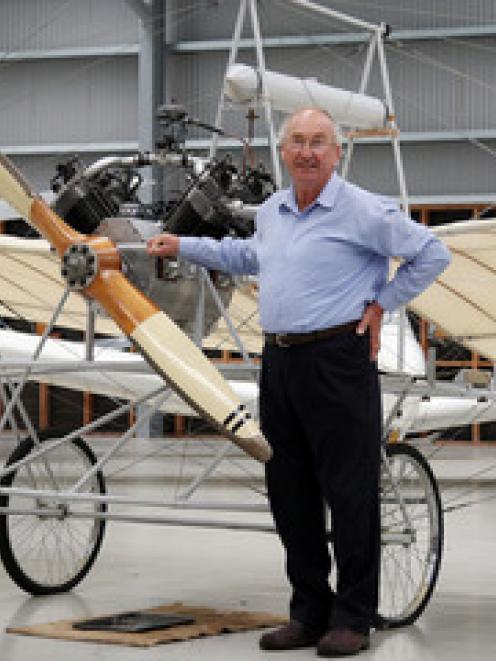
The replica of the 1910 Pither Monoplane, built in 2004 by Colin Smith, of the Croydon Aircraft Company in Mandeville near Gore, and friend Bill Sutherland, and has been airborne several times since then, will not loop, roll or do any other fancy aerial manoeuvres to mark the centennial.
Instead, its owners say it will probably fly in a straight line for about 100 metres, just as inventor, aviation enthusiast, plane builder and pilot Bert Pither is said to have done 100 years ago.
Smith and Sutherland plan to get it airborne on July 3 or July 4, one or two days short of the 100th anniversary of Herbert John Pither's flight on July 5, 1910.
Pither, who made bicycles and anything else "weird and mechanical", built the monoplane in Invercargill before taking it to the western end of Oreti Beach (known as Riverton Beach) where he claimed to have flown it.
If he did, Pither was probably the second person to get airborne in New Zealand after Richard Pearse took off in his home built aircraft at his farm at Waitohi near Timaru on March 31, 1903.
Pearse flew more than 100 metres before crashing into a gorse hedge.
Some people believe Pearse was the first man to fly in the world although many others say Pearse crashed and therefore his aerial sortie did not qualify as a controlled flight and or as the world's first.
The initial controlled flight is credited to the Wright brothers in America in December, 1903, several months after Pearse.
The first officially recorded, controlled, powered flight in New Zealand was at Glenora Park in Papakura, Auckland, in February, 1911 by Vivian Walsh in his aircraft Manurewa. He and his brother Leo built the British-designed, Howard Wright biplane from imported plans.
Pither constructed his monoplane from tubular steel used for making bicycles. The tubular steel wings had wooden ribs covered with a fabric but the rest of the plane had no fabric.
The aircraft weighed about 230kg without the pilot and was 7.9 metres long.
Colin Smith's wife Maeva said New Zealand and Australia descendants of Pither would attend the centennial celebrations and getting the replica monoplane off the ground would be the gathering's highlight.
Mrs Smith said flying the replica on Oreti Beach was too risky and it was planned to get it airborne at the company airfield at Mandeville.
"Oreti Beach in July is not an ideal place for a flimsy, paper weight kind of machine," she told NZPA.
"The risk is too great because if we smash the thing we haven't achieved anything."
She said the replica was as close as they could get to the original -- the same weight, the same horsepower and of similar materials. She said Pither spent three days on Oreti Beach with others trying to get his machine into the air in 1910.
"The people who were hanging around helping him had gone home in disgust.
"All of a sudden one day he got it to go and it took off.
"But he didn't know how to stop it we don't imagine, and he ended up stopping it by hitting the flax bushes at the end of the beach and probably scared the bejesus out of himself."
She said like Pearse, Pither did not know how to fly but desperately wanted to get his aircraft off the ground.
Mrs Smith said because their replica had already flown, there was nothing to say Pither's original did not fly.
"We wanted to build this thing and say he may have flown."
She said Pither apparently never turned or banked his monoplane, but they believed their replica was capable of more than just straight flight although they did not intend anything other than that in July.
"We don't make it go around. We taxi, we lift it off, we turn it off, we let it go down and the guys catch it."
She said the building of the 1910 Pither monoplane was a remarkable achievement.
The replica made its first flight in February, 2005, at Mandeville when it reached a taxi speed of 70kmh and took off for about 100 metres.
It had since flown several times and would become part of the Croydon Aviation Heritage Trust's future museum collection.