The rocket attacks were a challenge to Israel's Gaza offensive and came just hours after Egypt's prime minister, denouncing what he described as Israeli aggression, visited the enclave and said Cairo was prepared to mediate.
Israel's armed forces announced that a highway leading to the Gaza Strip and two roads bordering the enclave would be off-limits to civilian traffic until further notice.
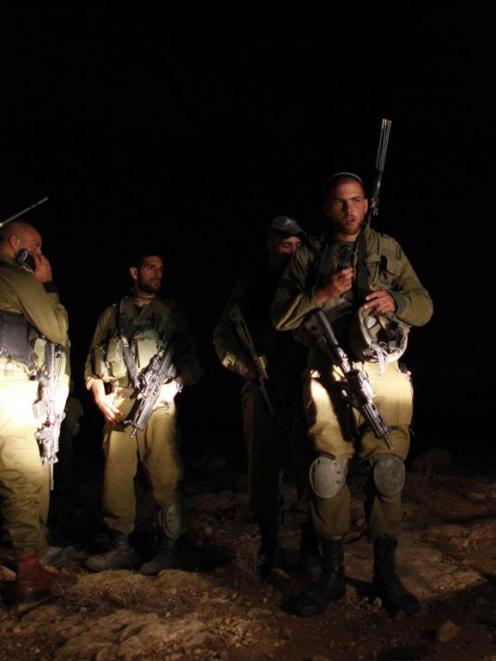
Tanks and self-propelled guns were seen near the border area, and the military said it had already called 16,000 reservists to active duty.
Prime Minister Benjamin Netanyahu convened senior cabinet ministers in Tel Aviv after the rockets struck to decide on widening the Gaza campaign.
Political sources said ministers were asked to approve the mobilisation of up to 75,000 reservists, in what could be preparation for a possible ground operation.
No decision was immediately announced and some commentators speculated in the Israeli media the move could be psychological warfare against Gaza's Hamas rulers. A quota of 30,000 reservists had been set earlier.
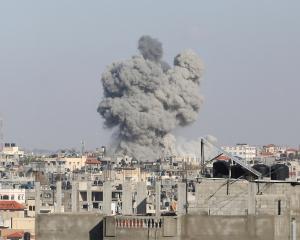
Israel began bombing Gaza on Thursday with an attack that killed the Hamas military chief. It says its campaign is in response to Hamas missiles fired on its territory. Hamas stepped up rocket attacks in response.
Israeli police said a rocket fired from Gaza landed in the Jerusalem area, outside the city, today.
It was the first Palestinian rocket since 1970 to reach the vicinity of the holy city, which Israel claims as its capital, and was likely to spur an escalation in its three-day old air war against militants in Gaza.
Rockets nearly hit Tel Aviv yesterday for the first time since Saddam Hussein's Iraq fired them during the 1991 Gulf War. An air raid siren rang out on Friday when the commercial centre was targeted again. Motorists crouched next to cars, many with their hands protecting their heads, while pedestrians scurried for cover in building stairwells.
The Jerusalem and Tel Aviv strikes have so far caused no casualties or damage, but could be political poison for Netanyahu, a conservative favoured to win re-election in January on the strength of his ability to guarantee security.
"The Israel Defence Forces will continue to hit Hamas hard and are prepared to broaden the action inside Gaza," Netanyahu said before the rocket attacks on the two cities.
Asked about Israel massing forces for a possible Gaza invasion, Hamas spokesman Sami Abu Zuhri said: "The Israelis should be aware of the grave results of such a raid and they should bring their body bags."
Officials in Gaza said 28 Palestinians had been killed in the enclave since Israel began the air offensive with the declared aim of stemming surges of rocket strikes that have disrupted life in southern Israeli towns.
The Palestinian dead include 12 militants and 16 civilians, among them eight children and a pregnant woman. Three Israelis were killed by a rocket on Thursday. A Hamas source said the Israeli air force launched an attack on the house of Hamas's commander for southern Gaza which resulted in the death of two civilians, one a child.
A solidarity visit to Gaza by Egyptian Prime Minister Hisham Kandil, whose Islamist government is allied with Hamas but also party to a 1979 peace treaty with Israel, had appeared to open a tiny window to emergency peace diplomacy.
Kandil said: "Egypt will spare no effort ... to stop the aggression and to achieve a truce."
But a three-hour truce that Israel declared for the duration of Kandil's visit never took hold. Israel said 66 rockets launched from the Gaza Strip hit its territory on Friday and a further 99 were intercepted by the Iron Dome anti-missile system.
Israel denied Palestinian assertions that its aircraft struck while Kandil was in the enclave.
Israel Radio's military affairs correspondent said the army's Homefront Command had told municipal officials to make civil defence preparations for the possibility that fighting could drag on for seven weeks. An Israeli military spokeswoman declined to comment on the report.
The Gaza conflagration has stoked the flames of a Middle East already ablaze with two years of Arab revolution and a civil war in Syria that threatens to leap across borders.
It is the biggest test yet for Egypt's new President Mohamed Mursi, a veteran Islamist politician from the Muslim Brotherhood who was elected this year after last year's protests ousted military autocrat Hosni Mubarak.
Egypt's Muslim Brotherhood are spiritual mentors of Hamas, yet Mursi has also pledged to respect Cairo's 1979 peace treaty with Israel, seen in the West as the cornerstone of regional security. Egypt and Israel both receive billions of dollars in U.S. military aid to underwrite their treaty.
Mursi has vocally denounced the Israeli military action while promoting Egypt as a mediator, a mission that his prime minister's visit was intended to further.
A Palestinian official close to Egypt's mediators told Reuters Kandil's visit "was the beginning of a process to explore the possibility of reaching a truce. It is early to speak of any details or of how things will evolve".
Hamas fighters are no match for the Israeli military. The last Gaza war, involving a three-week long Israeli air blitz and ground invasion over the New Year period of 2008-2009, killed more than 1,400 Palestinians, mostly civilians. Thirteen Israelis died.
Tunisia's foreign minister was due to visit Gaza on Saturday "to provide all political support for Gaza" the spokesman for the Tunisian president, Moncef Marzouki, said in a statement.
The United States asked countries that have contact with Hamas to urge the Islamist movement to stop its rocket attacks.
Hamas refuses to recognise Israel's right to exist. By contrast, Palestinian President Mahmoud Abbas, who rules in the nearby West Bank, does recognise Israel, but peace talks between the two sides have been frozen since 2010.
Abbas's supporters say they will push ahead with a plan to have Palestine declared an "observer state" rather than a mere "entity" at the United Nations later this month.