

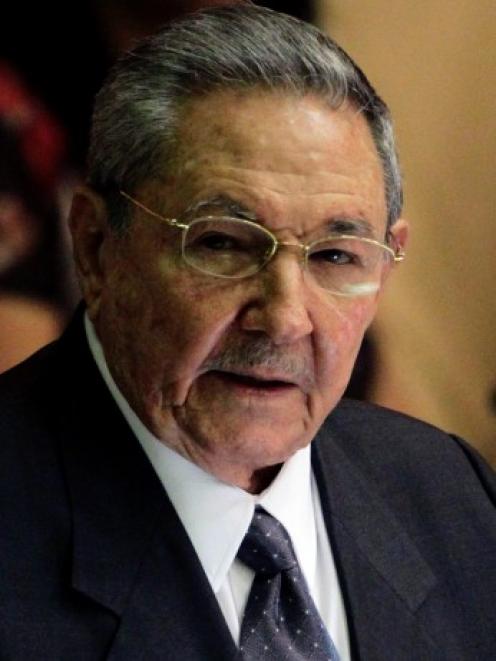
Castro, 81, made the announcement in a nationally broadcast speech shortly after the Cuban National Assembly elected him to a second five-year term in the opening session of the new parliament.
"This will be my last term," Castro said.
In a surprise move, the new parliament named as his first vice president Miguel Diaz-Canel, a member of the political bureau who rose through the party ranks in the provinces to become the most visible possible successor to Castro. Diaz-Canel would succeed Castro if he cannot serve his full term.
The new government will almost certainly be the last headed up by the Castro brothers and their followers who have ruled Cuba since they swept down from the mountains in the 1959 revolution.
Raul Castro starts his second term immediately, leaving him free to retire in 2018, aged 86.
Former president Fidel Castro joined the meeting, in a rare public appearance. Since falling ill in 2006 and ceding the presidency to his brother, the elder Castro, 86, has given up official positions except as a deputy in the National Assembly.
Governments, Cuba watchers and Cubans were keenly observing to see if any new, and younger, faces might appear among the Council of State members, in particular its first vice president and five vice presidents.
Their hopes were partially fulfilled with Diaz-Canel's ascension. He replaces former first vice president, Jose Machado Ventura, 82, who will continue on as one of five vice presidents. Commander of the Revolution Ramiro Valdes, 80, and Gladys Bejerano, 66, the comptroller general were also re-elected as vice presidents.
Two other newcomers, Mercedes López Acea, 48, first secretary of the Havana communist party, and Salvador Valdes Mesa, 64, head of the official labor federation, also earned vice presidential slots.
Former vice president Esteban Lazo, member of the political bureau of the Communist Party, 68, left his post upon being named parliament president on Sunday, replacing Ricardo Alarcon, who served for 20 years.
Six of the Council's top seven members sit on the party's political bureau which is also lead by Castro.
The National Assembly meets for just a few weeks each year and delegates its legislative powers between sessions to the 31-member Council of State, which also functions as the nation's executive through the Council of Ministers it appoints.
Eighty percent of the 612 deputies, who were elected in an uncontested vote Feb. 3 and with an average age under 50, were born after the Revolution.


