Addressing up to 200,000 people including many foreign leaders gathered under bright sunshine in St. Peter's Square, the Argentine pope underlined his central message since he was elected by a secret conclave of cardinals last Wednesday - that the Church's mission was to defend the poor and disadvantaged.
The Mass, formally installing Francis as head of the world's 1.2 billion Roman Catholics, was much simpler and an hour shorter than the baroque splendour of his predecessor Benedict's inauguration in 2005.
Although he is as conservative doctrinally as Benedict Francis's simpler style and emphasis on the poor marked a sea change from his predecessor that has been widely welcomed by Catholics.
The first Jesuit pope inherits a Church mired in scandals over priests' sexual abuse of children and the leak of confidential documents alleging corruption and rivalry between cardinals inside the Church government or Curia.
He has also been accused by some critics in Argentina of not doing enough to oppose human rights abuses under a military government during the 1976-1983 "dirty war" when some 30,000 leftists were kidnapped and killed. The Vatican has denied the accusations.
In his homily, delivered on the steps of the giant St. Peter's Basilica, Francis, 76, said the Church's mission "means respecting each of God's creatures and respecting the environment in which we live.
"It means protecting people, showing loving concern for each and every person, especially children, the elderly, those in need, who are often the last we think about."
The message chimed with the teachings of the 13th century St. Francis of Assisi, from whom the pope took his name and who is a symbol of poverty, simplicity, charity and love of nature.
In another sign that he wants to maintain a simple life, Francis is still staying at the Vatican hotel where he lived during the conclave and did not move into a suite reserved for him, a spokesman said. It is not clear when he will move into the Apostlic Palace.
In his homily, Francis said that whenever human beings failed to care for the environment and each other, "The way is opened to destruction and hearts are hardened. Tragically in every period of history there are 'Herods' who plot death, wreak havoc and mar the countenance of men and women."
Before the Mass, the pope toured St. Peter's Square in an open white jeep, abandoning the bullet-proof popemobile often used by Benedict.
He stopped frequently to greet those in the huge, flag-waving crowd, kissing babies and getting out to bless a disabled man.
"He is a simple, humble person, he is not like the untouchable popes, he seems like someone normal people can reach out to," said Argentine electrician Cirigliano Valetin, 51, who works in southern Italy.
Argentinian Cardinal Leonardo Sandri told Reuters: "For me this is a call to humility and service to others that will mark his papacy... This is a new breeze of fresh air that is blowing through the Church and the name of that breeze is Francis."
Six sovereigns, US Vice President Joe Biden, Argentine President Cristina Fernandez, other leaders as well as heads of many other faiths were among the 130 delegations. They included Muslim, Jewish, Buddhist, Russian Orthodox and Anglican leaders.
Francis called for world leaders to be "protectors of one another and of the environment ... Let us not forget that hatred, envy and pride defile our lives. Being protectors, then, also means keeping watch over our emotions, over our hearts."
For the Mass he wore plain white vestments, trimmed with gold and brown, and black lace-up shoes, in contrast to the stylish red loafers that Benedict wore.
"We have gone from the rigid theology professor to a teacher of Christian simplicity," said Italian church historian Alberto Melloni, referring to the contrast between the warm, common touch of Francis and Benedict's stiff, intellectual manner.
The ceremony was shortened to two hours after a three-hour service in 2005 when Benedict began his papacy. The Vatican said Francis later telephoned Benedict to wish him well for Tuesday's feast of St. Joseph, the saint day of the former Joseph Ratzinger.
Before the Mass, Francis collected his newly minted gold ring and pallium, a liturgical woollen band worn around the neck, that had been placed overnight on the tomb of St. Peter under the basilica's altar.
Hundreds of priests, sheltering from the sun under umbrellas in the Vatican's white and yellow colours, distributed communion to the crowd while Francis watched from a raised throne behind the altar.
Francis greeted foreign delegations inside the basilica after the Mass. They included Zimbabwe President Robert Mugabe, who has been under a European Union travel ban since 2002 because of allegations of vote rigging and human rights abuses. He was able to travel to the Vatican because it is a separate territory, outside the EU.
The pope also met Ecumenical Patriarch Bartholomew from Istanbul, the first time the spiritual head of Orthodox Christians has attended a Roman pope's inaugural Mass since the Great Schism between western and eastern Christianity in 1054.
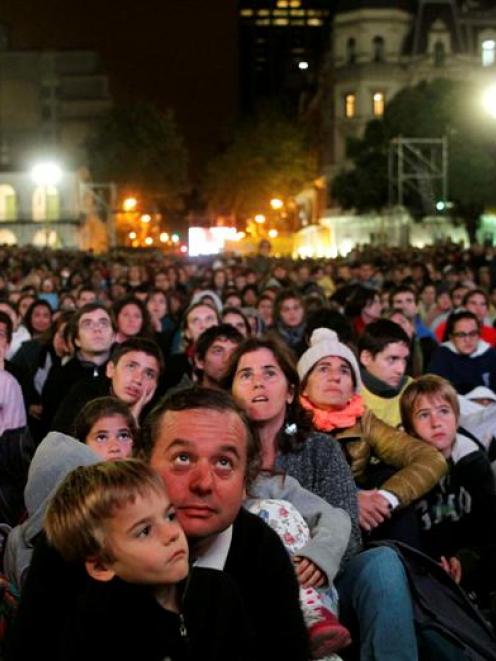
Before the Mass, Latin America's first pope made a surprise phone call to thousands of his compatriots listening at loudspeakers in the Plaza de Mayo square in Buenos Aires where they had gathered hours before dawn to watch the celebrations on large television screens.
In his message, the former Buenos Aires Cardinal Jorge Bergoglio thanked the crowd for their prayers "which I need a lot".
"I want to ask you a favour, that we walk together, that we look after each other... Don't forget this bishop who, though far away, cares so much for you," he said.
In the United States, a Reuters/Ipsos poll found 85 percent of those who said they were aware of the new pope had a favourable view of him, including 94 percent of Catholics.
Two-thirds of US adults, including 9 out of 10 Catholics, expect him to be a good leader of the Catholic Church.
About 50 percent, however, said they would have liked to see someone younger elected.