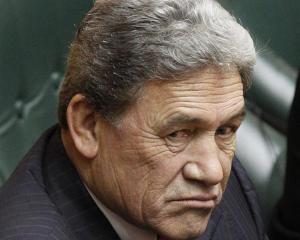
New Zealand First leader Winston Peters, as is his habit, protests too much.
He sees the sale of the Crafar farms, which went into receivership in 2009, to Chinese-owned company Shanghai Pengxin, as "economic treason".
The Labour Party, too, has weighed in calling it a "massive kick in the guts" for local farmers and iwi.
The outcry over the decision of the Government to act on the recommendations of the Overseas Investment Office in approving the Crafar farms bid by a Shanghai Pengxin, masks the fact that the sale of such land has become commonplace: consents have been granted for the sale of 357,056 hectares of agricultural land to foreign interests in the last two years.
United States buyers have acquired 25,306ha; German citizens have bought 6834ha; 9727ha have gone to the Swiss; Australia has acquired 3861ha; and 22,600ha of farm land has gone to owners fromthe United Kingdom.
The Crafar farms, owned by Allan, Frank and Beth Crafar, went into receivership in October 2009. The company KordaMentha was appointed receiver.
The relevant 13 dairy farms and three dry stock runs included properties spread throughout the North Island. A Chinese company Natural Dairy (NZ) Holdings, which previously had been known as the China Jin Hui Mining Corporation, sought to buy the Crafar farms pending OIO approval in 2010, as did state-owned enterprise Landcorp.
These bids were declined and in January last year the present bid, approved yesterday, was received by Milk New Zealand Holding Ltd, a subsidiary of Shanghai Pengxin. The winning bid is thought to be in the region of $200 million.
The next best bid is that of the Crafar Farms Purchase Group, at $171.5 million. This group consists of Auckland businessman, Sir Michael Fay, Central North Island farmers and iwi groups. It has filed for a judicial review of the decision in the Wellington High Court.
Running through all the opposition is the notion that it is somehow unpatriotic to sell farm land to the Chinese - and that this sale is the thin end of a wedge that will infiltrate a vertically integrated milk production and processing operation, which could eventually undermine the strength and market position of, for instance, Fonterra.
But Sir Michael Fay's credentials for arguing from a standpoint of economic patriotism are little short of laughable, given his past history of profiting from the buying and selling of strategic assets, including Tranz Rail in the early 1990s.
It is also a proposition that has been factored into the OIO consent conditions which not only required the bid to meet a number of stipulations - including the creation of jobs, increased export receipts, added investment, and environmental considerations - but also mandated the limited extent to which the parent company could involve itself in processing operations.
Where the opposition to the deal has force - and it is a point that has not yet been satisfactorily answered - is why the farms had to be sold as a package, putting them out of reach of most New Zealand farming interests, rather than as individual propositions.
This, however, is down to the receiver, rather than the Government, although it does make something of a mockery of the latter's former claims to greater oversight on offshore ownership.
While the Labour Party, and Mr Peters, might make much of the fact that Landcorp will run the farms - rendering, somewhat bizarrely, a taxpayer-owned company a tenant in its own country - it was the Labour Party which championed closer economic ties with China through its pioneering Free Trade Agreement.
The Government says this deal has nothing to do with the FTA, but written into the consent is a requirement for Milk New Zealand to "assist Landcorp to extend its business to, and market its products in, China".
When other sales of land to overseas owners are considered, and the safeguards written into the consent considered, the outcry over this bid has been disproportionate.
Its real importance to New Zealand is the extent to which it strengthens ties with a market fast becoming this country's most important economic lifeline.