
The travel details of a woman in her 50s who on Sunday became the third person in Canterbury to test positive for Covid-19 have been revealed.
The woman flew from San Francisco to Auckland on Monday, March 16, on flight NZ7, and then Auckland to Christchurch on Tuesday, March 17, on flight NZ523.
New Zealand had 36 new confirmed cases of coronavirus on Monday, Director-General of Health Ashley Bloomfield announced.
This took the total number of cases in this country to 102.
Nearly all are linked to overseas travel or an already confirmed case, but two - one in Auckland and one in Wairarapa - have no firm links to either and officials have not ruled out community transmission.
The other confirmed cases in Canterbury are a male in his 50s who flew from Los Angeles to Auckland on Saturday, March 14, on flight AA83, and then Auckland to Christchurch on Sunday, March 15, on flight NZ535. And a woman in her 40s, who flew from Singapore to Christchurch on Monday, March 16, on flight SQ297, was Canterbury's first confirmed case.
Bloomfield said people who were continuing to go to bars, cafes and restaurants and treating Covid-19 as a bad flu should "get with the programme" and play their part in helping to restrict the virus' spread.
He said 1100-1500 tests are being done each day. About 1-2 per cent of those were coming back positive - which was comparatively low compared to other countries suggesting our rate of testing is reasonably high, he said,
Some DHBs have opened drive-through clinics for people to get tested. That doesn't mean people should turn up to get swabbed if they feel like it - they will not automatically be tested.
Over half of today's 36 new cases were directly linked to overseas travel - people who have returned to New Zealand recently.
Most of the remainder are close contacts of previously concerned cases or associated with events where there were confirmed cases.
There still remain two where it's not clear where the infection came from.
The two cases of suspected community transmission are in Auckland and Wairarapa.
Bloomfield said authorities were expecting to find these cases because so many people were returning from around the world from places where Covid-19 was common.
Just over 1200 lab tests were carried out yesterday - bringing the total conducted to more than 7400.
While most cases are still people who have come from overseas, an increasing number of cases were close contacts of those people, Bloomfield said.
He added that hygiene practices, physical distancing and staying home if you are unwell are becoming increasingly important.
Healthline's capacity is continuing to increase - the average waiting time yesterday was 30 minutes, Bloomfield said. More staff have been brought on board and other government helplines have also been linked in.
Healthline should only be used to ask about your health. If you have an urgent medical issue, call your GP and get advice there, Bloomfield stressed.
Prime Minister Jacinda Ardern will be updating the public on alert levels at 1.30pm today, he said.
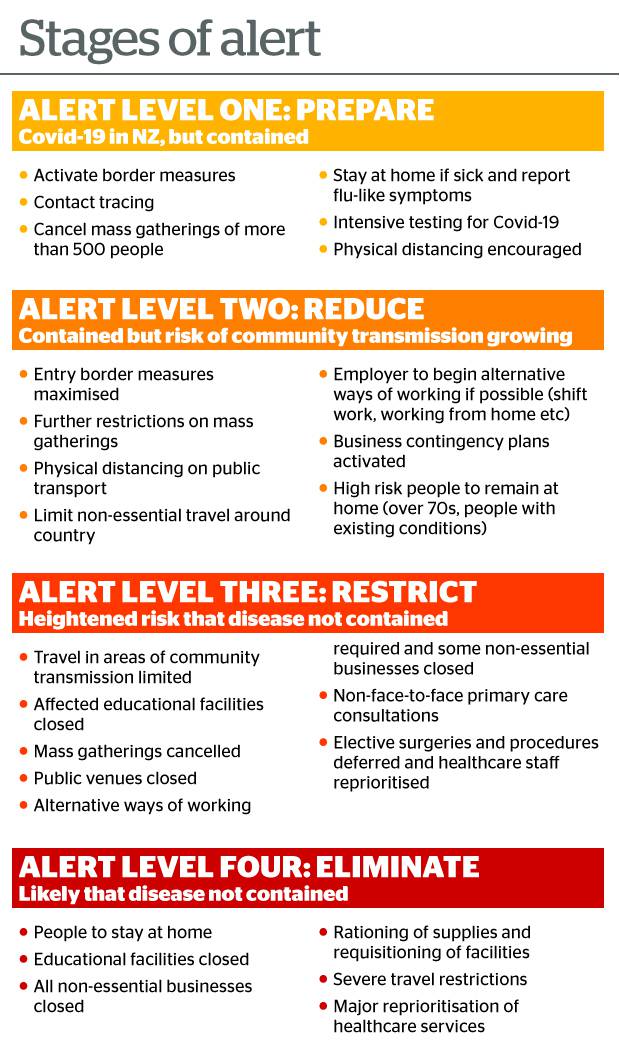
DHBs have plans in place on how to scale down activity - especially elective operations and outpatient appointments - to free up capacity and staff if more people need hospital level care.
That doesn't mean people won't be seen if they need care - but many outpatient appointments could be done via phone calls rather than face to face.
Most hospitals are also restricting visitors, he said.
Bloomfield said a stocktake of NZ's ICU capacity will show how many beds the country has - it also shows the country can triple the number of beds available. The information will be published on the ministry's website shortly.
Regarding the latest modelling from Auckland University, which shows many thousands of people could die without containment of the virus, Bloomfield said: "We have acted very strongly on a whole range of measures and will continue to ... with the express purpose of avoiding that worst-case scenario."
New Zealand was looking closely at different testing options, including new technology which could speed up the time to get a diagnosis.
"Nothing is off the table," Bloomfield said.
There are about 180 fully staffed ICU beds. With current ventilator capacity, that can be trebled.
More staff are also being trained and more ventilators being sourced.
Concerns have been raised about the amount of personal protective equipment (PPEs) available for health workers such as GPs.
Bloomfield said there is "a lot of PPE" - the important thing is that it's at the places where it's needed."
Having dedicated community-based testing places would help with that, as would GPs moving to more online consultations.
The Government is looking at options for quarantine - whether people coming into the country or others in the country that authorities weren't confident would self-isolate.
Whangaparaoa is a good starting point for how that might work.
Bloomfield thanked the wider all-of-government team working on the Covid-19 response, and to all health professionals.
"They are incredibly dedicated, highly professional and aiming to look after New Zealanders - if you could look after them too I'd be very grateful."


