
The new coalition government says it will drive down government spending levels and focus on law and order.
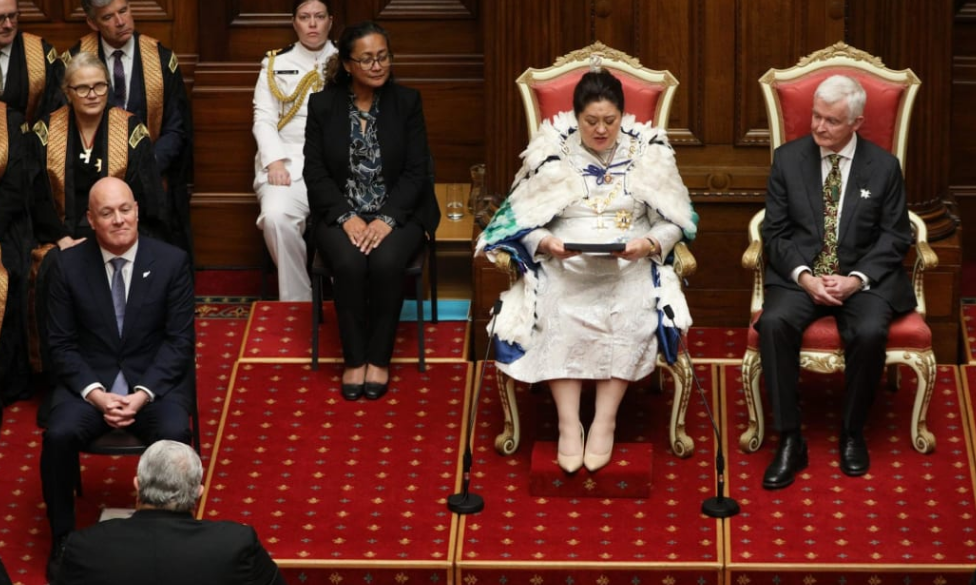
The commitment was read by Governor-General Dame Cindy Kiro in her speech from the throne at Parliament this morning, written by the incoming government setting out its priorities for the next term.
Despite being read by Kiro, the speech should really be understood as the work of National, Act and New Zealand First. The commitments in the speech are also found in the coalition agreements between the parties.
Kiro said the government would achieve its spending promises by “restoring discipline to government spending”. There would be "savings in government agencies targeted to deliver tax relief for hard-working, low-and-middle-income workers”.
The savings would be “informed by” the increase in back-office head counts in each agency since 2017, but Ministers will be expected to work with individual chief executives to achieve their respective savings targets.
Economy
Kiro said the Government had already axed projects including Central Otago's Lake Onslow pumped hydro scheme and other projects would go.
“The government will also stop work on Industry Transformation Plans, the costly Income Insurance Scheme, Auckland’s Light Rail project, and Let’s Get Wellington Moving,” she said.
She promised fuel taxes would be frozen, and landlords would have their ability to deduct interest costs from their tax bills restored.
“The government will provide income tax relief to compensate for the increase in the cost of living, increase Working for Families tax credits, introduce the FamilyBoost tax credit to support young families with the cost of childcare, and widen eligibility for the independent earner tax credit,” Kiro said.
“These changes will see a median wage earner better off by at least $50 a fortnight - and more for many with children,” she said.
Law and Order
Kiro reiterated the new government’s promises on law and order. She said New Zealanders were “wearied and worried by brazen offending, particularly against retailers”.
“All New Zealanders are paying for this offending but those working in fear are bearing the highest personal cost,” she said.
Kiro said the government would: ban gang patches; give police the power to issue dispersal notices requiring gang members to immediately leave a public area; allow police to issue Consorting Prohibition Notices to stop known gang offenders committing serious offences, and give police power to issue Firearms Prohibition Orders.
The Sentencing Act would be made more punitive, and the “three strikes” rule would be restored, although with a “tighter definition of offences that qualify as strikes”.
Education
On Education, Kiro said the government would “require every primary and intermediate class to be taught an hour of reading, an hour of writing and an hour of maths, every day, because a good grasp of the basics is the essential foundation on which to build further education”.
The speech was critical of the previous government’s record on education, saying the new government would “not stand by as cohorts of young people see their life horizons shrink because of a lack of schooling”.
Kiro reiterated a commitment to structured literacy for all students, the reintroduction of charter schools, and the disestablishment of Te Pūkenga, the New Zealand Institute of Skills and Technology.
Health
The health section of the speech said that the sector had been under “enormous ‘pressure” and needed more support on the frontline.
She reiterated National’s campaign pledge of helping nurses with study costs if they pledged to remain in New Zealand after study.
“The government will establish a system to pay their student loan repayments, up to $4500 year for five years, in exchange for them agreeing to work here for at least five years,” she said.
She also promised boosting training of other health professionals.
The speech promised $280 million to Pharmac over four years for 13 cancer treatments, and an increase to the breast cancer screening age to 74.
The speech said the Māori Health Authority will be disestablished and that there would be ‘no co-governance of public services “.
“Services will be delivered on need, using a range of effective providers, including iwi and community groups who have the best reach into the communities they serve,” she said.
Parliament was formally opened and MPs were sworn in on Tuesday. National senior MP Gerry Brownlee was elected Speaker of the House.
After the State Opening, at 2pm today National MPs James Meager and Katie Nimon will deliver their maiden speeches. Party leaders will then speak.


