

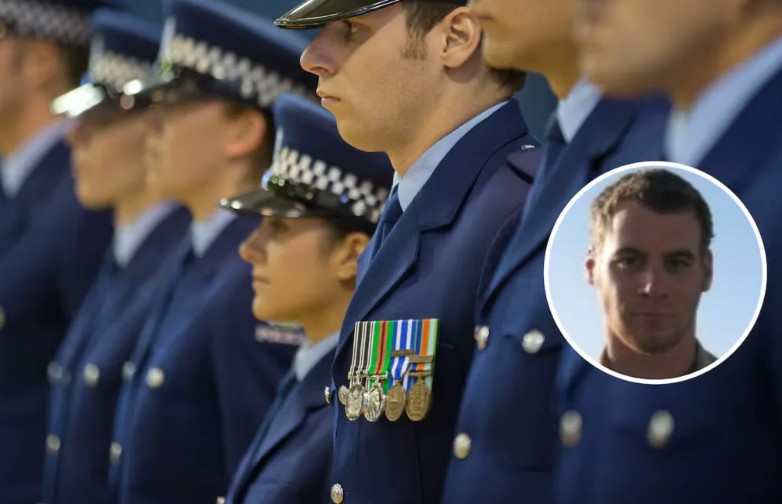
After serving in the army and working as a police constable in child protection services, the traumatic events Sam Sweetman had encountered caught up with him.
He suffered a major depressive episode and over 10 days, he drove dangerously, fled police and attacked a police officer.
Two years on, a psychological report opined that Sweetman, now 37, was experiencing a delayed Post Traumatic Stress Disorder (PTSD) at the time of the September 2024 offending.
This was made worse by cannabis and steroid use, the report stated.
At the former constable's recent hearing in the Waitākere District Court, his lawyer Andrew Comeskey made a bid for Sweetman to be discharged without conviction on the five charges he faced.
Comeskey argued the consequences of a conviction, such as difficulty applying for jobs, would be disproportionate to the offending.
An afternoon walk turned violent

At the time of the assault, the victim was going for an afternoon stroll through a park walkway in Hobsonville with a friend.
Sweetman had resigned from New Zealand Police three months earlier after suffering symptoms of burnout and depression.
He was also going for a walk when the two crossed paths.
They had worked together in the Waitematā district and the victim acknowledged Sweetman.
His response was to ask what the victim was "smiling at" before punching him in the face multiple times, the agreed-upon summary of facts stated.
The pair tripped over the sidewalk, falling to the ground and the victim's friend intervened, jumping on Sweetman's back.
Sweetman then walked away.
The altercation lasted around 30 seconds, and the victim was left with a black eye.
Fleeing police
Eight days earlier, Sweetman was driving a Ducati motorbike on State Highway 16 in Henderson.
He was seen speeding by police and a patrol car's sirens were switched on, indicating that Sweetman must pull over.
Instead he sped away, weaving through traffic until police abandoned their chase.
Three days after the assault, Sweetman was driving on State Highway 18 in Albany.
He was heading east, as was a marked police car ahead of him.

After driving at 127km/h in a 100km/h zone, he slowed so he was parallel to the police car before swerving toward it, and missing it only by about 30cm.
The police car's sirens were switched on and, again, Sweetman took off, speeding and swerving through lanes.
After Sweetman abruptly pulled over, the police car stopped ahead of him.
However, the officer in the vehicle feared for his safety and drove away.
Sweetman was later located at a gym in Albany and was taken into custody.
A psychotic disorder
The court heard the psychological report stated that Sweetman had been under so much stress and pressure at the time that he had developed a psychotic disorder.
He was at the time experiencing paranoid thoughts related to the police, such as their putting recording devices in his car.
After he was arrested, Sweetman was placed on involuntary psychiatric hold and prescribed anti-psychotic medication.
Following his time in hospital, he was released on bail and quickly moved to the South Island to be closer to family and recuperate.
At the hearing, Judge Lisa Tremewan acknowledged that all the incidents related to the police.
She said it was clear that Sweetman was suffering from delusional thoughts at the time and felt he was being targeted by his former employer.
"[You felt] the person you assaulted, perhaps, was part of some surveillance that you felt you were under," she told Sweetman.
"But the court is heartened to see you are no longer saying that."
Sweetman had since realised the assault victim and his friend were just out for a walk, as he was, and how he responded was wrong, and the result of delusional thoughts, the judge said.
 Sam Sweetman's medals were awarded for his service in the New Zealand Defence Force. Photo: NZME via Open Justice
Leave before resigning
Sam Sweetman's medals were awarded for his service in the New Zealand Defence Force. Photo: NZME via Open Justice
Leave before resigning
The court heard Sweetman had joined the New Zealand Defence Force at 18.
He served for seven years, during which he worked as a medic in war-torn Afghanistan.
He later entered the police force, working on the front line, the Criminal Investigation Bureau and for two years, the child protection team.
A year before he resigned, in April 2023, Sweetman experienced a mental breakdown due to stress from work, the gym and his relationship.
He took two weeks off work, feeling exhausted and burnt-out, and engaged a psychologist.
A report from his psychologist at this time said Sweetman appeared sad, tearful, apprehensive and lacked enjoyment.
After the short period of leave, he felt guilty, suspecting his employers thought he was lazy.
The court heard he resigned in June 2024 when his symptoms worsened.
Crown prosecutor Caitlin Bourke opposed the discharge without conviction application.
She submitted concerns that Sweetman was not taking enough action to maintain his mental health.
Despite engaging psychologists before his offending, he had told the report writer he no longer wanted to attend talk therapy.
Bourke was concerned that Sweetman had told the report writer he no longer took some medications and continued to use cannabis and steroids.
Judge Tremewan said it sounded like Sweetman had given therapy "quite a go" and it was understandable he may not want to talk about the things he had seen during his career.
She trusted that he was in a safe environment, removed from his previous pressures, and did not believe his use of drugs had caused the offending.
A 'stoic' who served others
The judge discharged Sweetman without conviction on the two charges of dangerous driving, failing to stop and one of common assault.
But for his mental health episode, none of the offending would have happened, she said.
She called Sweetman "a stoic", saying he liked to tough it out, serve others and not talk about it.
It was "quite obvious" that his past work would have been gruelling and had an impact on him, particularly his time with the child protection team.
"A special unit, one that might be called upon to deal with some of the most traumatic kinds of individuals and cases that there are."
She suggested that in future, he find a less stressful profession to help maintain his wellness.
Starting on a new career path at his age was difficult enough without a conviction on his record, she said.
However, for the driving matters, he was disqualified for six months.


