

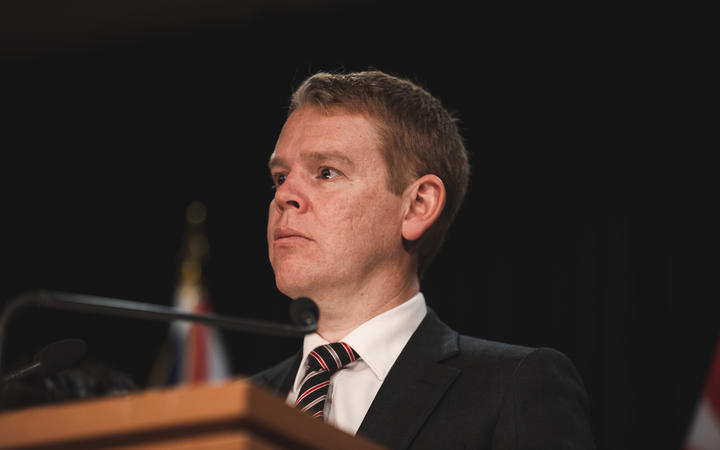
Saliva testing is being rolled out to all frontline border workers, Covid-19 Response Minister Chris Hipkins has announced.
Hipkins and Joint Head of Managed Isolation Megan Main made the announcement during the Covid-19 briefing at the Beehive.
The saliva testing comes as the ministry issues 16 infringement notices to border workers who have not complied with testing requirements, Hipkins said.
"Prior to the infringement notices being sent, many were being made to contact these workers to provide them with support and assistance to comply with the required testing order, including being provided with testing opportunities, providing reminders and giving them a formal warning."
He said the notices will be sent by mail or email and those 16 people are being fined.
Hipkins said the saliva testing would start in mid-August for those who were already on a seven-day testing cycle, then roll out to the remaining 13,000 active border workers.
He said the saliva testing would be an optional full replacement for the nasal swab testing for those staff, and could be done at their workplace.
A prototype was already under way in Canterbury.
"This will help boost uptake of saliva testing as a testing option for those who have to do it regularly," Hipkins said.
"By offering this an alternative, we're helping border workers who have frequent testing and find having a swab inserted in the nose very uncomfortable and hard to tolerate."
He said most workers would not need to be tested outside normal shift patterns, and the Ministry of Health had provided assurances that the saliva testing provider could handle demand.
Hipkins said saliva testing will be "not just a complement ... but actually an alternative" to nasal cotton bud swabs.
He said he was sure the option will be welcomed by those frontline workers.
"Public health science and clinical advisors will continue to monitor and regularly review our approach as we undertake a phased rollout of saliva testing ... it will be a useful new addition to the toolkit."
He said the advice from the ministry had previously recommended that saliva testing could be a complement to a fortnightly nasal swab as well.
"Now that it is an alternative, the feedback we've had from those workers is that there'll be more enthusiasm for it and we're also expecting that the rollout to a much larger number of sites will happen quite quickly."
He said the approach was changed from complementary to alternative on the advice of the technical advisory group.
This is for surveillance testing at the border, but the advice is it's best to keep using nasopharyngeal swabs for diagnostic testing.
"The Ministry of Health themselves acknowledge that we're going to need to move a bit faster as new testing technologies become more readily available and become more reliable."
He said the government wants to be in a position to be able to quickly assess new testing methods for reliability.
"The technology around rapid testing is certainly evolving quite quickly."
Main said that if someone arrived in New Zealand who did not meet the quarantine-free travel requirements, they must go into managed isolation for 14 days.
"The only exceptions to that are where a medical officer of health makes a determination," she said.
She said there were a total of 60 people in MIQ at the moment who have breached one of the requirements.
On computer programmes being used to book spots in MIQ, Main said the system required someone to physically be making the booking. Auto-filling programmes can speed the process up but where they have found people breaching the use agreements, those people are being blocked.
She said there were thousands of people making the bookings, and demand was exceeding supply.
The ministry is also looking at providing alerts for different classes of people.
She said one of the challenges with using a waitlist system is it pushes the problem further up the pipeline.
"What we don't want is a lot of people who don't need vouchers anymore because their plans have changed sitting on a wait list."
She said the NSW managed return process is not a usual green-flight or red-flight process, and the ministry needed to design a new process matching commercial flight times and locations.
"This is sustainable as a short burst but not as a long-term solution."
No new cases today
There are no cases of Covid-19 in the community. The number of active cases in New Zealand is 42 and the total number of confirmed cases is 2434.
An update on vaccine numbers was also provided today - there have been more than 1.4 million doses given, an increase of more than 133,000 on last week.
About 839,000 people have received a first dose and 564,000 of those have had a second dose. More than 400,000 doses have been delivered across group three.
Covid-19 Response Minister Chris Hipkins said vaccine delivery schedule for August has been confirmed and Pfizer will deliver 1.5 million doses in the month.
"With those numbers backing us up it's really important we offer people the opportunity to be vaccinated in as many different settings as possible and at as many different times as possible .... one of those options we have are mass vaccination events."
The first mass vaccination event will be held at the Vodafone events centre in Auckland's Manukau from 30 July to 1 August.
"We're aiming to provide vaccinations to 15,000 people across those three days. It will be open to students and staff from the Manukau institute to technology and their whānau."
Another mass vaccination event will be held at the same location six weeks later.
"We've got sufficient vaccine stock to run this particular event without that having to disrupt the wider rollout plan or ... reduce the allocation to district health boards."
He said vaccines will also be available at vaccination centres, GPs, pharmacies, and at workplaces.
Hipkins has also announced that saliva testing is being rolled out to all frontline border workers.


