

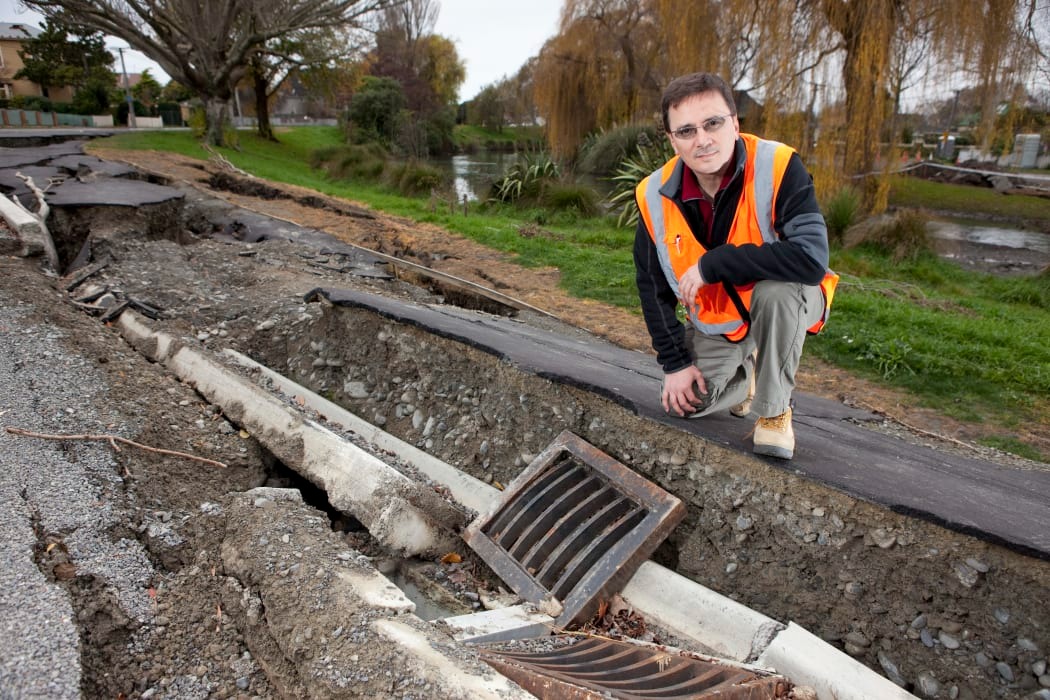
When leading liquefaction expert Misko Cubrinovski was just five years old, disaster struck his hometown.
In 1963, Skopje, the capital of Macedonia, was hit by a shallow and devastating 6.1-magnitude earthquake. More than 1000 people were killed, about 80% of the city was destroyed, and 200,000 residents were left homeless.
Cubrinovski and his family narrowly escaped the devastation, holidaying on the Adriatic Coast at the time.
“When we got back about a week later, I remember just seeing the collapsed buildings and there were no other kids.
“Most people were evacuated so when I was walking on the streets, people were just would hug me, because they couldn't see another child,” he said.
Nearly five decades later, Skopje had been rebuilt and Cubrinovski had become a leading geotechnical engineer, a husband to Aneta and father to daughter Ilina.
In 2005, he moved to Christchurch to take up a lecturing and research role at Canterbury University.
“While most of the public had never heard of liquefaction, those of us in the field knew that the soils in Christchurch were vulnerable to liquefaction even then,” Cubrinovski said.
“We decided, why don’t we write guidelines for geotechnical engineers around liquefaction. We wrote those and published them in July 2010, just two months before the September earthquake.”
While back overseas at an earthquake engineering conference in Macedonia, the 7.1 magnitude Darfield earthquake struck on September 4, causing widespread damage in Christchurch.
“It always felt odd that I lived in two cities hit by earthquakes but somehow missed them.”
After returning to Christchurch, Cubrinovski was tasked with leading observation and research into liquefaction and its impact on buildings and infrastructure.
Just after noon on February 22, 2011, he was preparing for a public lecture on liquefaction that evening.
“I had just five or 10 minutes before class. I was working on my last slide of the presentation, and it was super weird.
“My slide was about living in two cities hit by earthquakes, but in both cases, I wasn’t in the city when the earthquake happened. I was working on that slide when the shaking started.”
As the earthquake struck, Cubrinovski took cover under his desk and immediately recognised the danger.
“Shaking for over 10 seconds was significant, but there were also two cycles of the earthquake which were significant. I knew that those were very damaging cycles.”
He went on to play a key role in Christchurch’s rebuild, particularly in understanding liquefaction and advising how to rebuild safely.
One major concern was underground infrastructure.
“People were saying to me, we are rebuilding the water infrastructure spending $40 million to $50 million per month, but we are doing exactly the same type of construction we were doing before the earthquakes. They didn’t know what to do about liquefaction.”
Cubrinovski helped develop a liquefaction hazard map to guide rebuilding.
“We had already used ground motion recordings and zoned the city based on severity of liquefaction. From there we provided engineering parameters and what should be used in the design.”
Despite the scale of the task, Cubrinovski said he was “highly prepared” for the challenge.
He spent 15 years studying and working in Japan under Kenji Ishihara, one of the founders of modern geotechnical engineering, and completed his PhD at the University of Tokyo.
A career highlight was helping develop new earthquake and liquefaction design guidelines for Taisei Corporation, Japan’s leading high-rise builder.
“It’s not my job to design the building itself, but when you see the buildings go up, it’s very rewarding knowing you’ve been part of the process.”
Skopje received significant international support after the 1963 quake and within 15 years was completely rebuilt.
Similar to Christchurch now, Cubrinovski said it was an exciting time to be a young person seeing new facilities pop up.
“Christchurch’s rebuild has probably been a little slower, but similar in that the rebuild has brought great benefit.”
Growing up in a city being rebuilt – and following his father, a civil engineer – shaped Cubrinovski’s career path.
He studied at the Institute of Earthquake Engineering and Engineering Seismology in Skopje, established after the 1963 quake as an international research centre.
Although Christchurch’s liquefaction risk was well understood in theory, the scale of damage in the eastern suburbs was still confronting.
“It was totally unprecedented. There were effects of liquefaction, and there were effects of lateral spreading. That’s where once the soil liquefies, if there is even a very gently sloping ground, then it moves down slope towards the river. And those movements were quite large,” he said.
Cubrinovski also developed a simplified liquefaction analysis for land, now widely used by engineers internationally.
As debate continues about rebuilding homes on parts of the red zone, he urged caution.
“There is no question that you can build on parts of that land, but first you need to mitigate the hazards, and that means quite a severe engineering intervention, which will be expensive as well.”
“Every other option for the redzone should be examined too. It should be up to community to decide if it’s worth it.”
Now 67 and entering semi-retirement, Cubrinovski plans to continue research and mentoring, write a book on liquefaction, and spend more time with family.
“We are all unfortunate that the earthquake happened during our time, but on the other hand, because of all the expertise that I have, I kind of feel privileged I was here so I could put all the theory into practice and support the city.”
With more free time ahead, he is looking forward to travel – and perhaps dusting off the golf clubs.
Memorial service
A public civic memorial service will be held to mark the 15th anniversary of the February 22, 2011, earthquake.
The ceremony will be held at Oi Manawa Canterbury National Earthquake Memorial on Sunday on the banks of the Avon River at the corner of Cambridge Tce and Montreal St.
A minute of silence will be shared at 12.51pm, and the names of the 185 people who lost their lives will be read aloud with the HMNZS Canterbury bell tolled with each name.
Office of the mayor and civic services manager Duncan Sandeman said deputy mayor Victoria Henstock will lay a wreath at the Memorial Wall on behalf of the people of Christchurch.
"The wider community will be invited to lay floral tributes after the ceremony concludes around 1.15pm,” he said.
“We welcome all members of the community who wish to attend to join and reflect on the impact the destructive earthquakes had on our district and remember those lives that were lost.”
Oi Manawa Memorial was developed in consultation with those most affected by the disaster, including bereaved families and first responders, and was unveiled on the sixth anniversary of the earthquakes.


