
PHOTO
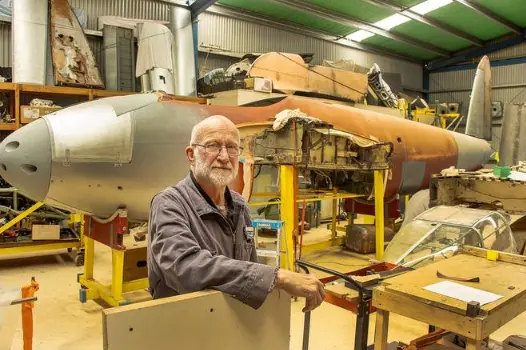
For 26 years, Dag Guest has poured time, skill and determination into restoring one of the rarest warbirds in existence – a World War 2 de Havilland Mosquito 98.
“It’s a very historically significant aircraft,” he said.
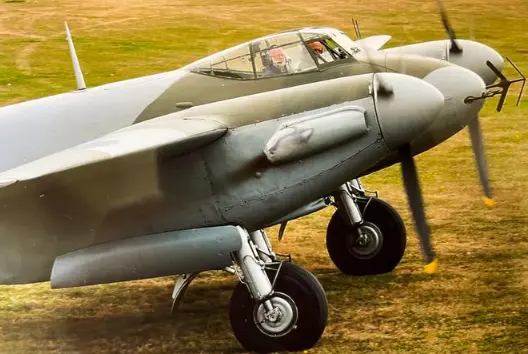
More than 7700 Mosquitos were built from 1940-1950, serving in multiple roles from fighters to bombers. Only about 30 are left worldwide and just five are still capable of flying.
Guest is one of about 30 volunteers at Christchurch's Ferrymead Aeronautical Society, a group dedicated to preserving New Zealand’s aviation history at Ferrymead Heritage Park.
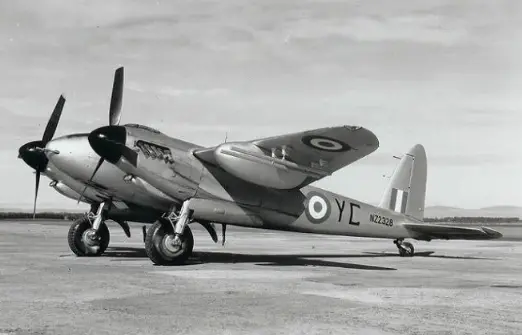
He leads a team of four volunteers to restore Mosquito HR339, the last surviving aircraft operated by No 487 Squadron RNZAF and the only surviving Mosquito flown by an RNZAF squadron during WW2.
The de Havilland Mk VI Mosquito flew 31 combat operations between December 1944 and May 1945.
“It saw action over Germany, and it was severely damaged by flak while attacking a train during operation Clarion, forcing it to belly-land at an emergency airfield,” said Guest.
After extensive repairs, HR339 returned to No 487 Squadron in April 1945, continuing its service.
In 1948, it was flown to RNZAF Ohakea near Palmerston North and later written off after it was involved in a taxiing accident at RNZAF Wigram.
It was sold to a Banks Peninsula farmer in 1952, who cut it into pieces small enough to fit on his small truck and transported it back to his farm at Pigeon Bay.
The remains were spotted by members of the Aviation Historical Society in 1972 and retrieved by Ferrymead Aeronautical Society volunteers.
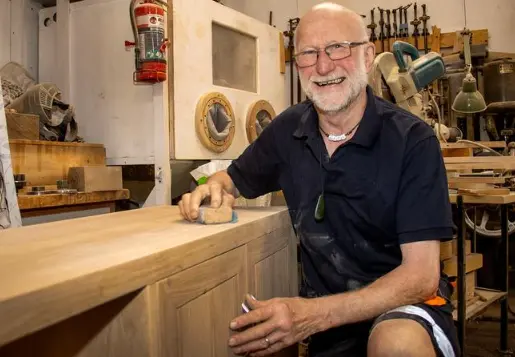
Guest is a former aircraft engineer and a furniture maker. Yet advice from around the world was there was no way the master craftsman could repair that much damage – and not to bother trying.
“Well, that was like a red rag to a bull to me. I like a challenge,” said Guest.
The restoration project combines the fuselage of another Mosquito, NZ2328, with the wings of HR339 to make a single aircraft to static display standard.
“It’s taken me 26 years to repair the fuselage. It was very badly damaged, particularly around the starboard cockpit area,” said Guest.
However, after more than a quarter of a century, the project doesn’t look like being completed anytime soon.
“The structural repairs are extremely complicated. As far as we know, there’s only one other person in the world who's tackled wings as badly damaged as ours.”
But that doesn’t faze the energetic 73-year-old.
Born in Bradford, England, Guest became known as ‘Dag’ after enlisting with the Royal Naval Reserve Air Branch at age 17.
“I walked into a Royal Navy mess with the initials D.A.G on my kitbag. Someone just said you must be Dag, and the name stuck.”
It was used so much he had it changed to his legal name.
Guest went on to train as an aircraft engineer with the Royal Navy. He left the navy in 1978 after for 10 years.
“After I left the navy, I worked for an American company in the Middle East. Unfortunately I got caught up in the January 1979 Iranian Revolution and was trapped there for a while.”
The Iranian Revolution saw the US-backed shah overthrown and an Islamic Republic established, led by Ayatollah Khomeini, who had returned from exile.
Guest said after he was evacuated to America, he retrained and got further qualifications and a job working on Bell helicopters.
In December 1979, he came to New Zealand on holiday.
“I was broke and needed to work, so I got a six-month work permit and got a job as an aircraft maintenance engineer at Christchurch Airport.”
When his work permit ended, he applied for permanent residency. Two years later, he married a New Zealander.
When asked how his wife Carol feels about the amount of time he devotes to his long-term labour of love, Guest said she was very supportive.
“She puts up with it, and treats it as a good reason to send me out of the house.”
In 1984, Guest changed careers and opened a handmade furniture business at Ferrymead Heritage Park.
He joined the aeronautical society six years later.
“I had my furniture business in the park, but when I moved it out I joined the aeronautical society so I could still have access to Ferrymead.”
The park is home to a significant collection of 10 fixed wing aircraft, ranging from a Vickers Viscount airliner with a 94ft wingspan, to a de Havilland Vampire jet fighter and a Lockheed Hudson light bomber.
The aircraft represent New Zealand’s civil and military history of aviation from WW2 to the present day. The park also boasts one of the largest collections of helicopters in New Zealand, with seven complete or near-complete aircraft.
The society welcomed the former aircraft engineer turned woodworker with open arms. Guest said it “gently nudged me towards the Mosquito”.
It was an ideal fit, as the WW2 de Havilland Mosquito was famously constructed primarily from wood, earning it the wartime nickname “Wooden Wonder”.
It was constructed of plywood and balsa wood, along with spruce for spars and ash for framing, which minimised
the use of metal which was a scarce commodity in wartime Britain.
Guest said they could easily have sped up the restoration process by installing metal plates to repair the aircraft, “but that just wouldn’t look right.”
He still runs his Halswell-based hand-made furniture business, but after semi-retiring earlier this year has been able to spend a lot more time on the Mosquito’s restoration.
“With the progress we're making now, I would hope that the wing would be together in five years, but it may be more.”
He said if all goes to plan, the Mosquito may be ready for public display in about 10 years.
“But that all depends on if we get a new building.”
He said a bigger display space would be needed when the wings are reunited with the Mosquito’s fuselage.
“We’d like to be able to raise the money to house the Mosquito, along with the vampire and Lockheed Hudson – but that’s just a pipe dream at the moment.”
He said the uncertain future of Ferrymead Heritage Park was also a worry for the society.
However, he remains unfazed by the scale of the rebuild.
“Provided I don’t go doolally, I’d like to keep going until it's finished. What we want to do is get the airplane together, and on display.”
Any donations of money or parts to help complete the project would be gratefully received.