
PHOTO
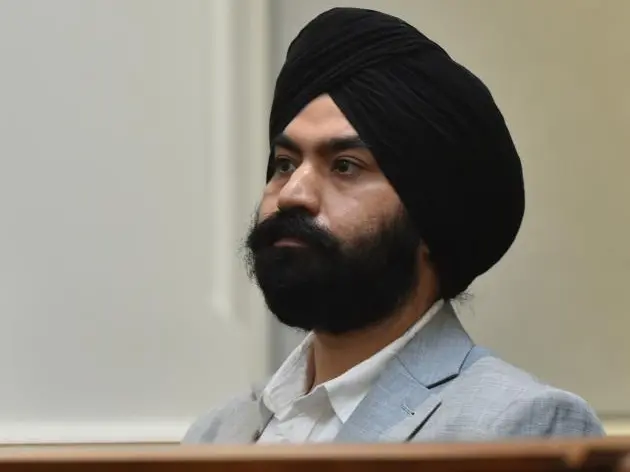
A Dunedin man has been found guilty of murdering his former employee, leaving him partially decapitated on his own front lawn.
Rajinder, 35, went to 27-year-old Gurjit Singh’s Liberton home late on January 28 last year where he brutally stabbed him at least 46 times with a knife he had bought just hours earlier.
After nearly a day of deliberation, the jury returned its unanimous verdict in the High Court at Dunedin this afternoon prompting no reaction from the defendant.
Rajinder worked for Downer as a fibre-optic cable installer, employing Mr Singh for about a year before the victim started his own business in September 2022.
Witnesses said the split had caused no animosity between the men but it was in their personal lives where the Crown said the motive lay.
In July 2023, Mr Singh married Kamaljeet Kaur in India, a woman who had previously turned down an arranged marriage to Rajinder.
She was just days away from arriving in Dunedin to start her new life, the court heard.
“Perhaps that opened old wounds,” Crown prosecutor Richard Smith said.
On the afternoon of Mr Singh’s death, Rajinder was captured on CCTV buying gloves from Bunnings, a knife and neck gaiter from Hunting & Fishing – purchases he later failed to disclose to police when interviewed.
The footage may never have been dug up if the murder had “gone to plan”, Mr Smith said.
But it did not.
During the frenzied attack, Rajinder suffered a deep wound on his left hand, something police noted and photographed during his initial interview.
The defendant passed it off as an old chainsaw injury but the CCTV showed him without any such blemish in the hours before the killing.
In a second interview, Rajinder admitted the lie and claimed he had sustained the wound in a bike accident during a midnight jaunt to Mosgiel, giving his wife a driving lesson.
It was one of a series of “ridiculous” lies, Mr Smith said.
It prompted police to zero in on his movements but it was the forensic evidence from the crime scene which proved most damning.
Blood from inside the Hillary St home and drops swabbed by scientists on the path and road outside came back as 500,000 million times more likely to be Rajinder’s DNA than anyone else.
A blood stain on the roof lining of the defendant’s Toyota Prius was revealed to contain cellular material from both him and the victim.
The Crown, in closing, also highlighted the fact a hair matching the defendant’s DNA profile was found in the bloodied hand of Mr Singh during an autopsy.
“That’s about all the evidence you need,” Mr Smith told the jury.
Alongside that, there was the detached thumb of a glove found by police lying on the victim’s blood-spattered deck.
When analysed by experts, a DNA match could not be made but the material components of the item matched the gloves bought by Rajinder earlier in the day.
Neither the gloves nor the knife or neck gaiter were found by police in a subsequent search of the defendant’s home.
Mr Smith said the items were likely disposed of during the Mosgiel trip or during Rajinder’s visit to a skip at his Green Island workplace early the following morning, which was captured on video at the premises.
Once he was arrested a week after the murder, police also gained access to his cell phones.
Despite Rajinder saying he had never visited Mr Singh’s home and denying knowledge of where he lived, a phone used by the defendant and his father featured a search for the victim’s address and a “dropped pin” at the location.
Mr Smith said the evidence painted a clear picture.
“Either [Rajinder's] guilty or he’s the victim of the most unbelievable series of coincidences,” he said.
Rajinder will be sentenced in April.