


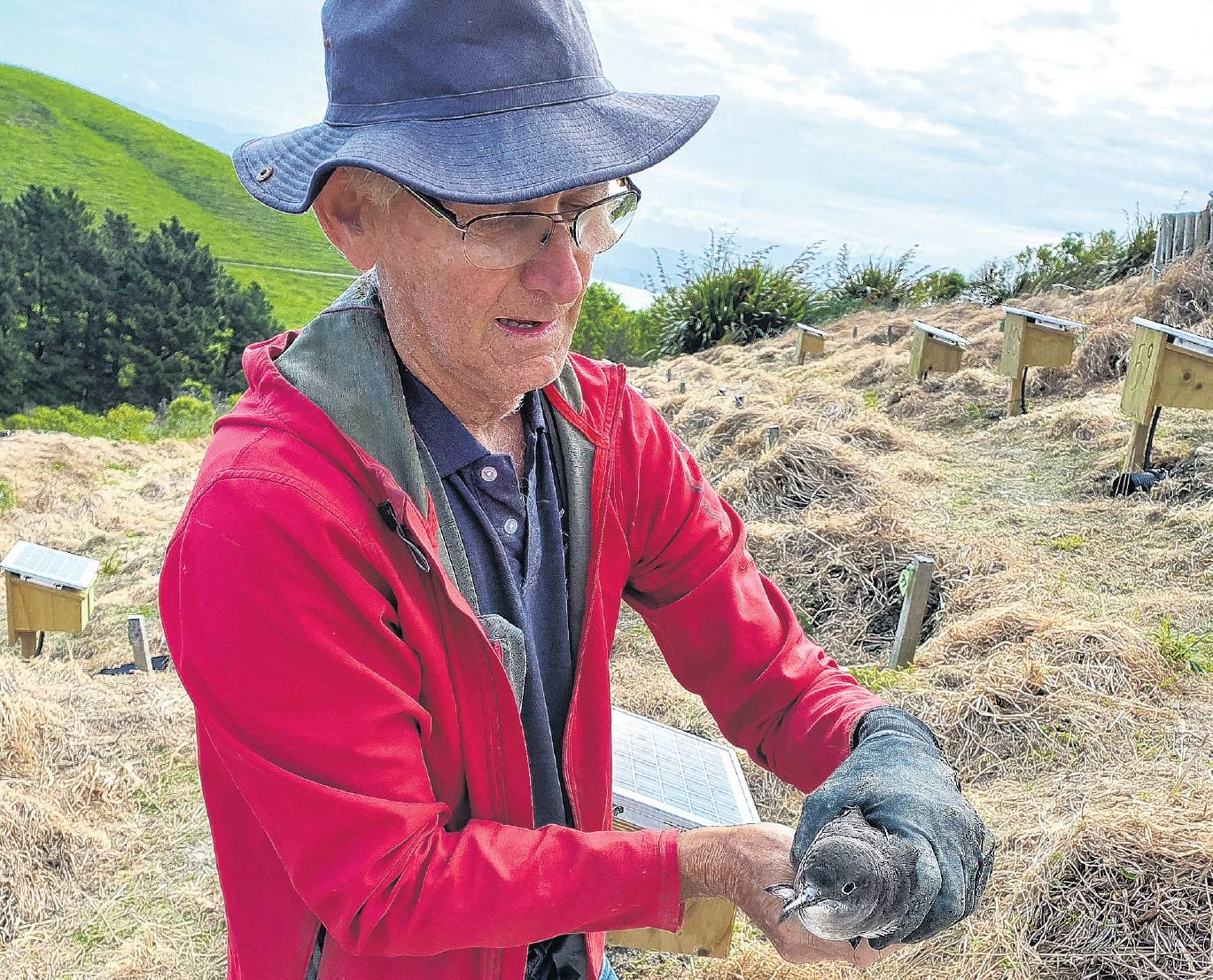
A lack of feed meant volunteers ended up feeding the fledgling chicks at Te Rae o Atiu colony on Kaikoura Peninsula earlier this year.
‘‘Last season they had a real problem in February, March and April,’’ Ted Howard, Hutton’s Shearwater Charitable Trust chairperson, says.
‘‘They were doing quite well up to that point and then suddenly the chicks stopped growing.
‘‘We started supplemental feeding, but we lost one to starvation before we started the feeding regime.
‘‘We got them up to normal fledgling weight, but the adults were really light.
‘‘They were about 100 grams lighter than normal.’’
Mr Howard suspects it was due to rising ocean temperatures, with the krill, the birds’ staple diet, forced to go deeper for cooler temperatures.
Foraging trips can be between 250km to 2100km, flying as far south as Oamaru or out to the Chatham Islands.
Some Shearwaters can do more than 300 dives in a day and go as deep as 35 metres.
Global warming is just the latest threat to the endangered Kaikoura titi, which was once an important source of mahinga kai for Ngati Kuri (Kaikoura runanga).
Threats include birds crash landing due to street lighting, getting caught in nets, plastic pollution, the 2016 earthquake and subsequent landslips, and predators such as cats, dogs, stoats and wild pigs.
It is thought there were 10 wild colonies in 1900 and eight in 1965, but now there are just two in the Seaward Kaikoura Ranges.
One colony at the head of the Kowhai River has more than 100,000 breeding pairs and there are about 8000 breeding pairs at Shearwater Stream.
Te Rae o Atiu colony is a partnership between Tukete Charitable Trust, which owns the land, local runanga, the Hutton’s Shearwater Charitable Trust and the Department of Conservation. It has been established over the last 17 years by translocating chicks from the wild. Mr Howard expected about 80-85 birds to return to the colony this year, which could result in up to 37 eggs laid, 25 chicks hatching and 20 flying away. The birds return to the colony after four years or more at sea to mate and can continue breeding well into their 20s.
The parents take turns at incubating the egg and then feeding their chick until it reaches a weight of 670 grams, almost twice the adult weight, before leaving it to fend for itself.
‘‘At the moment it is a very tiny colony, but our plan is that over the next 100 years it grows to a colony of at least 10,000 breeding pairs,’’ Mr Howard says.
Ngati Kuri hope the Kaikoura titi will one day become a source of mahinga kai for their mokopuna, as it was for their tipuna.
Public interest journalism is funded by New Zealand on Air.
Local Democracy Reporter
By DAVID HILL,


