



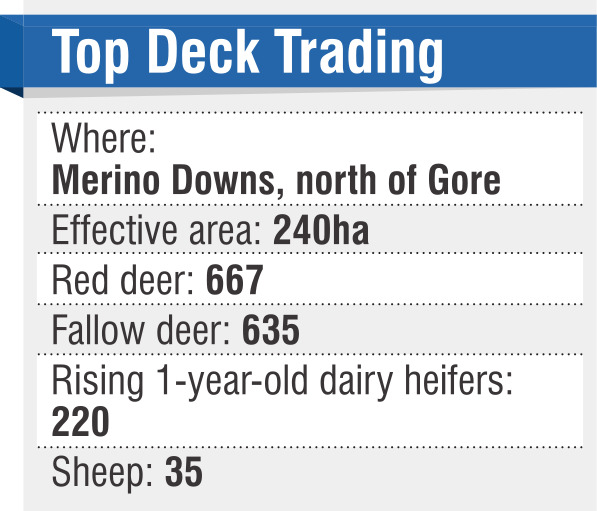
Tony and Michelle Roberts, their daughter Kate Roberts and her partner Mark Lieshout are the team farming at Top Deck Trading in Merino Downs, north of Gore.
They are the 2026 Ballance Farm Environment Awards Southland supreme winners.
Mr Roberts, speaking to about 100 people at a regional awards open day, said his family moved from Taranaki to sharemilk in West Otago in 1995.
They stopped milking cows and bought their existing farm more than eight years ago.
Deer were run on half the farm and the other half was dairy grazing.
"We were successful in dairy farming but we were looking for a change," Mr Roberts said.
The change gave them a better work-life balance, he said.
Mrs Roberts said their background in deer farming was limited when they bought the farm.
To gain industry knowledge they joined the Southland Environment Advance Party, a group of local deer farmers.
"It really opened our eyes to some of the possibilities with deer farming in the environmental space. These people were doing some pretty cool things and we’ve adopted a number of them."

Cattle troughs on the deer blocks were replaced with smaller troughs with lids, to prevent contamination of drinking water for animals.
The covered yards at the woolshed were converted into a deer shed and outer yards were added.
With the guidance and assistance from Environment Southland, they constructed wetlands in 2019 on the deer block with a catchment area of 28ha.
Wetlands were fenced to exclude livestock.
Ponds were constructed around the farm to capture sediment.
A successful trial of indoor wintering of deer in the converted woolshed resulted in the construction of a five-bay wintering barn in 2020.
The winter barn could house up to 80% of their red deer in winter to avoid pugging paddocks.
Ms Roberts said the nearly 670 red deer on Top Deck included 350 velveting stags.
The 220 rising 1-year-old heifers arrived on farm in December and 200 rising 2-year-old heifers left Top Deck to return to their dairy farm at the end of last month.
About 20 beef cattle and 35 sheep run on the farm were used as tools to improve pasture quality and fill the freezer on Top Deck.
"It is quite diverse."
This year the family put Nedap SmartTags in the ears of their deer.
The technology was designed for dairy cows.
"We wanted to monitor rumination, resting time, locomotion and heat detection," Mr Roberts said.
He was most interested in the heat detection to aid their deer embryo transfer programme.
The early signs pointed to the smart technology working in deer.
"These are the kind of opportunities we are exploring all the time."
Mr Roberts said fallow deer provided the highest return per hectare on Top Deck.
Trophy fallow bucks were grown to about age 5 and sold to game parks in Upper Clutha.
"I saw an opportunity in the market that needed to be filled and I thought they were great animals I wanted to be involved with."


