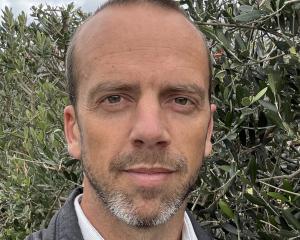



The advance would help farmers in many ways such as being able to prioritise their most efficient cows at converting grass to milk.
App upgrades are going on daily with major advances being worked on for the near future by the company.
Founded by chief executive Craig Piggott, Halter now has solar-powered cow collars and virtual fencing combined with pasture-eating, health monitoring and heat-detecting software in New Zealand, Australia and the United States.
Mr Piggott said farmer feedback had enabled Halter to build a product with a big impact on farms.
"We are still trying to go as fast as we can. There are a lot of things in the works at the moment in terms of new features and new advancements for the industry."
After growing up on a Waikato dairy farm, he worked as an engineer for Rocket Lab before going back to his farming roots to launch Halter.
He told farmers and rural professionals at the Precision Dairy Farming conference in Christchurch last month that Rocket Lab was his first exposure to a start-up and venture capitalism.
The company provided the inspiration for him to carry out agriculture innovation, he said.
Halter started with a collar for cows and an app on farmers’ phones after a lot of research training cows to listen to sound cues to free up farms from fences, shift cows for unconstrained rotational grazing and more precise feeding.
Halter commercialised its collar and software in 2021. Two years later Pasture Probe was launched, feeding data from sources such as sunlight, weather stations and collar information into an advanced learning model to work out pasture growth on each farm to make the most of virtual fencing and shifting cows.
Then cow health, cow heat and grazing behaviours were inserted into the software.
Mr Piggott said they were working on cow intake becoming the next addition on the app.
He said there was a big variation between how efficiently cows were converting grass to milk or beef and measuring cow intake would be a game changer for farmers.
"It’s been measured in labs and inside set-ups, but for most commercial farms there is no way to know which cow is efficient or not."
The app development would help farmers lift their overall production or have fewer inputs. They could have fewer cows for the same production through breeding more efficient cows and culling less efficient cows or allocate feed to more efficient cows.
"Today we are running versions of measuring cow intake on many of our customers’ farms just behind the scenes. We can already see the massive bell curve on how much cows are eating ... I think that’s a huge step forward for the industry in terms of feed conversion efficiency."
Halter usually has 10 to 20 experiments on the go, mostly kept in-house to avoid raising expectations falsely, but several of them are expected to be released next year.

However, the priority was to do the work in front of Halter first, he said.
Halter was unlikely to build milk meters or body condition scoring cameras if the hardware already existed and worked well. He would rather work with companies to integrate existing technology and concentrate on investing in innovations no-one else was doing.
A hardware team of about 30 staff were on the fifth family of collar hardware and the goal was to make it as reliable and cheap as possible and do all the value-add and innovation in software.
"We can push that cow intake as literally a piece of code to push out to all of our customers rather than farmers having to replace collars with a new sensor," he said.
Mr Piggott said precision was being built into data to give farmers more insight and more accurate data which was more convenient to access and easier to make decisions.
"We are usually updating the software on the collar on a fortnightly basis and updating the app many times a day. Often you don’t notice that but on a fortnightly or monthly basis we will be pushing out quite big new features to use as well."
He said farmers bought Halter to save themselves time, have a better work life balance or enjoy farming more, but others wanted to build equity and run a better operation.
Big gains were seen on low-performing farms, but a recently completed independent report showed the better data and more precise tools were helping farmers at the upper end run a more productive and progressive farm, he said.
The report analysed 10 high-performing farms — five in the north and five in the south — which had good numbers before Halter was introduced. The study showed an average 13% lift in profit before tax mostly from increased pasture harvesting.
One of the North Otago farmers, Nathan McLachlan, lifted his pasture harvest by about 22% with 20% more milksolids per cow for his 2000 cow herd across his farms. He had a 5% lift in the six week in-calf rate and about a 4% drop in empty cows.
Mr Piggott said these results were exceptional and not typical of Halter farmers, but showed what was possible.
He said Halter was not solely responsible for the 20% pasture harvest increase as a big system change was involved, but the tech enabled the system change.
Typically, cows picked up the technology quickly with most farmers seeing them hold at a grazing break over two to three days and shifting fluently in a week or two after the collars are first worn.
Farmers were innovative in shaping Halter to their needs and cows, often working together to adapt systems and develop skills where there were clusters of them.
Ag-tech had been guilty of being isolated in the past and Halter had tried to partner with farmers by taking everything early to the market without being afraid if it did not work. Farmers had pushed them to be better through their feedback, he said.
Mr Piggott said Halter was keeping an eye out on a direct-to-satellite version, but this was unlikely to replace cellphone towers at the moment. Connecting to towers was easier and more cost-effective on farms and more work was being carried out to expand their range and make them cheaper, he said.