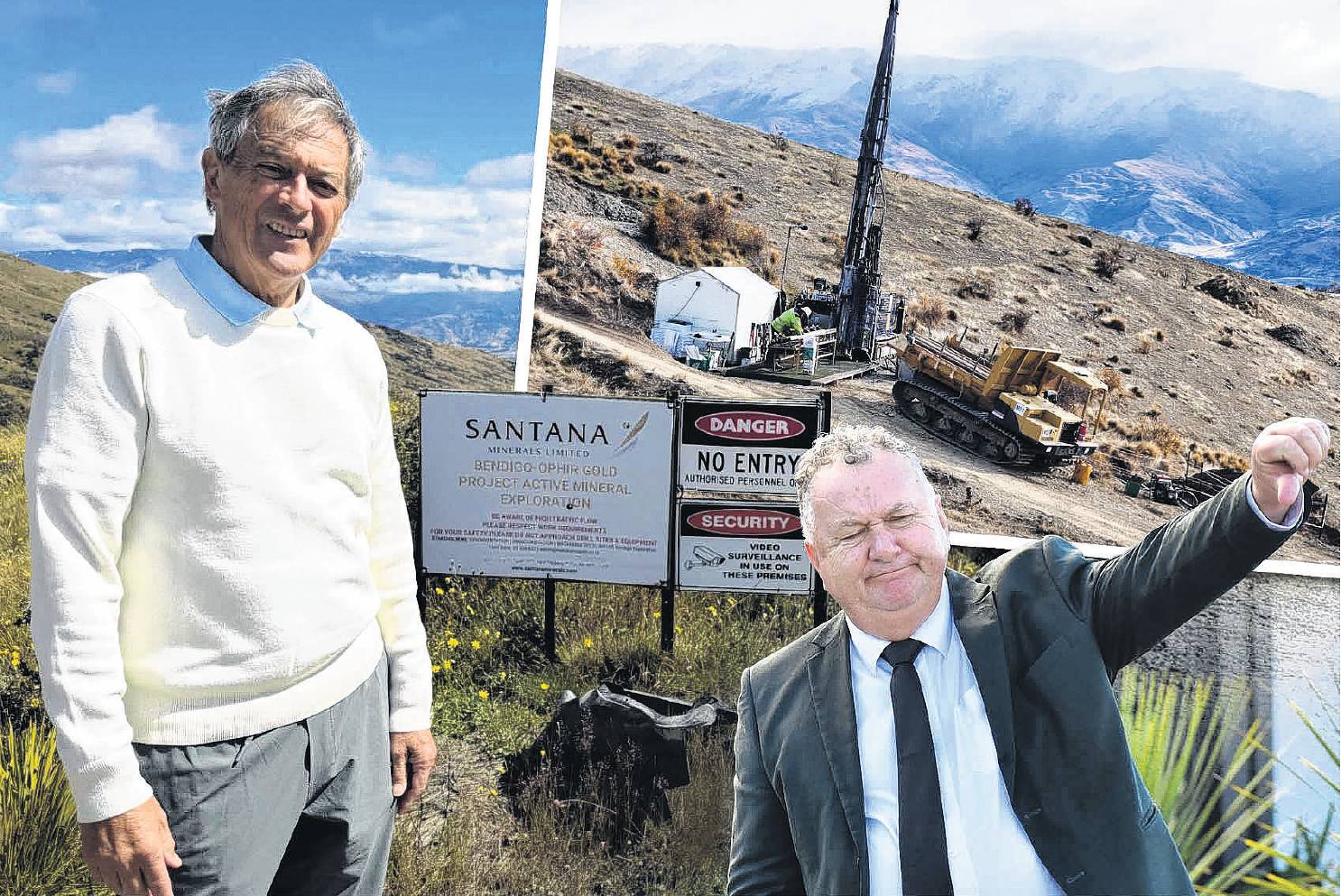
 Dunedin businessman Sir Ian Taylor has questions to ask Minister for Resources Shane Jones about Santana Minerals’ proposed Bendigo-Ophir gold mine.
- SUBSCRIBER: 'We're stuffed' if mine doesn't go ahead
A few weeks ago Shane Jones challenged me to debate the proposed Bendigo-Ophir gold mine. I accepted. Since then, silence.
That is unfortunate, because this proposal deserves exactly the kind of calm public discussion that a debate would have provided. Not slogans about growth. Not ideology about mining. Just a careful look at one proposal in one place.
One mine. One mineral. One location.
Bendigo-Ophir. Gold. Central Otago.
My concern has never been about mining itself. Mining has been part of New Zealand’s story for generations. My concern is about the consequence of this particular mine, specifically the tailings facility that will remain long after the mining stops.
That is where the real risk-reward question sits.
We hear large export numbers used to justify expanding mining. But the number that matters isn’t what’s sold. It’s what’s left here after the costs.
If I sell my house for a million dollars, that doesn’t mean I’ve made a million dollars. I still have to pay the mortgage, the agent and the lawyer. What remains after those costs is the real return.
The same logic applies to mining exports.
New Zealand’s entire mining sector currently exports roughly $1.2billion to $1.4b of minerals each year. Yet the royalties returned to the country from those minerals amount to only about $20million to $30m annually.
When we narrow the numbers to gold alone the picture becomes even clearer. According to the latest government statistics, all gold mining in New Zealand returned about $11.6m in royalties to the Crown last year. The vast majority of that gold, about 84%, came from the Macraes and Waihi mines.
In national economic terms that is a very small return from the extraction of a finite natural resource.
To place the figure in context, the new Dunedin hospital is expected to cost close to $2b. At current levels it would take well over a century of gold royalties to equal the cost of that single public project.
Those figures represent the return from all gold mining across the entire country. My debate with Mr Jones was to have been about one gold mine, Bendigo-Ophir, and my question to the him, if he had turned up, would have been: ‘‘Minister, if the total royalty return from all gold mining in New Zealand is just over $11m a year, what does the return from one additional mine actually look like?’’
Supporters of the project will rightly point out that royalties are not the only economic return. Mining companies pay company tax. Workers pay PAYE. Their spending generates GST. Those contributions should be acknowledged.
But those revenues are also tied to the life of the mine and the number of people it employs.
Gold mining is a highly mechanised industry. Even large operations employ only a few hundred people. The PAYE and GST generated by those jobs exist only while the mine operates.
Another question I would have put to the minister concerns corporate tax. New Zealand’s largest gold mine is Macraes in Otago, operated by the foreign-owned company OceanaGold. Public accounts show that in some recent years the company recorded no New Zealand corporate income tax payable, largely because capital investment and other deductions offset taxable income.
That may be entirely lawful. Mining companies operate within the tax rules Parliament sets.
But it illustrates an important point. Export values do not automatically translate into public revenue.
Which brings us back to Bendigo-Ophir.
One mine.
One mineral.
One tailings facility.
The mine may operate for 15 or perhaps 20 years. When it closes, the economic activity stops. The jobs disappear. The export revenue ends.
But the tailings facility remains.
Nearly 30 years ago the Parliamentary Commissioner for the Environment examined this issue in a report titled ‘‘Long-term Management of the Environmental Effects of Tailings Dams’’. The conclusion was clear: tailings dams create environmental obligations that extend far beyond the commercial life of the mine.
In other words, the real management challenge begins when the mining ends.
That insight has since been reinforced internationally. Following catastrophic tailings dam failures such as the Mount Polley disaster in Canada in 2014 and the Brumadinho collapse in Brazil in 2019, the United Nations Environment Programme, the International Council on Mining and Metals and the Principles for Responsible Investment launched a global review that produced the ‘‘Global Industry Standard on Tailings Management in 2020’’.
Its central message is simple: tailings facilities must be managed safely for their entire life, including after mine closure. In the case of Bendigo-Ophir, that is forever.
Location matters as well.
The proposed Bendigo tailings facility sits at the headwaters of a river system that flows through farms, vineyards and communities across Central Otago. Those rivers support an economy built on agriculture, viticulture and tourism.
And we live in a seismically active country. In 2023 official hazard modelling for New Zealand was revised upward as scientists refined their understanding of earthquake risk. The Alpine Fault, which runs the length of the South Island, will rupture again at some point. That is not speculation; it is geology.
None of this means a tailings facility cannot be engineered safely. Modern engineering is impressive. But engineering works within defined design lifetimes and probability models. Rivers and geological systems operate across centuries.
Which brings us back to the central question of balance.
The company proposing this mine has invested heavily in its application. Santana Minerals has spent around $8m preparing a 9400-page report and has engaged internationally recognised experts. They are operating within the rules government has set.
Independent groups examining that proposal do not have those resources. Until recently, community organisations could apply to the Environmental Legal Assistance Fund to help pay for scientific and legal expertise when scrutinising major environmental proposals. That fund was removed in Budget 2024, meaning groups seeking to analyse complex applications such as this must now raise those funds themselves.
My question to the minister would have been simple: why remove the one mechanism that helped communities scrutinise projects of this scale?
While the fast-track panel can commission independent advice, the reality remains that one side arrives with teams of paid experts while others must fundraise simply to examine the evidence. All of which reflects how complex these decisions have become.
That complexity is precisely why we should take our time and ensure that all voices — scientists, engineers, communities and industry — are properly heard.
This debate is not simply about whether mining produces economic activity. It clearly does.
The real question is whether the scale of that economic return justifies the long-term obligation created by the mines tailings facility, not to mention the visual and physical impact on this unique landscape that is an integral part of our international Pure New Zealand brand.
Some economic decisions expire when the activity ends.
Others continue long after.
Tailings dams fall into the second category.
The mine will close.
The tailings will remain.
If the reward from one mine is measured in years, but the responsibility it leaves behind must be carried for generations, then surely the least we can do is pause, listen to all voices and make certain we have the balance right.