



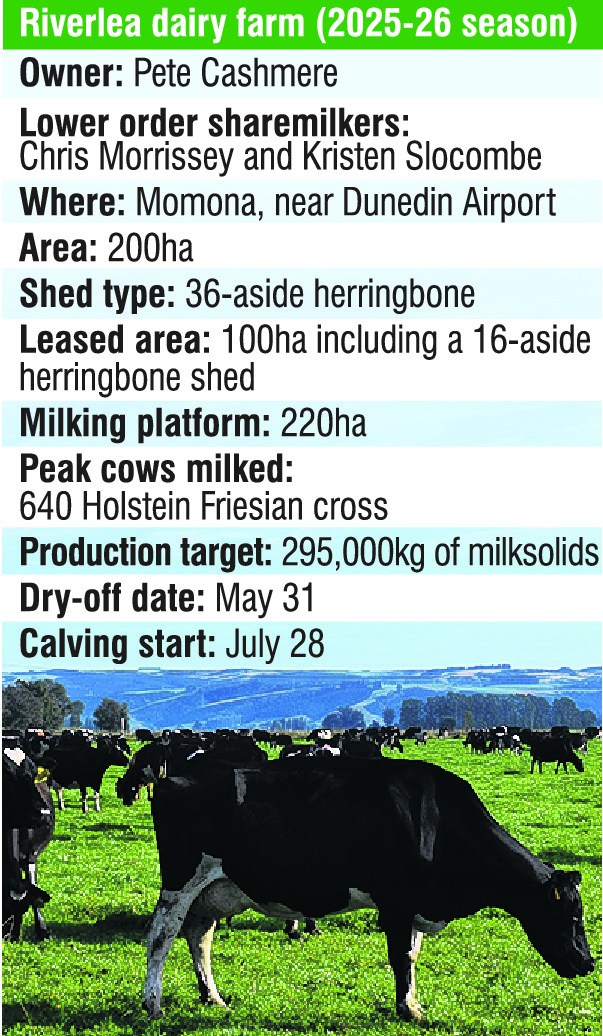
Riverlea owner Pete Cashmere is the third generation of his family to own the 200ha dairy farm.
The farm was 32ha when his grandfather milked cows on it for 30 years.
His father then milked cows for town supply for the next 25 years.
‘‘I grew up here but vowed I’d never milk a cow,’’ Pete said.
He chased a career as a sheep farmer for more than a decade.
When his father needed both hips replaced, Pete stopped working on a sheep and beef farm in Lawrence to help on the family farm.
‘‘It was only suppose to be for six weeks until he got back on his pins. That six weeks turned into 38 years.’’
During his tenure, Pete increased the size of the farm to about 200ha by buying neighbouring properties.
‘‘We were fortunate enough to have some opportunities with ground around us, which never came up in Dad’s time. Everybody stayed put back-in-the-day.’’
He also now leased a 100ha neighbouring block, which included a 16-aside herringbone shed.
Cows were milked in the shed on the lease block for about six weeks to keep it operational and ensure it remained compliant with milk company rules.
The leased land allowed Riverlea to be a self-contained system.
Pete looks after the young replacement dairy cattle, produces silage and grows winter crops, a mix of fodder beet and kale.
Protrack technology will be used on the herd for the automatic drafting from this winter.
Other investments include a new effluent system featuring a weeping wall and a 4.5 million-litre effluent storage tank.
Mr Cashmere was having a feed pad built on Riverlea to reduce feed wastage.
Pasture growing conditions had been tremendous this year, he said.
‘‘Usually our river flats would be burned off now but it has been phenomenal.’’
He had ‘‘revamped’’ the 36-aside herringbone on Riverlea three times as the herd size increased from 65 cows to 640 cows.
‘‘One of the bugbears of buying the neighbours is the infrastructure stays the same ... so you have to get the gorse out of your pockets and spend according,’’ Mr Cashmere said.

Lower order sharemilkers Chris Morrissey and fiance Kristen Slocombe have been milking the cows on Riverlea for the past two seasons.
The couple have four children, aged between 6 and 16.
Ms Slocombe said a goal was to maintain a work-life balance so they could enjoy time with their children.
‘‘So we can go on adventures with the kids, while they are young.’’
A balance ensured they continued to enjoy their farm work, she said.
She was raised in Middlemarch, the daughter of a mechanic.
Mr Morrissey was born and raised a townie on the Hauraki Plains and never planned to be a dairy farmer.
During his high school years, he helped some friends milk cows.
The plan was to study accounting at university but on leaving school, age 17, he got a fulltime job as a dairy assistant.
‘‘I never looked back.’’
He moved to Ashburton to return to fulltime dairy farming in 2003, where he spent the next 17 years working in the dairy industry.
The last job in Ashburton was contract milking about 5000 cows, managing 22 staff across three sheds.
‘‘It was busy.’’
The work was more about managing people than being a farmer, he said.
The experience was enjoyable but it had a time limit.
"You can only do it for a certain amount of years.’’
His mother Anne Morrissey works fulltime on Riverlea. She moved from Auckland to work for him in Ashburton and then to Riverlea.
‘‘I’m quite lucky,’’ Mr Morrissey said.
The production target on Riverlea was 295,000kg of milksolids this season.
If it was hit, it would be a record for them on the farm.
The production increase was due to focus on consistent feeding and making sure the herd always had food in front of them.
The herd were served palm kernel on a trailer in a paddock.
Mating consisted of five weeks of artificial insemination using CRV dairy bull semen and then a Jersey bull was put over the remaining empty cows.
Jersey genetics improved calving ease.
A future plan was to use beef genetics in the breeding programme to produce fewer bobby calves.
He had never regretted not training to be an accountant.
‘‘I quite enjoy getting up in the mornings.’’


