



"There’s a bit on," Josh Adam jokes about running his family’s dairy, sheep, beef and egg farm on the Taieri.
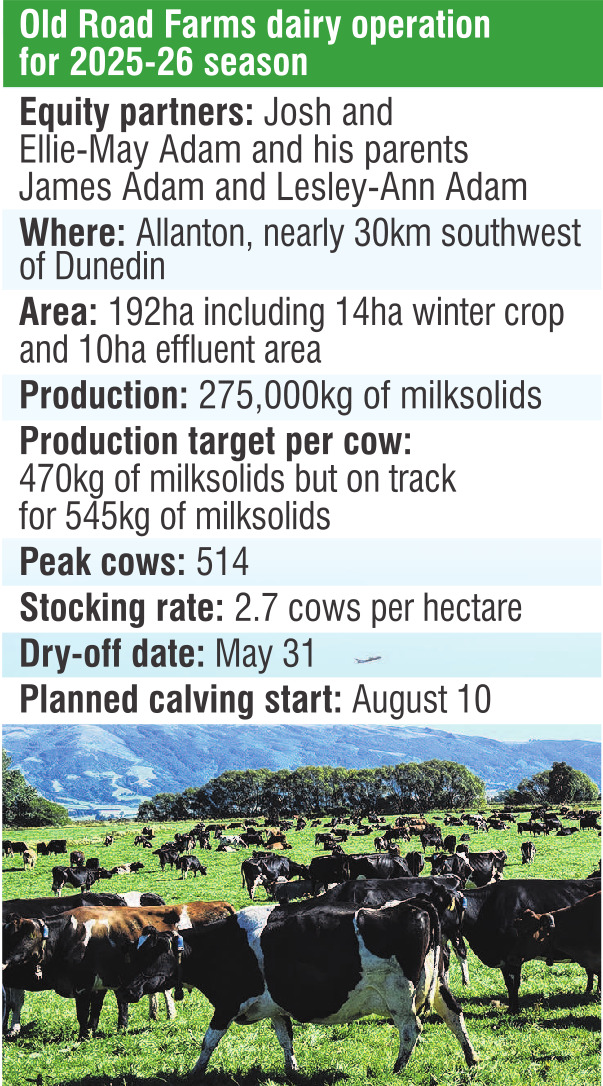
Mr Adam and his wife Ellie-May Adam and their three children, Archie, 7, Millie, 4 and Russell, 1, are running the livestock on family property Old Road Farms.
The couple have entered an equity partnership with his parents James and Lesley-Ann Adam.
"We are all in it together," Josh Adam said.
He was the fifth generation to work on the farm since 1911.
After leaving high school at 16, his work experience includes working for state-owned farming enterprise Pāmu and on an Australian cattle station.
His parents buying Black Swan Cafe in Waihola, spurred his decision to return home to run the sheep and beef arm of Old Road Farms.

The departure of a contract milker on the dairy arm of Old Road Farms, spurred his decision to milk the herd of more than 510 cows this season.
A target of 470kg of milksolids per cow was set at the start of the season.
Production was on track for 545kg of milksolids per cow this season, which would equate to nearly 13% more in the vat than the previous season, despite there being nearly 20 fewer cows.
He did not know why there was a rise in production this season on last season.
Possibly it was due to more favourable growing grass conditions this season, he said.
"The grass never slowed."
He had been feeding the milking herd baleage and fodder beet but the silage supply had not been needed, he said.
A plan was to double the flock size from 6000 hens to 12,000 hens next year.
"There is demand for eggs, so it is time to grow the business."
The boundaries of the more than 190ha dairy farm includes State Highway 1 and Taieri River.
A swollen river puts the entire dairy farm underwater at least once a year, he said.
When the farm flooded, the herd was moved to a feed pad beside the milking shed, where it could access supplementary feed.
During the flood, the cows were also given access to a grass area near the highway to have a change from concrete, he said.
A feeding system in the 40-aside herringbone milking shed serves a mix of wheat, barley, distiller’s dried grains, palm kernel and molasses.

The herd wore Allflex collars, for monitoring heats and herd health.
Josh Adam planned to replace the Allflex collars on his herd with Halter collars in June this year.
Halter collars had more features, including virtual fencing, which would make it easier to manage the herd.
"Halter has a few more bells and whistles."
As some cows in his herd were under producing and some had saggy udders, he bought 185 calves to replace some of them.
"I need to clean the herd out."
A plan for mating next season was to artificially inseminate the bottom performing 30% of the herd with beef genetics.
On Old Road Farms, 500 dairy beef calves were reared to 100kg liveweight.

An aspiration was to increase the milking herd up to 550 cows.
The calving season was longer than ideal this season.
Heifers began calving on July 15.
At mating this season, the herd was artificially inseminated across 11 weeks, which would result in a shorter calving season, set to begin in early August this year.
Holstein Friesian genetics were used during the first five weeks of mating, then two weeks of beef genetics and four weeks of short gestation genetics.
He was interested in breeding a better cow.
"I want to breed cows I want to look at," he said.
Breeding cows was a hobby and made dairy farming more interesting than just producing milk, he said.

"I’ll put in a wee bit of Jersey if they get too big."
The farm being prone to flooding was a consideration in the breeding decisions, he said.
He sought advice from Nathan Bayne, of Busbybrook Holsteins in North Otago, on the best bull semen straws to buy to chase certain traits, he said.
Josh Adam’s goal was to produce a cow with a more robust udder.
He wintered up to 300 cows at a grazier in Kurow and the rest stayed on farm on a 14ha paddock of fodder beet.
His long-term plan was to stay on the family farm and focus on producing beef, eggs and milk.
"This is me for good — I’m not going far."


