PHOTO

Otago Ballance Farm Environment Awards supreme winners Luke and Nicole Kane are continually seeking ways to improve their business.
They are the fourth generation of the Kane family to run Westholm farm near Tapanui since 1929.
The first generation, David and Nellie Kane, milked four house cows, churning cream into butter, wrapping it in paper and sending it by train to Dunedin.
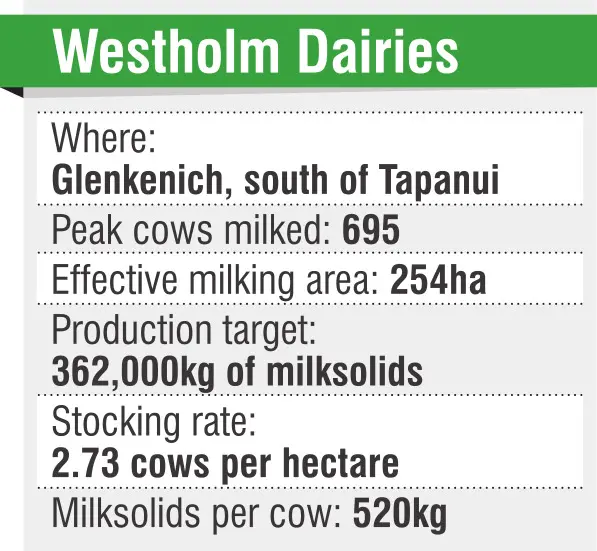
Now the Kane family milk about 700 cows on Westholm.
Luke said milk was the main source of income on the dairy and beef operation.
In 2010, the Kane family held a dispersal sale to downsize the beef stud to make way for a dairy conversion and milk 480 cows on Westholm.
The first time Luke milked a cow was on Westholm.
"It was a big, fast learning curve, with a lot of ITO training, learning from mistakes and talking to neighbours, discussion groups and rural professionals."
More land was bought and sheep sales followed, the last of the flock going in 2021, allowing for the beef and dairy operation to expand.
An aim on Westholm was to grow the business by making it more efficient, he said.
"Chasing more production for less money and continue to make this thing bigger."
The farm lies between 90m and 220m above sea level.
All of the livestock was wintered on farm on fodder beet, kale and swedes.
Heavy cattle were excluded from fodder beet.
Their herd wear CowManager technology which tracks data including body temperature, rumination and lying time, he said.
"During a cold wet day in the winter, we can prove that an animal is comfortable, lying, happy and healthy."
The data had revealed how to feed their cows better and hit their genetic potential, he said.
After leaving John McGlashan College in Dunedin, Luke got a summer job working for a local contractor raking silage.
He enjoyed the work so much, he scrapped his plans to study at Lincoln University.
The contractor gig allowed him to work in a range of heavy machinery.
"All the Tonka toys. The opportunities were endless and quite addictive."
Luke’s father Robert Kane said his son loved developing the farm.
"He builds lanes where I’d just put up with it and use my dogs. Luke just won’t stop developing. He is a pain to me and our bank manager.
"But once he has got it done I think, why didn’t I do this? It has made life so much easier."
As a general rule, Luke wanted a $5 return for every $1 invested on farm.
Stops on the open day included a wetland and a pad for calving Angus cows and heifers.
Breeding objectives include producing an Angus cow which produces a calf without any assistance.
"We haven’t pulled a calf in five or six years."
The beef herd was culled to improve traits in the herd, such as temperament.
"As it’s not our key source of income, we can be ruthless and we are."
Other traits targeted including short gestation and high growth.
A benefit of beef cattle was they could follow the dairy cattle to eat leftover pasture.
"At certain times of the year they are worth their weight in gold."
Luke’s mother Mary-Anne praised the work ethic of her son and daughter-in-law since building their dairy business from their 25% sharemilking partnership with them.
"People will say they were spoiled but this young couple worked and really, really worked."