


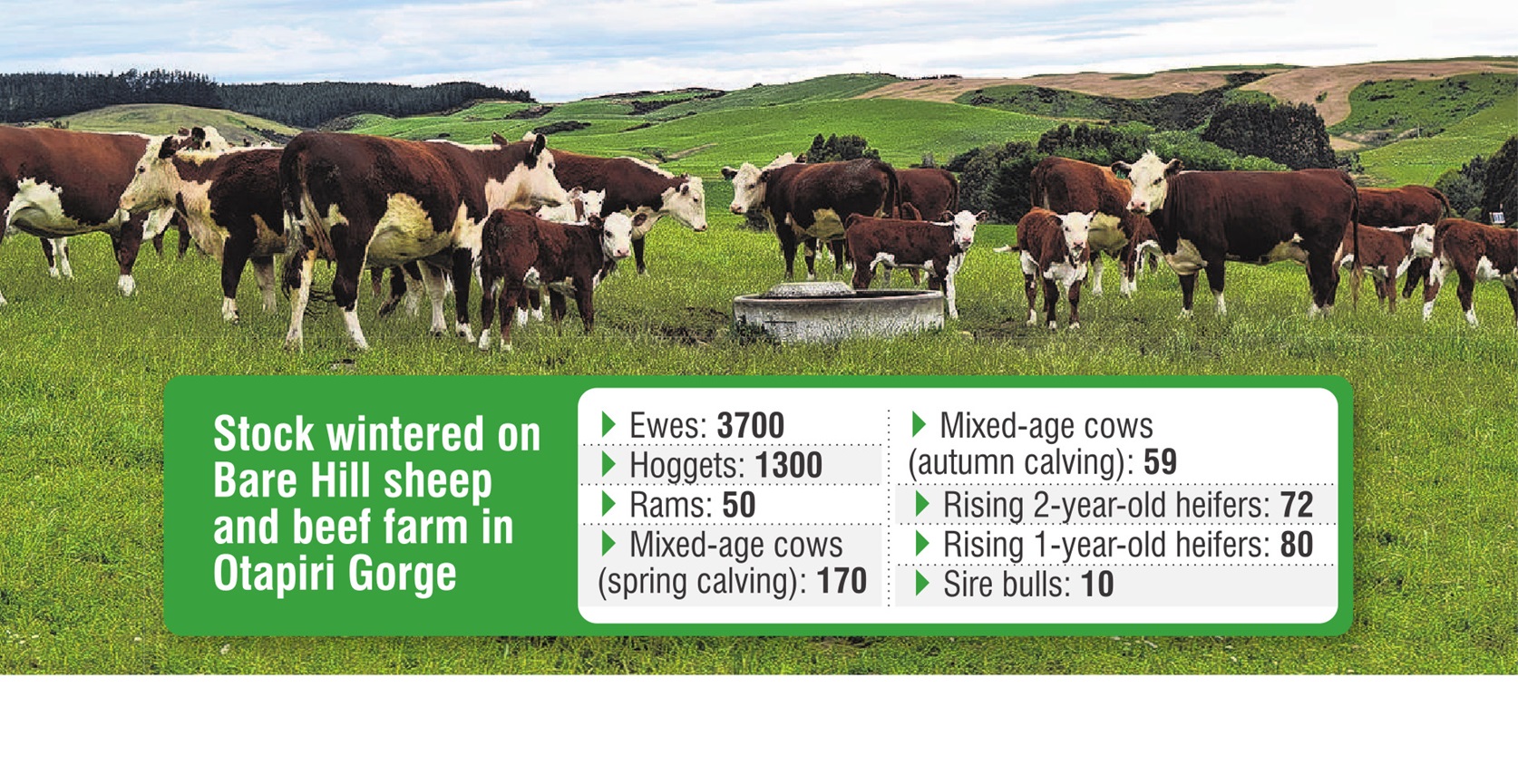
The Wadworths hosted a Beef + Lamb New Zealand Southland Farming for Profit event on their Bare Hill sheep and beef farm in Otapiri Gorge, northeast of Winton last month.
Mr Wadworth said most of the livestock was bred on farm and sold as store.
"We are concentrating on ‘breed them and feed them’."
Two different mobs of Hereford cows were calving at different times of the year which, despite not being the norm, they found worked.
The five-year average calving percentage was 80%.

The black bulls were then put over a B-mob of Hereford cows to calve from the end of January to March.
B-mob cows were selected because they had traits, such as calving late, which they wanted to keep out of their Hereford breeding herd.
The B-mob cows with calves at foot were wintered on grass baleage and weaned in August.
Bull and steer calves were sold store at weaning.
First-cross Angus heifers were retained for mating.
The B-mob cows were moved from effective areas of the farm to development blocks to make room for the Hereford breeding cows to have their calves at the end of September.

Hereford heifers were kept as replacements.
After weaning, the mixed-age breeding cows were put in development blocks.
During winter, sheep graze crop and cattle eat grass and baleage.
Halter smart collars were being put on breeding cows to improve the way they and their calves at foot could access feed.
The collars had the potential for cows to hit peak milk production and for calves to put on an average of 300 grams more liveweight a day.
Bare Hill had been run by Mr Wadworth’s family for more than a century.

The couple leased Bare Hill from Nick’s father, Bill, from 2016 and then bought the farm in 2020.
"The last five years was probably not the ideal time to take on debt and buy a farm, but we are really excited," Mrs Wadworth said.
She credited her father-in-law for his development work during his tenure and said the farm still had plenty of scope for more development.
"We are trying new things each year and make the most of what we’ve got and improve the production of the property."
Mr Wadworth said they had been transitioning their flock from Romdale to shedding breeds, including Exlana, Shire and Wiltshire, for the past five years.
They were using a range of shedding breeds to chase hybrid vigour at mating.

About half of the lambs were sold as store and the rest were finished on the farm.
The main mob of ewes on Bare Hill begin lambing in October and were weaned about 90 days later, Mr Wadworth said.
"We get things moving as quick as we can."
A drone was used to check on the flock during lambing and identify any cast ewes.
The flock remained calm when a drone approached them, which meant it was hard to muster them with the flying technology.
A drone was deployed to find where sheep were grazing in development blocks so dogs could muster them.

Mr Wadworth’s career includes working as an engineer in Dunedin and drilling crops in Canada.
Mrs Wadworth was born and raised in Taranaki.
She worked in rural banking for a decade, mostly in Otago and Southland.
The couple met when both studying at Lincoln University, she said.
"That’s where most good stories start."


