



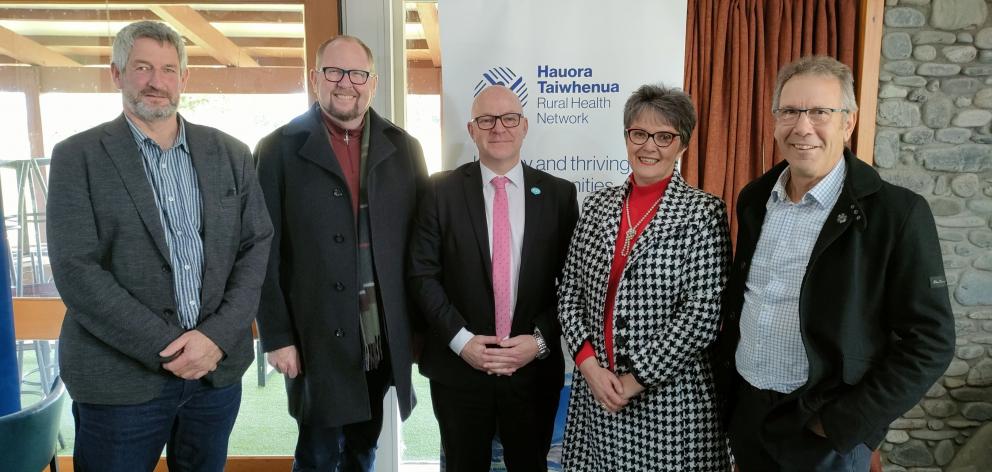
Mr Doocey, who is also a Government Minister, said in his view, the Christchurch, Selwyn and Waimakariri councils should work towards forming a unitary council to replace Environment Canterbury.
‘‘In my view a new Greater Christchurch council is inevitable and a result of evolution rather than revolution.’’
The Canterbury Mayoral Forum has been reviewing options for the future of local government in the region and discussions have taken on some urgency since the Government announced its intention to abolish regional councils in November.

It is unclear whether a Greater Christchurch unitary council would comprise the entirety of the three districts, or just the urban parts, or what it might mean for the rest of the Canterbury region.
The Christchurch City Council has previously proposed a unitary council for the city and Mayor Phil Mauger said the council was open to exploring a Greater Christchurch unitary council.
He said the boundaries of a ‘‘super city’’ had not been considered and there would need to be a discussion with other councils and communities.
‘‘Our council is considering the options and no decisions have been made yet. We will examine the options and consult with our community.’’
Mr Mauger said Canterbury needed ‘‘a more integrated and efficient system’’.
‘‘It is the right time to be having this conversation especially with the proposed rates cap, which will put more pressure on us to find efficiencies.’’
Waimakariri Mayor Dan Gordon said no decisions have been made and all options are on the table.
‘‘What we do know is that as a council, we stay very close to our communities, and we have a strong understanding of how much people value their local identity and local decision making.
‘‘Our residents identify strongly as part of this district, and that sense of connection matters.’’
Mr Gordon said the council has established a local government reform working group to consider the Government’s proposals and prepare a response.
Hurunui Mayor Marie Black, who is the Canterbury Mayoral Forum’s deputy chair, said the region’s strength was its unity.
‘‘I’m confident that as Canterbury mayors we would look at it with a Canterbury lens.
‘‘In reality there are urban issues and there are more rural issues, but that doesn’t mean we need to be divided and create a them and us scenario.’’
She said whatever structure was settled on, there needed to be a regional perspective.
‘‘River management crosses boundaries, it doesn’t separate from one district to the next, and when it comes to emergency management we work best when we all work together.
‘‘It would seem to me there’s not a great deal of wisdom in separating it out.’’
Kaikōura Mayor Craig Mackle said change is coming, but the devil will be in the detail.
‘‘A tsunami of change is coming and we haven’t got enough information to get our heads around it yet.
‘‘I’m not opposed to anything. Just show me that it works and that we are not going to be worse off.’’
Mr Mackle said regional functions could be delivered across the region through shared services between councils.
Kaikōura MP Stuart Smith said he has seen ‘‘first-hand the benefits’’ of a unitary council through the Marlborough District Council.
‘‘It has delivered efficiencies and helped keep the focus on core functions, which is something I believe is crucial.
He suggested the Kaikōura and Hurunui councils could ‘‘work well together under a similar approach’’.
■ LDR is local body journalism co-funded by RNZ and NZ On Air.


