

An unconfirmed plan that could require the loss of one in four South Dunedin homes has been met with a noisy political backlash that may not reflect public sentiment. Mary Williams hit the streets and talked to residents.
Carolyn Sime, her children and Boogie the pug dog have lived on Surrey St in a stately 1907 four-bed villa since 2016, the year after the big flood.
The Forbury street is notorious for water lapping at doorsteps during heavy rainfall and Ms Sime quickly guessed why a journalist was on hers.
‘‘You’re here about the flooding. Our house has never flooded. I guess it wouldn’t have stood for 100 years if it did. It is just a wee bit higher, I think.’’
She laughed that during one flood event ‘‘wood chips floated off the corner of my garden’’ but that had been the extent of it.

However, residents who spoke to the ODT this week were aware the future looked more watery and tough decisions were needed to keep the low-lying area’s nose above rising waves.
The council-led South Dunedin Future Programme — which has led multiple rounds of community engagement and commissioned research on risks and solutions — had communicated tough news this week.
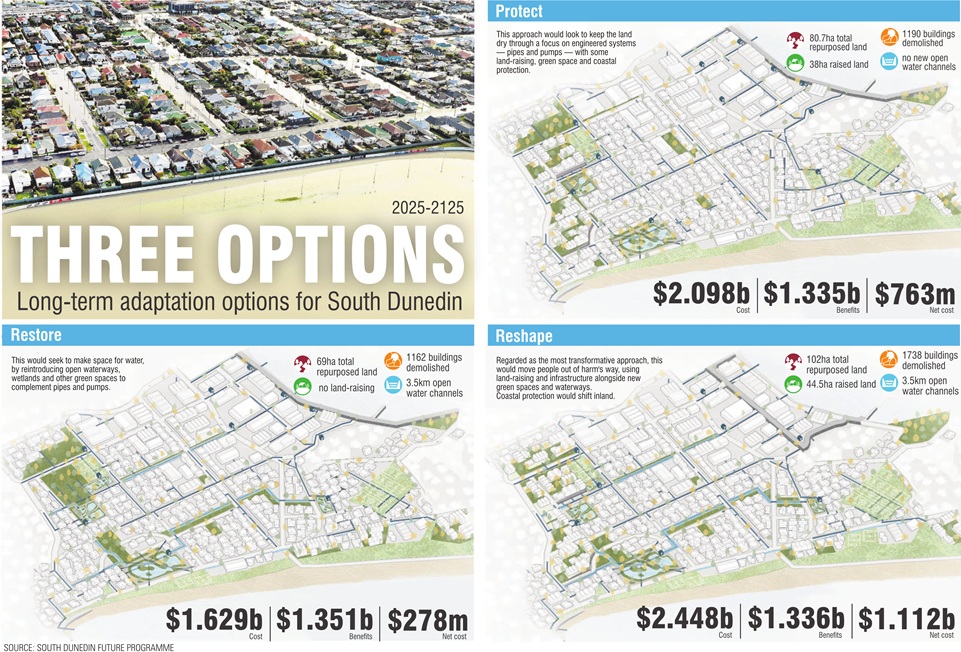
Three versions of a proposed plan — one of which needs to be agreed by the community and council to get started — all require large-scale council purchase of homes to make way for flood solutions.
There are 6500 homes in the area, and between 1100 and 1700 homes would need to be acquired, South Dunedin Future Programme manager Jonathan Rowe says.
That means more than one in six homes, possibly more than one in four, would go.
They would be replaced by a mix of solutions: raised land, green and blue spaces to soak up and store water and more pumps and pipes to remove water.
There would also be a sea wall built around the harbour.
South Dunedin is known as much for its community spirit as its social deprivation, and social leaders are always clamouring for more social housing. Some new builds, possibly of medium density, are also indicated on the plans — but it remains unclear how many people, or who, they could house.
The reasons for the plan are well known. South Dunedin sits on reclaimed wetland precariously protected by eroding dunes to the south and an only-slightly raised harbour to the north. The shallow groundwater cannot drain naturally, so more intense storms and rising sea levels are expected to cause more flooding — unless a plan is decided.
Mr Rowe said house acquisition, using powers in the Public Works Act, would happen within the first 25 years of any accepted plan, but there were uncertainties.
‘‘A lot of the acquisitions would need to occur in the shorter term to enable council to then build public works, but it depends ... If the impacts of climate change are faster or slower we may need to accelerate or decelerate.
‘‘Similarly, if resources did not allow for acquisition at a fast rate we might have to slow it down for that reason.’’
Mr Rowe stressed that cracking on with sustaining South Dunedin — at a cost of up to $2.4bn over 100 years with significant disruption and change — was better value for local and central government investment than leaving things to possibly go horribly wrong, with houses uninsurable and uninhabitable.
There were plenty of uncertainties, however, and a danger that climate change happens faster than expected, funds are released too slowly to combat impacts and there are potentially worsening climate change impacts beyond 2125.
Council also had to consider funding alongside ‘‘the city’s other issues’’, Mr Rowe said.
An obvious question was raised earlier this week: ‘‘Can the council name streets where houses will be bought?’’
Mr Rowe said he couldn’t; the mapped plans in the presentation behind him had purple splodges earmarking areas for property acquisitions, but they were ‘‘indicative’’.
However, anyone with a knowledge of South Dunedin’s streets could see purple shading over parts of Forbury to the west of the Hillside workshops, including Surrey St and other streets running towards, but not including, the St Clair esplanade.
To the east, the area around Marlow St, known to have particularly shallow groundwater due to its underground geology, was also purple. The presentation indicated the area could be replaced with extensive recreation grounds.
There were additional, smaller areas of purple in parts of central South Dunedin, although they were a little harder to pinpoint and varied between iterations of the plan.
Back in Surrey St, Ms Sime, an ICU nurse, had not heard about the plans to lose houses. She was quick to ask if her house was ‘‘on the chopping block’’.
‘‘I want to get out here anyway, so whatever. As long as they give me what I paid, and I can move on, that is OK ... It might make me question painting my house though.’’
She had been saving to pay for scaffolding to do the bits at the top.
When asked where she would go, she indicated she would not be keen on somewhere else in South Dunedin. She wanted a home with cheaper energy bills ‘‘somewhere on a hill that wouldn’t flood.’’
She had empathy for people in tougher circumstances who might be ‘‘quite distraught’’.
‘‘I feel bad for the people who have bought the the new developments that have popped up all over South D. It’s not good.’’
She was referring to South Dunedin’s tall, small and often white townhouses that locals call ‘‘mushrooms’’.
Some of them are in areas indicated for house acquisition, and Ms Sime queried why they had been allowed — and indicated migratory drift was already happening away from the area.
Neighbours renting an older house had moved and the owner was doing the place up ‘‘so I don’t know how the news will affect her. Maybe she will sell it.’’
She didn’t think the council had done a good job of consulting her, but felt she might be ‘‘pushing up daisies’’ by the time it was sorted.
Mr Rowe explained the townhouses had shot up because the current district plan allowed them.
City council staff were aware planning rules in South Dunedin were not fit for purpose, and were considering options to restrict land use, but there had also been a ‘‘big drop off’’ of new builds in the past year or two.

Standing next to a small square of artificial grass, he said it was ‘‘quite silly’’ that such builds were happening in such a vulnerable area at a time of climate change.
‘‘We struggle to see the reality of a situation unless it is impacting us. Most people aren’t able to see the long-term negative effects [of climate change] because it is not impacting daily life.
‘‘Half the population is also thinking, how am I going to make it through the next week? That’s the issue with climate. Even myself I’m guilty of it. In an ideal world, we would all be activists.’’

She reckoned South Dunedin’s property values could go up, not down, in the long term if the council cracked on with a transformational plan.
‘‘It could become more wealthy ... I am thinking way, way in the future. If they spend all this money, and put all these lovely areas in, it could be great.’’
She bought her house, complete with swimming pool, just three years ago.
‘‘I had a new house, in cul-de-sac in Mosgiel, but realised I wanted to get back to town. I love it here. Everyone keeps an eye on everyone. If my blinds aren’t up or down by certain times then a lady over the way is texting me.’’
If the council came and asked her to sell she would ask ‘‘How much?’’ and hope to move to a good area, but echoed Ms Sime’s point that some people might not be able to afford that.
‘‘It could be quite gutting ... it could be a terrible worry.’’
In the meantime, she was trying to move to somewhere smaller — and still considering St Clair — but also queried why townhouses had shot up when ‘‘the future is coming’’.

When told that more than 1000 homes could go, his one-word response was ‘‘Wow’’.
He had ‘‘sort of’’ known about the flooding issues when moving in, but ‘‘you just go with it anyway. We bought the house for the garage and it didn’t really bother us too much. ’’
‘‘What I question is, why are new homes going up? What do they [the developers] know that we don’t know?’’
The family loved the proximity to schools, the beach and the sound of waves, but didn’t plan to be there forever.
‘‘At the end of the day, it is what it is. As long as they give me good money for my house and garage that is the main thing, but I don’t know where they will get the money from. That’s the next question.
‘‘It will take years. But, I guess, if they are doing stuff now, to make it happen, it is good.’’
Some plots may be easier for the council to buy than others: the house next door had been empty for 20 years, he said.
Mr Rowe said the level of compensation for acquisitions was ‘‘not a level of detail worked out yet’’ and would evolve through an acquisition strategy.

‘‘There is a little group of us.’’
She had sand bags for when it flooded, but if the council asked her to sell her house she said it would be ‘‘up to her daughter’’ to help her decide what to do.
Her daughter lived up a hill, ‘‘safe as anything’’, and, if it came to it, a move out of South Dunedin ‘‘wouldn’t worry me’’.


