

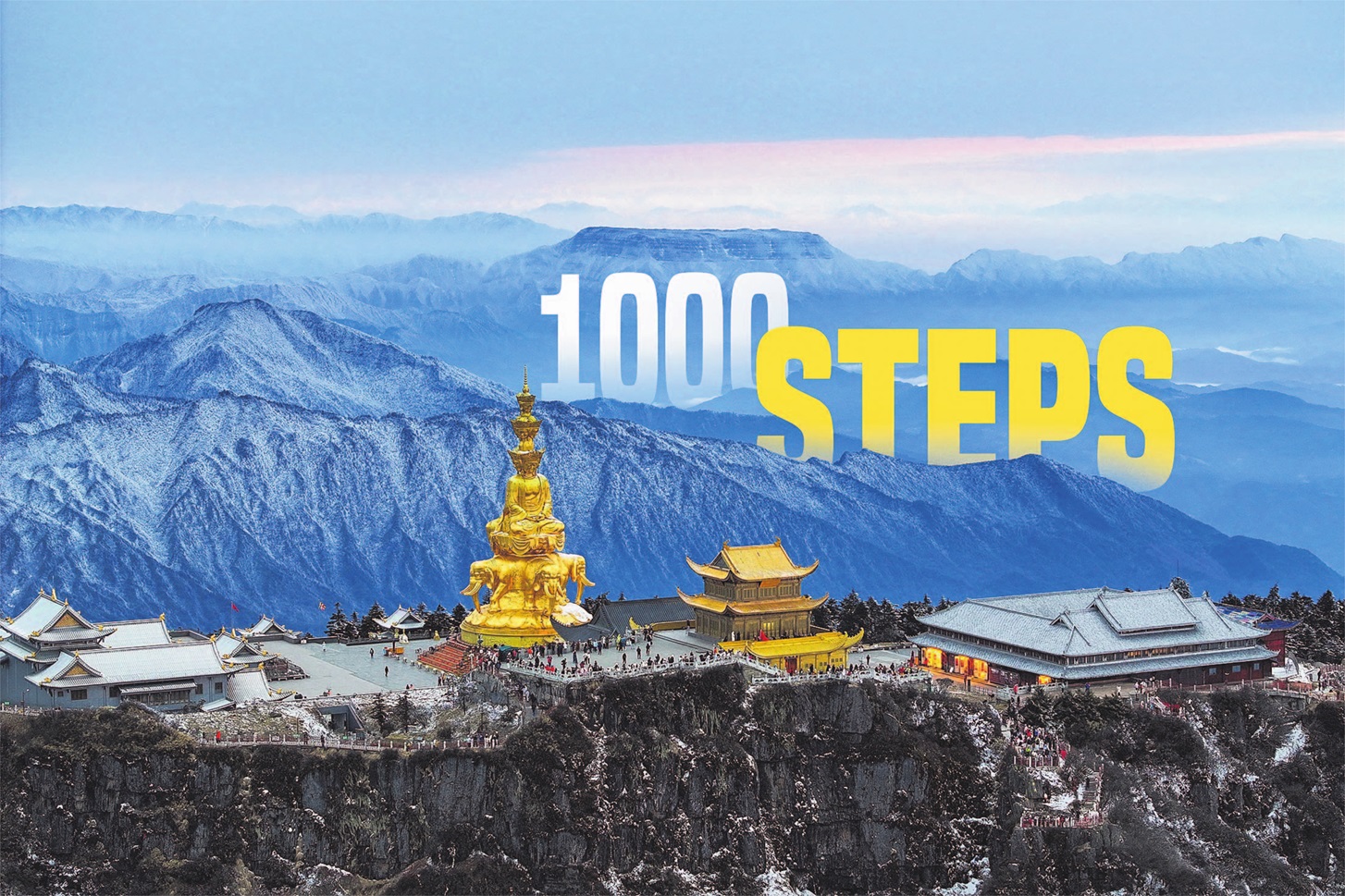
I ask J., the young professor, how far it is. I am dizzy, almost falling over, only the walking pole keeps me upright. We are at nearly 3000m on Mt Emei. He goes away with D. and comes back to say, "Just another 200". Two hundred! That means there are about a thousand all up. Steps. Back home there are 200 up to our place, a big effort. At sea level. I pant a bit. "OK. You and D. go ahead." I shake my head to throw off the dizziness. Two men stomp past carrying someone in a litter. It costs 300 yuan for that. My body says, "Oh, yes" at the sight but my bloody-mindedness says, "Don’t be so pathetic".
Buddha says he has been waiting for you for thousands of years and he remains in no hurry. Waiting up there somewhere. The big golden one. Close to the sky.
All the Guiyang institutions are on a hill, shining or not, grandly forbearing of the people on streams of scooters and DiDis below. The Guizhou Museum stands on a hill. Steps, more steps, some broken but J. says all this area of the city is new. Not long ago there were open fields here. When he arrived five years ago to take up a research job, there was one Metro line. Now there are four. And endless kilometres of viaducts and tunnels for high-speed trains. Progress "putting the interests of the people first and considering the people at all times".
Next to the museum is the financial quarter. The towers are higher, glassier, glinting blueness. Between them stands a replica of the Wall Street bull. J. finds this amusing. I wonder which part this plays in "socialism with Chinese characteristics". The leader’s thoughts are clear: "We should be inclusive of the colourful world, learn from others with an open mind, digest and absorb others’ good things from an independent standpoint, and turn them into our own good things, but we must never swallow them whole or imitate others blindly". The newest law from Beijing states that every child must learn Mandarin. In the interests of the people. A sign nearby declares, To Shine Not Be Illuminated.
Guizhou history is pillared with bronzes, great pots, reconstructed shrines, stone friezes of warriors, a dragon waka longer than any at home. One museum section is titled, Ancestor of Sauce, Legion of Countless Troops. Could they mean those local red hot peppers? But where are Kublai Khan’s Mongols? Absorbed, no doubt, in the cause of Maintaining Ethnic Harmony and National Unity. Everyone must learn Mandarin.
More Love More Spring.
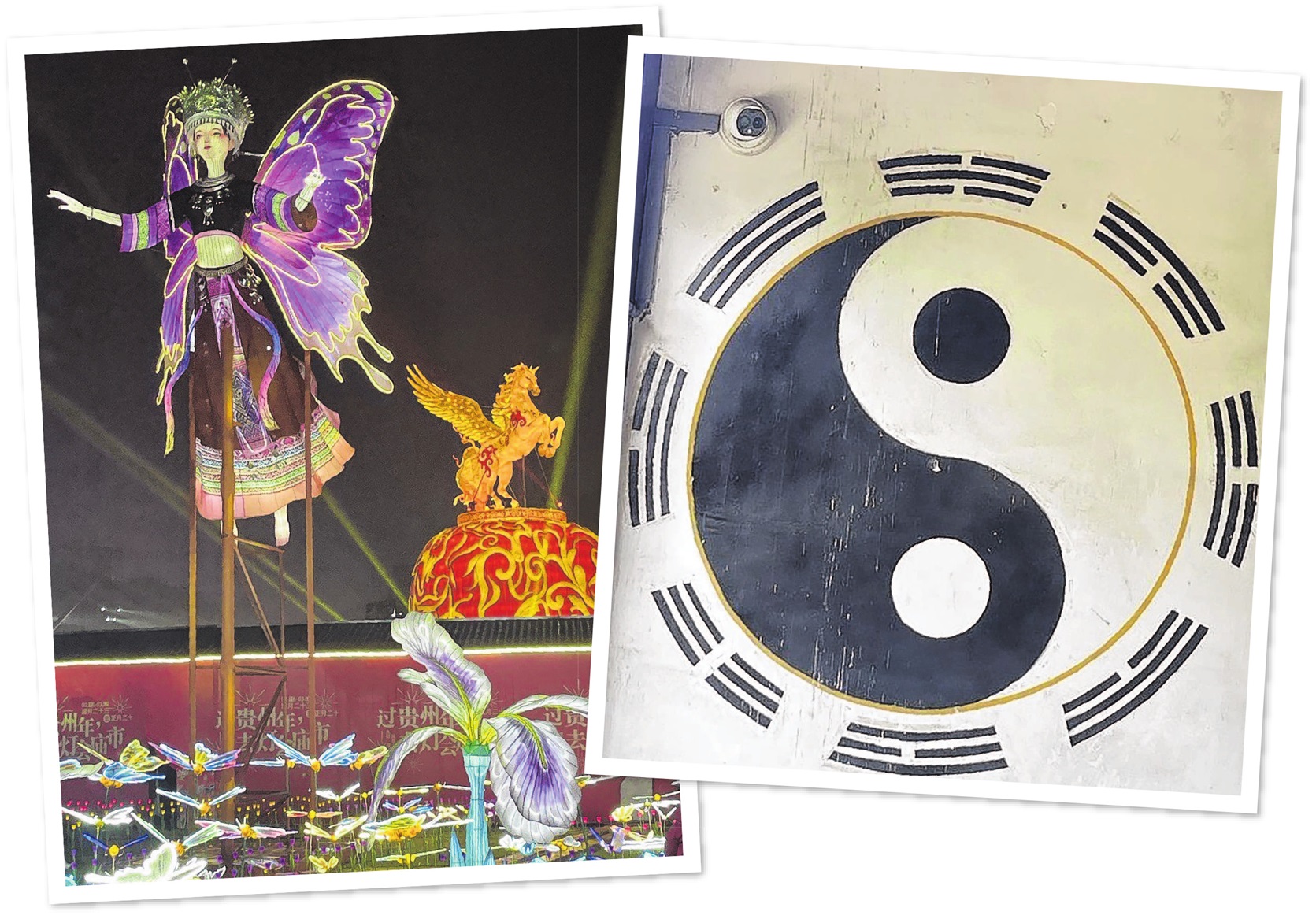
The rain falls finely green and yellow through lights probing the sky. The spirit of spring floats in the night, she drops plastic petals over us. Warriors spew fire and swing hot-coal braziers around their heads. What if a chain breaks? Spring is a colossal new-year lantern park of horses and dragons, temples, flowers. Where does all this go in the summer?
Everything is captured for the public record. Now and then I look up and see the optic eyes in clusters on the poles or eaves. The two eyes of a yin-yang emblem by a Taoist temple are augmented by a third, wired to a post. As we scud along in our DiDi, the lights flash, not red, amber or green, just laser white, distracting, reminding me that somewhere I am on candid camera. How many of the knowing eyes are there, a million in this city? How much power is needed for them and their data centres and the rooms of screens, the air conditioning for the slightly sweating watchers?
I touch my pocket to assure myself that my passport is secure. I have never used it so much. To catch a train, to check-in at a hotel, to enter a public building. To enter the panda park. More than 20 years before, above the archway to an arts centre in Berlin, I saw the words, I am aware of who you are & what you do, a chilling text of Kafkaesque existentialism. Here it has been made live.
Empathy is the essential spirit of the Buddha.
Where shall we eat? We stand on the pavement in Chengdu and try to decipher the signs. I feel lost inside a Chinese movie without subtitles. A well-dressed woman overhears us. She speaks English and asks where we are from. Then she takes us across the street and into a small eating place. She asks us what we would like and discusses this with two old women in their kitchen. She tells us everything is sorted and we are very grateful. We all smile and, as she leaves, she tells us she has also paid.
Close to Civilisation, Close to Convenience.
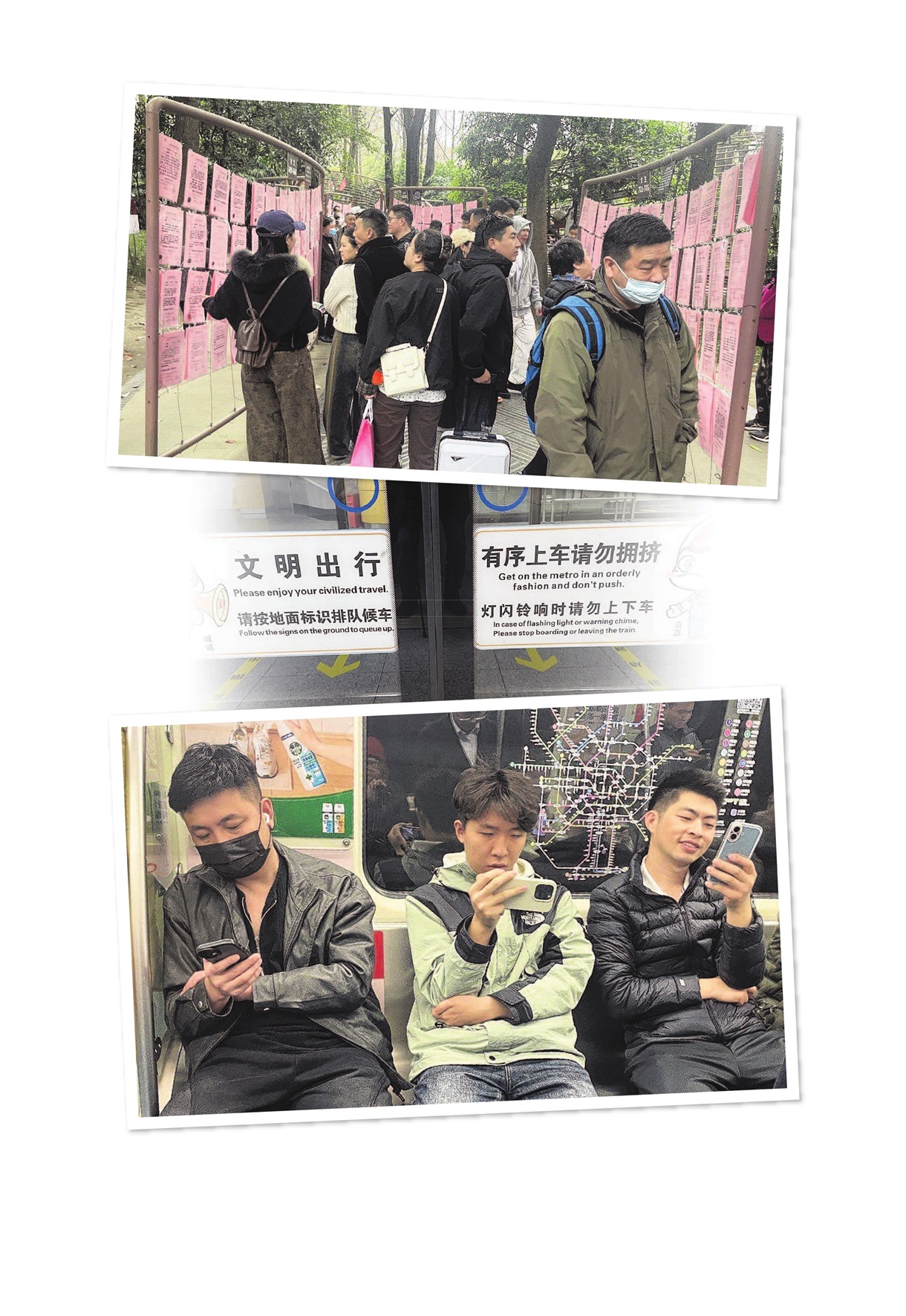
Shall we take our poles? Better to be safe, there is sure to be a step somewhere. Ah, yes, there are a hundred steps down to the Chengdu Metro. I am too old for this. We cannot afford to fall. Has a fall not marked the beginning of the end for, it seems, everyone we once knew? At the Metro security barrier D. must put her bag through the X-ray machine. After the sensor arch, a young woman in uniform waves her wand at me and then stops. I am clearly too old for this.
As the Metro train pulls in, the sign on the safety door reads, Please enjoy your civilised travel. The carriage is crowded. Everyone stares at their phones. Everything in this world is digitised, even thinking. In a courtesy seat a young woman stares at her phone. But she knows. I gently tap the top of it and she stands up, still staring at it, and D. can sit down. There are no words, no bolshie looks. The cameras are watching. But another woman is embarrassed. She gets up and insists I sit down, too. We are both too old for this.
We are the only white faces on the Metro, at the station, even in the streets. Children wonder and sometimes take fright. One bursts into tears.
I feel a rising need for wing mirrors. They come from anywhere, everywhere, single riders, dual, sometimes with a child in between. Small, large, with canopies against the rain, duvet leg and hand-guards against the cold. Riders with helmets and visors, masks, or nothing at all, hair sculpted by the slipstream. No sign of apology or regret as they motor off the road and on to the footpaths, demanding passage through clusters of pedestrians. We are the riders! We are the citizens with priority! Silent electrics slide out of the darkness behind me. "Look out!" D. cries. But do I move left, right or just stop? Look out! Where can I buy wing mirrors, where?
Carrying forward Civilisation and Enjoying Comfort.
The People’s Park is space for residents cooped among the serried ranks of high-rise apartments, offices, factory floors. There is a monument to the fighters against the Japanese invaders. Bronze hands shine from rubs of remembering. I note there are few Japanese cars on the roads, many brands of Chinese, half EVs. Teslas and Beamers for the rich.
The forecast was for 18 and dry but when we arrive it is eight and raining. Our kind DiDi driver insists I take her umbrella. It has taken nearly an hour from the city centre. She will wait until we have finished viewing the pandas.
They are dirty from the mud in their enclosures, black and brown, not white, and crapping regularly, 40 times a day because the bamboo they chew relentlessly provides little protein. That means a lot of bamboo. They seem a bit stupid, cute sloths who take time to work things out. Maybe because they are myopic. But the influencers are there with their special cameras. What a tourist industry they support! Two and a-half hours later we emerge and our DiDi driver takes us back. All up, the equivalent of $50. Was that a good day for her? She seems delighted. Buddha says — Give out love and good wishes and you will receive the same.
Please do your best to create a harmonious environment.
At the bottom of the mountain, the maze of empty cattle races to the shuttle bus stop takes us minutes to zigzag through. But they regulate the thousands of visitors that fill them at peak summer times. The locals are not good queuers. Everywhere, at railway and Metro stations, everyone seems desperate to get there first. He who hesitates is lost. I have the feeling that if I fell over, they would just step over me. Another sign states, Do good manners in public places.
Mount Emei is sacred to Buddhists, 3099m high, over 10,000 feet. The shuttle bus takes us around hairpin bends up to 2400m. From there we begin climbing the steps. A thousand, even if we use the rope cable car for a while. The summit is 4km away. There is nothing to see. Heavy cloud hangs over the forest, mixed with the purple-brown tinge of something nasty rising up from the industrial plains.
At intervals there are food stalls offering everything from spicy sausages to hotpot to fried rice. There is a sign for KFC. But not the McDonald’s or Starbucks or Walmarts that litter the cities. The road to Nirvana is paved with signs of profit. Should the leader come clean and revise the objective to "capitalism with Chinese characteristics"? The macaque monkeys are tuned in. They grab offered food, are skilled at opening packets and throwing away the plastic. The mountainside is a dump.
Why are all these people passing me? Men point at their litters, haranguing me to use their services. I am clearly too old for this. The idea feels medieval but fits with the purpose of the journey. At the summit is the 48m-high golden statue of Samantabhadra Bodhisattva. Nearby is the first Buddhist monastery in China, 2000 years old.
Up the last steps my legs begin to lose power. Why am I doing this on my 87th birthday? Am I on a pilgrimage, drawn on by the injunction Happiness is not a treasure to be found but the journey itself? There, a golden spire above the cloud mass, the great gold-sheathed Buddha atop his elephants shines against the sky, and is caressed by slow-drifting wisps of mist. Like the great cathedrals of Europe, it declares the power of belief. Below, beneath the clouds, everyone must learn Mandarin. Here, only gold glints against the blue sky, and heaven. Wisdom comes from the heart not the mouth.
Dunedin author Philip Temple travelled independently to Guizhou and Sichuan in March with his wife Diane Brown to visit a young relative. All the quotes are from signs he encountered on the way.


