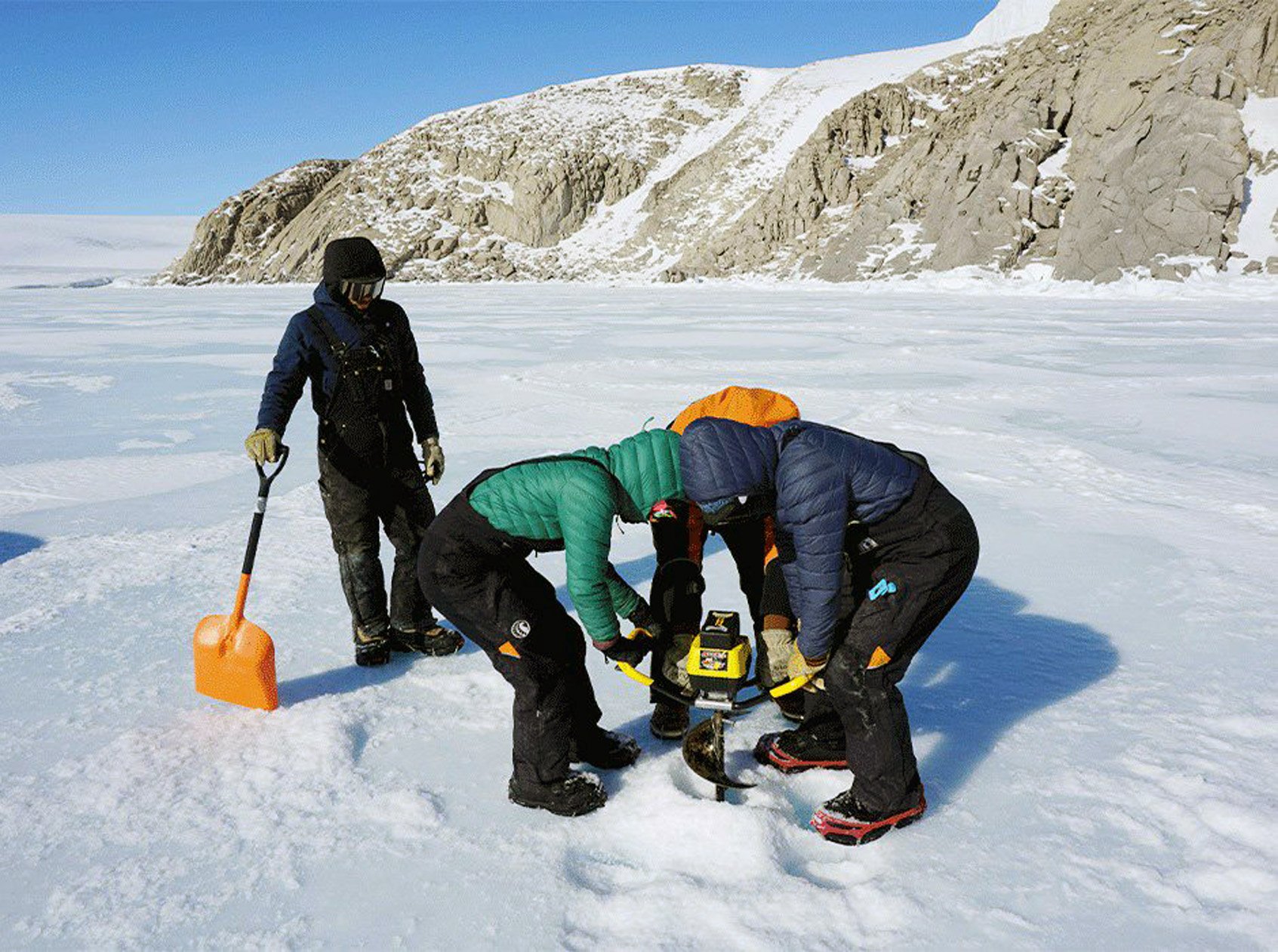
Physicist Associate Prof Inga Smith and marine scientist Dr Sarah Seabrook will receive up to $5 million from the government’s Catalyst Fund over the next five years to conduct climate and ecosystem change research in Antarctica.
Assoc Prof Smith will use novel buoys, remote sensing technologies and modelling to uncover why the Ross Sea ice is shrinking and what it means for ecosystems and management of the Marine Protected Area.
"Through this project, we will work closely with our USA-based colleagues, using innovative and cutting-edge technologies and modelling.
"Our research will link us to the wider international research effort, ‘Antarctica InSync’."

Meanwhile, Dr Seabrook’s research will delve below the surface.
She will provide the first integrated mapping and analysis of Antarctic groundwater flows, to understand how subsurface water moves carbon, nutrients and microbes between land, ice and ocean, improving environmental management in the Ross Sea region.
"In this research, we are working with a system that we know is changing rapidly, but the mechanics of this change remain poorly understood.
"To overcome these knowledge gaps, enabling us to determine regional and global implications and predict impacts of future climate scenarios, we need international, multidisciplinary collaboration and co-ordination — exactly what this Catalyst research programme provides.

Science, Innovation and Technology Minister Shane Reti said a third research project, run by the University of Waikato, had also been given Catalyst funding.
It aimed to create New Zealand’s first combined UAV, helicopter and satellite monitoring system, to track changes in Antarctic moss and microbial communities, with tools that also benefit ecological and agricultural monitoring at home.
Dr Reti said the recent funding was a "significant step in our Antarctic science co-operation" and would also help to unlock science-driven innovation and growth in New Zealand.
"Our researchers will work alongside leading US scientists, supported by the [US] National Science Foundation’s Office of Polar Programs, tackling some of the most urgent environmental questions facing the planet.
"It’s building on the important relationship between New Zealand and the United States, with over 60 years of logistics co-operation between our two nations," he said.