An end to the Middle East conflict, financial discipline and a return to solid economic growth are being relied on to deliver a quicker return to budget surpluses.
The budget forecasts a return to a budget surplus in 2028/29, a year ahead of the December update, from a mix of an increased tax take, controls on government spending, capital projects, and a reduction in borrowing and debt service costs.
Finance Minister Nicola Willis said the budget was a further step in repairing government finances.
"New Zealand is digging its way out of the post-Covid hole.
"What sets this government apart is that it is doing so within a funding envelope that is affordable and responsible, while continuing the fiscal repair needed to put New Zealand on a stronger footing."
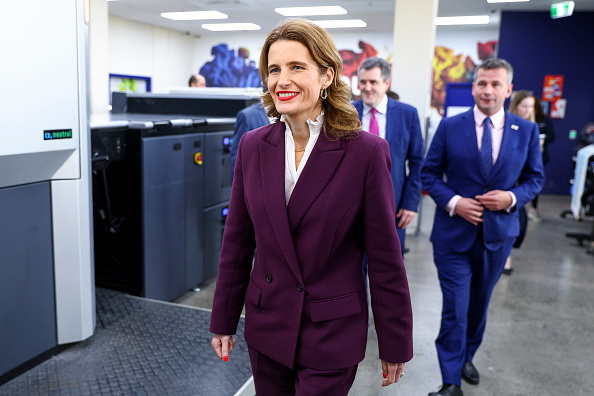 Finance Minister Nicola Willis arrives at today's Budget announcement. Photo: Getty Images
Surplus on the horizon
Finance Minister Nicola Willis arrives at today's Budget announcement. Photo: Getty Images
Surplus on the horizon
Treasury forecasts were based on a base scenario assuming a weaker term outlook because of the Middle East conflict which will hit growth, cause a surge in inflation, and a little changed deficit (Obegalx) for 2026/27 financial year of $11.4 billion.
"Treasury's central forecast assumes the impact of the fuel crisis will be temporary based on market pricing. While global uncertainty remains, even Treasury's downside scenario shows Obegalx returning to surplus in 2028/29," Willis said.
However, it expected the fall in fuel prices would spark business investment, household spending, leading to an increased tax take, while the government kept control on spending.
The improved financial situation results in the deficit being more than halved in 2027/28 and then a surplus of $2.6b in 2028/29.
The operational allowance - the day to day spending on government services - was reduced to $2.1b in the current year and would be held at $2.4b in subsequent years.
Spending on capital projects such as hospital improvements, schools, Kiwirail, roads and defence equipment was put at $5.7b, and Willis said many of the projects were job rich.
She said more than 220,000 jobs were expected to be created over the four-year forecast period.
Willis said the return to surplus would allow a cut in government borrowing and return debt servicing costs, with net debt forecast to peak at 46.1% of the value of the economy in 2028 before falling.
Contrary to finance market expectations of an increase of up to $10b over the next four years, the amount to be borrowed was forecast to fall by $6b between 2028-30.
"It shows what is possible when you show discipline," Willis said.
She said the sale of the Crown's holding of debt in telecommunications company Chorus would also free up hundreds of millions of dollars for spending and projects, while banks were to be levied to pay the costs of regulator supervision.
Economic outlook
Treasury economic forecasts were pulled back in the near term because of uncertainty about the global outlook and the outcome of the US-Iran war.
Growth was forecast to be slower for the rest of this year before picking up and averaging 2.7% annually for the next three years.
Unemployment is forecast to reach 5.5% in the current year before gradually falling to 4.4% in the next two years, while wage growth was expected to be around 2%.
Inflation is forecast to touch 4% this year, but then plunge to 1.6% the year after, and then steadying around the Reserve Bank's 2% target point.
This story was first published on rnz.co.nz |  |