A file note on the investigation — by regional freshwater watchdog Environment Southland (ES) — reveals the investigation had a restricted remit, was brief and closed quietly last September with no findings or announcement.
The note, titled ‘‘Knapdale Aquifer Nitrate Levels’’, concludes the investigation was ‘‘unable to find any evidence of a discrete source that may have caused the high concentrations of nitrate in the area of the Coopers Wells field’’.
University of Canterbury environmental health researcher Associate Prof Tim Chambers described the ES note as ‘‘rather vague and conclusions underwhelming’’.
Freshwater academics and Greenpeace have said dairy intensification was causing the nitrate increases across Southland and a recent ES science report indicated intensified dairy farming including winter grazing of dairy cows was a likely primary cause of Gore’s nitrate woes.
Greenpeace freshwater campaigner Will Appelbe said it was ‘‘clear from the get-go’’ that intensive dairying was the cause of ‘‘dangerously-high’’ nitrate levels, but ‘‘Environment Southland’s shoddy investigation has let polluters off the hook’’.
‘‘The people of Gore have been led to believe no specific cause was found, but there was a cause.’’
Last July, Gore Mayor Ben Bell announced ES would be ‘‘leading an investigation’’ into the nitrate crisis, which had temporarily shut down the town’s water supply.
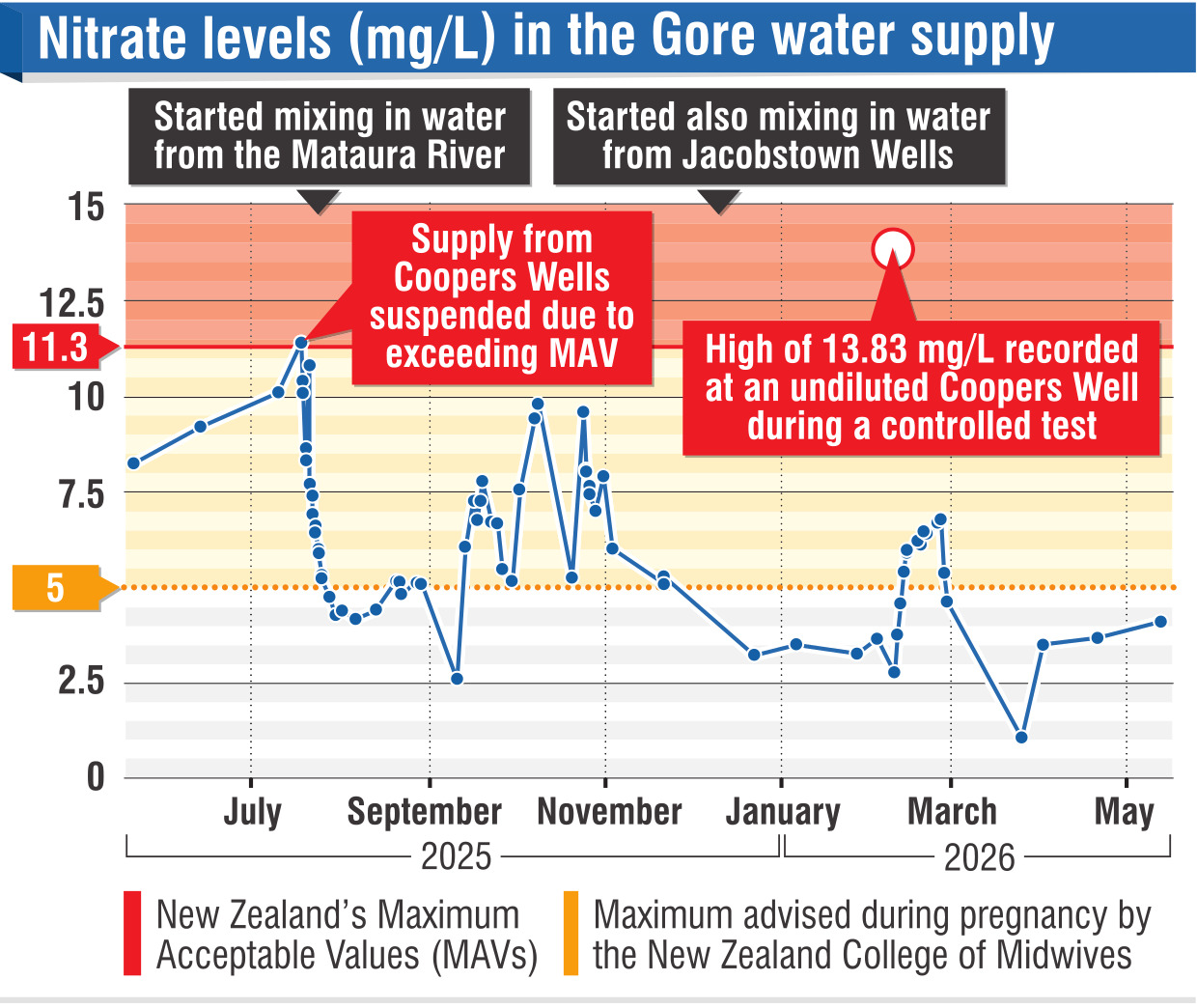
Water obtained from the Coopers Wells — between the Mataura River and Knapdale Rd — had spiked above the maximum 11.3mg/L and the town’s drinking water supply had to be diluted by adding water from the Mataura River and other wells.
Gore District Council tests in February still recorded high nitrate levels, including above the maximum, in the Coopers Wells and the town’s supply continues to be diluted from the other sources.
In November, ES said its investigation was ‘‘complete’’ and ‘‘hasn’t identified a specific cause’’.
‘‘It is likely to be the result of intensive land use in the area.’’
The council later added that nitrate comes from a ‘‘range of sources’’ making ‘‘any investigation ... extremely complicated’’.
No details have been provided of any further steps.
The file note on the investigation, dated September 29, was authored by ES resource management technical lead Graeme McKenzie.
About six months later, it had been handed to Gore councillor Mel Cupit after she asked, in a March council meeting attended by ES staff, to be sent any report resulting from the investigation.
The file note explained the investigation was restricted to determining ‘‘whether the possible source of the elevated concentrations of [nitrate in the Coopers Wells] was connected to a discrete incident/source’’.
The investigation checked the Coopers Wells, finding they had ‘‘appropriate’’ protection.
Smaller domestic wells had ‘‘limited’’ protection, but were ‘‘unlikely’’ causes of the high nitrate.
There was a ‘‘very basic’’ map search for ‘‘silage pads, feed pads, land use changes’’.
The consent holders had ES consents to discharge dairy shed effluent to land.
The investigation concluded it was ‘‘unable to find any evidence of a discrete source’’ for the high nitrate in the Coopers Wells and ES ‘‘believes that the most likely cause ... is associated with intensive land use’’.
There was no mention of any wider investigation into land-use intensification in the Knapdale area and ES declined to say whether this had, or now would, happen.
University of Otago freshwater ecologist Prof Ross Thompson said the ‘‘reality’’ was that agricultural intensification in Southland meant dairy.
Victoria University of Wellington freshwater ecologist Mike Joy said it was a ‘‘dodge’’ to only look at consent holder compliance.
Dairy farmers could be ‘‘100% complying with their consent conditions and still massively polluting the groundwater’’, he said.
Industry body Dairy NZ’s chief science officer Dr David Burger said his organisation recognised land-use change and intensification had contributed to increased nitrogen pressure in parts of Southland.
‘‘For areas such as Gore’s Coopers Wells, DairyNZ supports evidence-based action to protect drinking water, including clear identification of well-capture zones and targeted management of high-risk activities within them.’’
An ES spokesperson said the council was ‘‘planning to share information with our communities about our activities and investigations in Gore soon’’.
An upcoming release would ‘‘provide comprehensive details’’.
Gore council general manager for critical services Jason Domigan said as far as he was aware, ES had not handed over its investigation file note to Gore council last September.
He had received a ‘‘verbal confirmation that ES was unable to identify a causation’’ for the Coopers Wells nitrate levels.
His council was ‘‘unaware of what their [ES’s] next steps are to manage nitrogen in groundwater across Southland.’’