

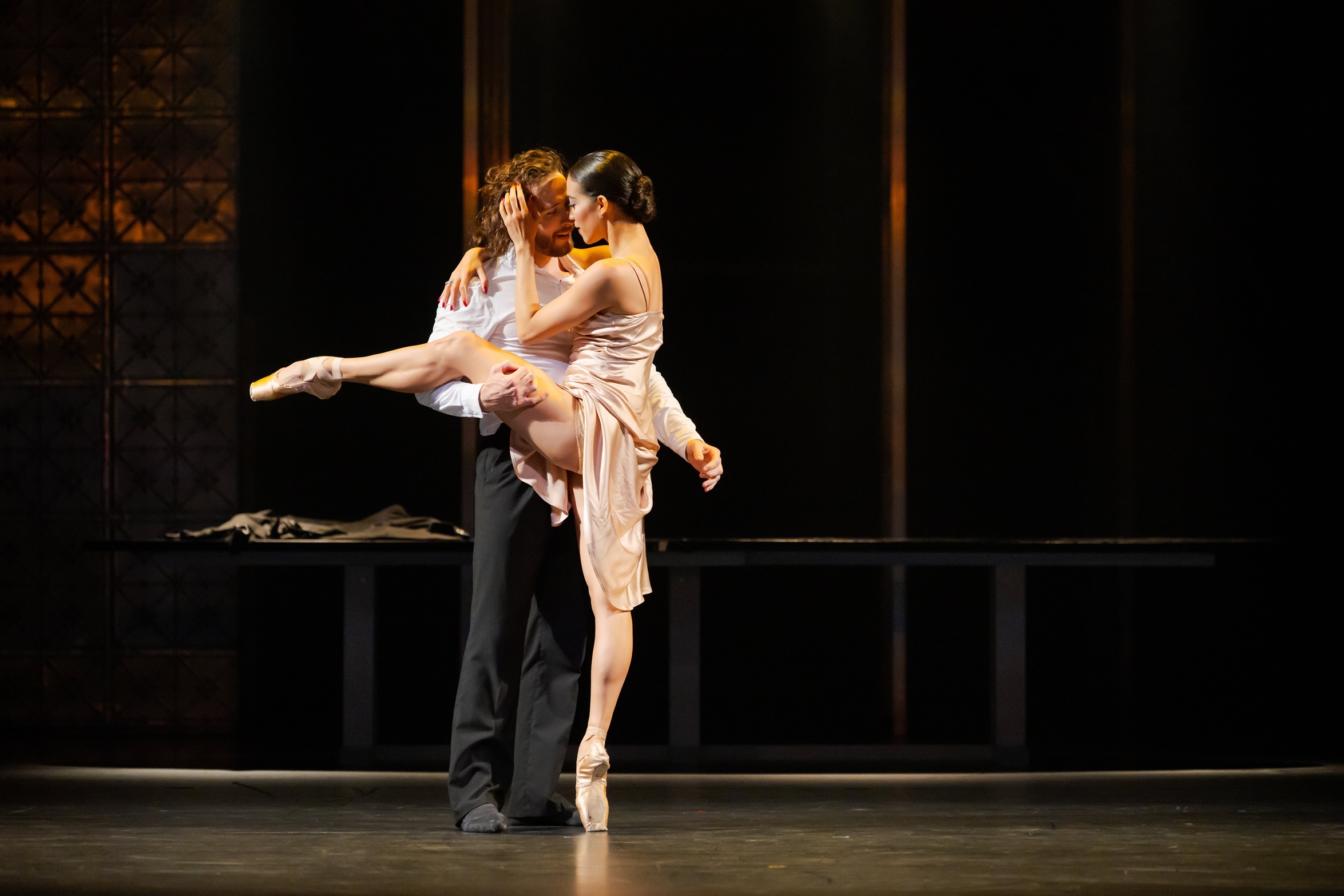
He may be losing his mind, but Branden Reiners is having the time of his life.
Performing the lead role in the Royal New Zealand Ballet’s (RNZB) new production by choreographer Alice Topp, Macbeth, Reiners is called on to portray an ambitious character who loves his wife and is willing to do anything for her in the contemporary retelling of the Shakespeare classic.
Reiners, who is from New Jersey in the United States, has thrown everything into the role, which he describes as an absolute privilege. He worked for hours in front of a mirror to learn to make himself cry in an effort to show just how devastated Macbeth is when his wife, Lady Macbeth, played by Ana Gallardo Lobaina, dies.
"I just wanted to show just how heartbroken he was before he really loses his mind."
Showing those emotions in front of fellow dancers and the artistic staff in rehearsals was difficult, he admits.
"Because it’s almost like you’re kind of embarrassed at first or a little bit insecure. I would say that was the toughest part of this. But once I achieved it, it felt really freeing and it was really well received."
The other challenge was to keep those emotions at the surface while performing complicated dance moves like pas de deux and lifts — something he says dancers are not trained for.
"They’re not classical so everything’s new. So, the hardest part was executing these lifts and all the pas de deux while also finding moments where you’re still showing a lot of emotion and you’re staring into the eyes of your partner and you’re acting, you’re still in character."
Achieving that goal paid off, though, with a standing ovation on opening night.
"I remember on opening night, I just felt this ... I really felt like very enthralled with the character and just very ‘in the story’. More like I was a part of it rather than performing. And I just kind of felt like, this high, and the audiences absolutely loved it. It was an immediate standing ovation, which was really spectacular to witness."
However, just one year ago Reiners could not have imagined being in such a place. Back then he was in constant pain from a neck disc injury sustained while performing in another Topp ballet.
"I lost some motor function in my right arm because the nerves were so compressed. Nerve pain is relentless. I was really frustrated all the time and kind of dealing with some depression just because I wanted to be better. And if I had known that a year from then I would have completed the hardest and most rewarding ballet that I’ve done so far, I would have been on top of the world."
Rehabilitation and cortisone injections have helped Reiners get back to peak condition, something he needed for this ballet which requires him to be on stage for nearly the entire first half.
On the positive side, he says, as a contemporary ballet, unlike classical, he is able to lean into the tiredness and the physical demands.
"There are three different duets that you have to execute. And you’re exhausted by the end and you’re dripping with sweat. But that just kind of plays into the character more. Especially towards the end, he’s exhausted, he’s sleep-deprived, and he’s losing his mind. So it’s really nice to just kind of go with the flow and show the audience how tired you are rather than putting a smile on and trying to pretend like you’re having a great time."
It has meant he has to be aware of his hydration and energy levels even though the last thing he feels like doing is eating.
In the few seconds he is off stage in the first half he quickly drinks an electrolyte mix that is waiting for him and then in the intermission he forces himself to eat a banana or granola bar and drink more electrolytes.
"When you’re going through something like this and your adrenaline’s pumping and you’re really excited, you do not have an appetite. I hate the taste of food at that moment. I think that was the hardest part to prepare, making sure my body was ready."
He knows that if he did not do it, his muscles would start cramping, something he does not want to happen on stage.
Having one of the lead roles in Macbeth, which is a co-production with West Australian Ballet, made for him gave him the opportunity to work with Topp to push further, to make the character his own as she allowed him to use his artistic expression.

He also appreciated having a choreographer who was willing to adapt to his own insecurities and ways of tapping into his creative force. He sometimes finds himself shutting down when working on an intense piece. When that happens he knows he needs to work on the piece on his own, something not all choreographers are willing to allow.
"I always kind of feel insecure, and I start doubting myself, and then I just need to go and be alone and try it. Every pas de deux that I’ve done of hers, I’ve always really loved, and it’s something we slowly work at, but it’s to the point where every movement feels so fluid, and there’s no struggle any more."
Topp (Aurum, Logos, High Tide), who had been working on Macbeth for six years, describes Reiners as her "muse".
"For a choreographer it’s an absolute dream to have a muse that is just so generous in giving and open to all ideas and information and who is there to discover and really deep dive into the character."
Having returned to Australia, Topp is suffering "withdrawals" from having to leave the production behind, but says the greatest gift she has ever received has been being able to spend time in a studio making art with people who are "hurling everything they have" to bring the work to life.
"They were so giving, so giving of their themselves and it can be a very vulnerable place being in the studio discovering things that, you know, you’re putting together a piece of art that doesn’t exist until you make it together. And so you have to be incredibly open and vulnerable to trying new things and, you know, working with Brandon as a muse was extraordinary and to have the privilege of witnessing all of the events out there on stage in full flight and emotion."
As Reiners has worked with Gallardo Lobaina before, stepping into such intense roles for Macbeth together was easier as they are comfortable with each other.
"The intimacy parts of the ballet were really easy to put together and to play around with. It really just felt natural. I’ve always really loved dancing with Ana. If I’m frustrated in rehearsal or she’s frustrated, we both can easily read that from one another and respect that, respect each other’s moods at any given time."
For Reiners, being a villain has always come easier and he has found connecting with Macbeth a dream, as while he is flawed, he has a semi-good moral compass.
"He’s the man who really loves his wife, you know, Lady Macbeth, and he’s willing to do anything for her. And in a way, you know, as a husband, that’s quite admirable. His wife kind of pushes him into maybe going a little bit too far. And in that sense, he’s kind of just a victim of fate almost. It’s like there are the witches who are twisting the fate a bit, but he’s more of a misunderstood character rather than just a straight villain who’s evil.
"His ambition has driven him down a path. He can’t turn back. And I feel like even good people are capable of horrible things, especially being forced into sort of a situation like that."
Having to delve into a character like Macbeth has reignited Reiners’ interest in acting. His mother did quite a bit of theatre so he always had an interest but dancing took over for himself and his twin brother.
The pair started off at the School of American Ballet before going on to train with the ballet companies in Boston and San Francisco. Reiners then worked with Minnesota Ballet (2013-15) and Grand Rapids Ballet (2015-23) in Michigan while his brother has been dancing in Europe.
"I struggled with wanting to do this and not really wanting to do this but pretty much after the age of 15 or 16 I had my mind set on it. But also acting really interested, but I never pursued it."
Macbeth has allowed him to indulge in this interest.
"So to be able to do a role like this, where the acting is as big of a part as the movement is, was really exciting."
It also reinforced his decision to come to New Zealand in 2023 for a job with the RNZB, a company he first worked for as a guest dancer under former artistic director Patricia Barker eight years ago. Back then he decided to return to the US to be closer to his family.
This time he followed his partner, also a dancer, out to New Zealand after securing the job with the RNZB. "I was living in Michigan at the time. Michigan kind of felt like my home. But leaving Michigan almost kind of felt like I was leaving home all over again. But as soon as I came here, I realised it was absolutely the right decision."
He has since performed in Swan Lake (2024), as Tybalt and Lord Capulet in Romeo & Juliet, the "Clay" pas de deux in Logos (2023, 2024) and the Father in Hansel & Gretel. He has also had a prominent solo in Moss Patterson’s Te Ao Mārama and performed in Wayne McGregor’s Infra and Topp’s High Tide (2024) and The Firebird and The Nutcracker in 2025.
TO SEE
Macbeth, Royal New Zealand Ballet, Dunedin March 13-14, The Regent


