

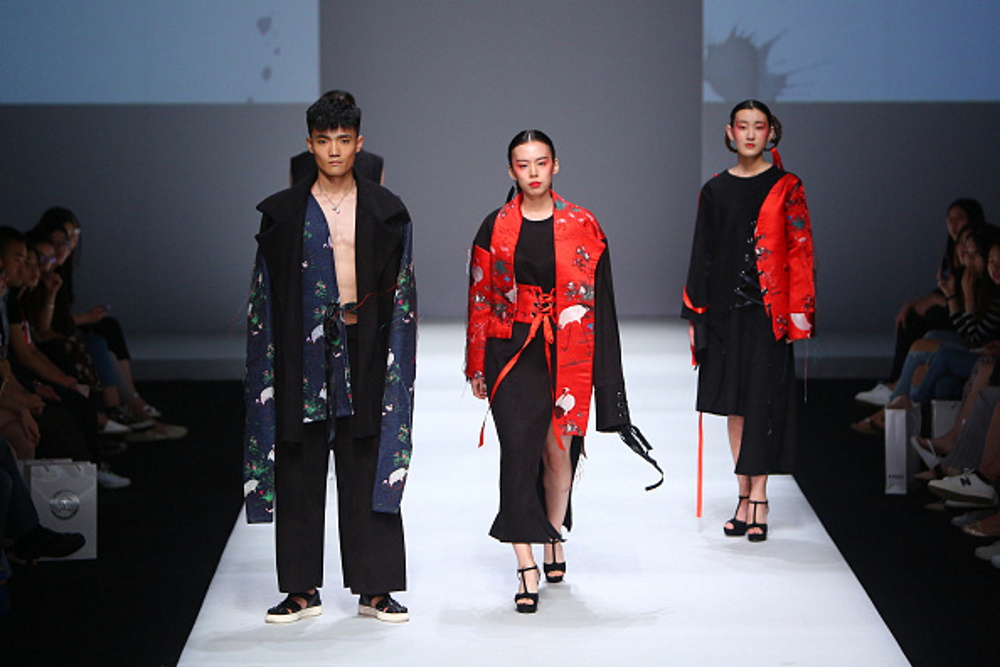
I have recently been back to China, following the silk road on a tour arranged by Tours Direct of Auckland. I was intrigued by changes in dress practices I noticed on this trip, some of which are no doubt spurred by social media.
Examples of these changes were evident in people adopting past fashions and traditional dress, and a Tibetan designer incorporating local materials and design into her fabulous fashions.

Connections to the past
The Chinese fashion renaissance is in full swing in the parts of China I visited. I was in far western China, then in Beijing.
In 2016 and 2017 in Shanghai and Beijing on Otago Polytechnic School of Design student trips, we had noticed the beginnings of a deeper interest in and respect for China’s past dress history when fashion graduates from around the country showed their collections at China Graduate Fashion Week in Beijing.
Many elements and colours of traditional Han and minority peoples’ dress were referenced in the graduates’ splendid fashion designs, from layering to textures. This year, that interest had morphed in two distinct ways in my eyes.
In Kashgar, Turpan, Dunhuang, Xian and Beijing we saw young women, a few men and some children reclaiming their cultural heritage by dressing up in earlier period costumes and wigs, including being made-up with pale faces and big eyes, to tour the local historic sites.

Copies of dress from the Tang, Song, Ming and sometimes the Qing dynasties, or the dress of ethnic minorities, were worn with modern sneakers for ease of walking the distances required by tourist sites.
Shops or studios that cater to this desire were prolific in tourist areas such as Kashgar’s Ancient Town and Tuyugou Valley where Uyghur dress predominated; on the Xi’an City wall, where the “horse-face’’ pleated skirt or mamianqun (controversially “copied’’ in Dior’s Fall 2022 collection) was popular when we were there; and at the Daci’en Temple site in Xi’an.
In Beijing at the Forbidden City, young women embodied courtesans, concubines or ladies for the day, some in richly embroidered gowns.
In Lhasa, older women wore their traditional Tibetan dress on an everyday basis and younger women dressed up in versions of older styles complete with long plaits. Everywhere professional photographers or boyfriends were in tow to record the visit.

In Xi’an, our guide and translator Kathy said the new custom was a way of people feeling closer to their history and a form of cosplay.
The other dress change I noticed this year was more elements and versions of Han or Manchu Chinese women’s traditional dress being worn as part of everyday dress by all ages - jackets, jacket-blouses, dresses, skirts and trousers worn with western fashion pieces.
The knot button pankou, featured on centre-front or offset openings, stand collars and fabrics with prints or weaves featuring Chinese plant, landscape or architectural designs in silk, cotton or wool abounded. Clearly these garments were readily available to purchase or to order at dressmakers.


History shapes contemporary fashion in Tibet
In Tibet at the Shangri-La Lhasa hotel, I came upon the work of Tibetan fashion designer Aja Nam, whose design label is AJ-Namo.
Her first career was as a singer with the highly successful Aja Group in Beijing, but in 2017 she switched to designing fashion with strong Tibetan influences in design research and fabrications.
AJ-Namo showed her designs at Beijing’s China International Fashion Week in 2017, the first designer from Tibet to do so, using Tibetan models and with her sister singing a Buddhist prayer to accompany the show.
She has continued to show in various locations since, and in 2022, she was named Outstanding Designer of the Year at Chengdu Fashion Week.
Her clothes, for many celebrities as well as for the rest of us, meld traditional Tibetan design with modern fashion, and she aims to create fashion works of art that combine natural materials in beautiful and wearable shapes.

Her output thus feeds into the desires of young people in particular, to embrace their cultural heritage by wearing clothes that blend customary fabrics and elements with up-to-date style.
She has six stores in Lhasa, Changdu and Chengdu, but I’m sure there will be more to come. Brand events in stores promote Tibetan models nationally, and the models influence others in their areas. They are often university and arts students, and AJ-NAMO provides them a platform to showcase their talents and serves as a window for the dissemination of youth culture.
In 2019, she appeared on fashion programme Angel’s New Clothes, which fostered confidence and creativity by pairing young people with designers to create fashion.


