

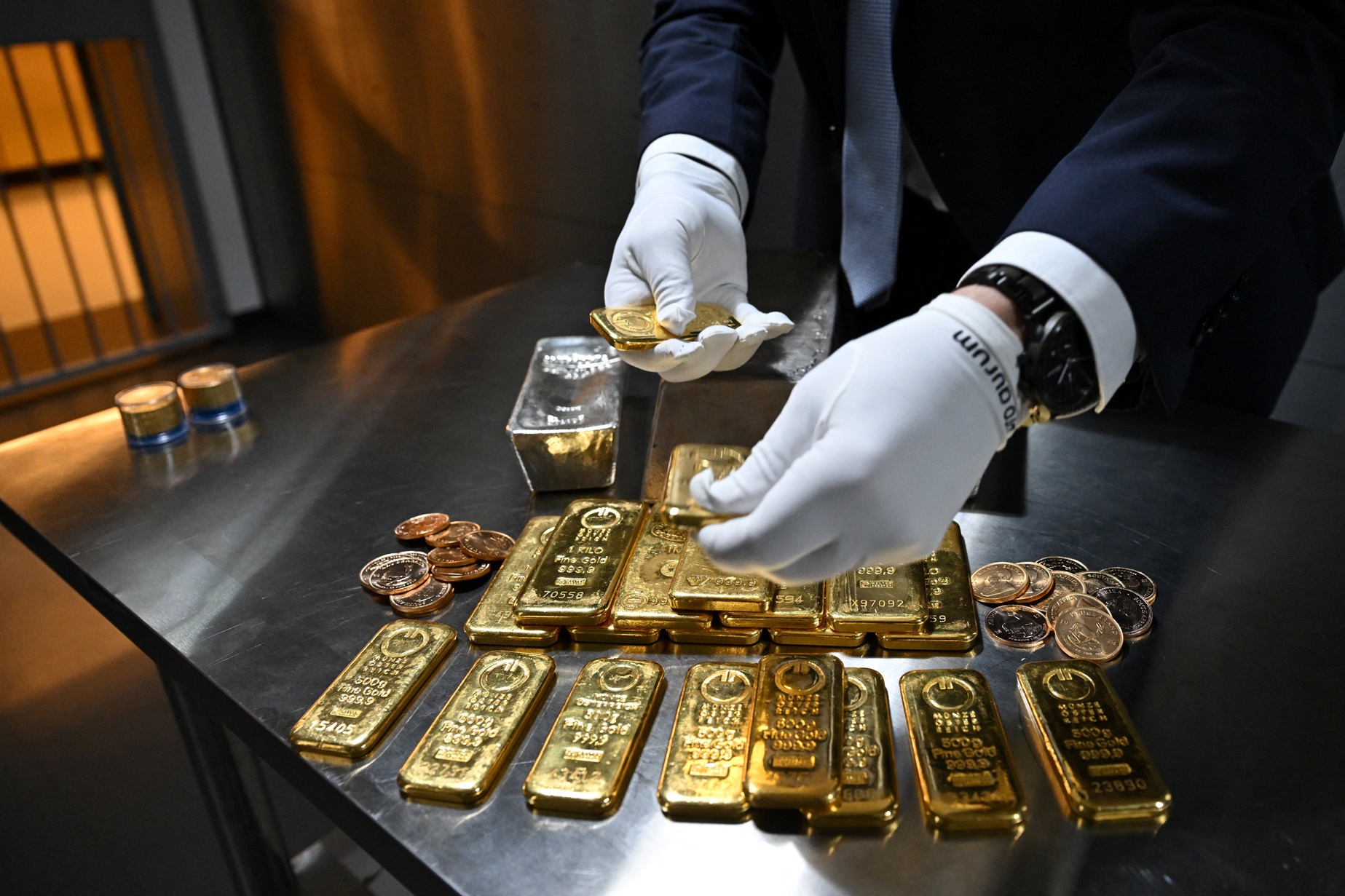
Rings for ears and fingers, necklaces and watches to help signal social status. Some of any gold Santana Minerals digs from the Central Otago hills will likely end up as bling.
But not as much of it will pass through the hands of jewellers as was once the case.
As Santana sharpens its spades in the hope of approval from the government’s fast-track process, the picture is changing.
Demand for jewellery has recorded double-digit percentage falls, down 18% last year according to the World Gold Council, as increasing quantities of gold do a different sort of duty in our fevered world.
Among those watching gold’s fortunes closely is University of Otago Ōtākou Whakaihu Waka senior lecturer Dr Muhammad A. Cheema, director of the university’s BNZ Bloomberg Markets Lab.
He’s familiar with gold’s time-honoured use in adornment.
"I’m originally from Pakistan. So, in Pakistan, when you get married you give a woman gold as a gift, as in the form of their dowry also," he says.
Part of the calculation is that the value of the jewellery will increase over time.
"So, that was considered as an investment."
Not, just a bauble then. And not a million miles from the conventional commentariat wisdom that gold is a safe bet in times of turbulence — marital or market.
But Dr Cheema says that advice might now need to come with a proviso. As lead author of a paper published last year, he chipped chunks off the precious metal’s reputation as a safe haven (SH) investment — where the smart money goes when other indices start seeing red.
There are a couple of main reasons its safe-haven sheen has dulled, he says.
The first is the rise and rise of gold exchange traded funds (ETFs). They have exploded in popularity in recent years.
When the first one launched in 2003, its assets under management (AUM) were worth just $US600 million ($NZ995.6 million). By last month the combined AUM of physically backed gold ETFs had ballooned to $US669 billion. Investment fund behemoth BlackRock is a big player. And the Chinese have started piling in.
In January this year, gold ETFs attracted $US19 billion, the strongest month on record, according to the World Gold Council.
ETFs have made it easier to invest in gold, Dr Cheema says, as you no longer need to hold physical gold, but can instead buy and sell through an exchange traded fund just as you do with stocks and shares.
"So, compared to holding physical gold, a gold ETF is very easy, you can invest even a very small amount."
Just a few hundred dollars gets you in the game.
But what it means, is that gold has become more like any other investment, and, in a number of recent examples, its fortunes have fared no better when crises have come calling.
For example, between 2011 and 2015 gold lost almost half of its value and has remained volatile since, Dr Cheema says.
Gold also failed to measure up to SH status during the last two stock market downturns — triggered by Covid-19 and the Ukraine war, his paper Which assets are safe havens? Evidence from 13 stock market downturns, found.
Its value has been increasing on average, but there have been periods when it has lost, perhaps, 10% of its value in the course of a few months. It did it again at the end of January.
"A safe-haven asset is expected to hold its value during periods of market stress and move independently of risky assets such as equities," Dr Cheema says. "However, gold has not consistently protected investors from stock market losses, and its volatility has at times been similar to that of equities. This raises doubts about its reliability as a true safe haven during financial uncertainty."
The second driver behind the increasing price of gold has been demand from central banks, measured in the hundreds of tonnes.
"Central banks throughout the world, especially China, Turkey, India, Indonesia, they are increasing their gold reserves," Dr Cheema says. "Probably one of the main reasons for increasing gold reserves is because they see that the US dollar is weakening, especially after Trump."
Russia is another believed to have been building its gold stash. It has particularly good reason to diversify its assets away from currency or treasuries, after it had foreign reserves frozen in response to its invasion of Ukraine, but Dr Cheema says other countries with large foreign exchange reserves, such as China, might also have a concern they could be vulnerable.
For similar reasons, countries have been repatriating their gold, as many have previously stored it offshore, particularly in the US.

It’s also likely to play well politically, a good news story with patriotic appeal.
A third cause for the spike in gold prices is the emergence of gold-backed crypto, though Dr Cheema says the sums involved there are relatively modest to date.
While the demand from central banks has pushed prices higher, it also presents a risk for investors.
If, for some reason, those same central banks decide to sell, prices will fall, potentially sparking a sell-off by retail investors, Dr Cheema says.
"They start selling their position, then gold might decline by 20%, 30%, 40%. So, it has become more speculative."
Dr Cheema puts some of the burgeoning interest in gold down to herd behaviour. People see its price rising and leap on the bandwagon. But policies being pursued by the Trump administration are also part of the picture, he says.
President Donald Trump’s tariff policies, stoking trade wars, have dented trust in the greenback.
Whatever the mix of motivations, demand for gold is up, to the extent that gold has overtaken the euro as the world’s second-largest reserve asset after the US dollar. Gold also now represents a bigger share of central banks' reserves than US government bonds.
It’s rise and rise will have surprised some. Not so much others, including those who ascribe a value to the metal beyond its market price.
Indeed, there’s a school of thought — or nostalgia for a metal’s age-old mythologies, depending on your inclination — that says this always had to happen, gold was always going to stage a comeback. It’s a subplot, playing out at some distance from the dispassionate data sets of academics such as Dr Cheema, but again illustrates something of our time.
The moment when gold eclipsed the euro will have drawn particular cheers of vindication from a certain sector of the German political classes.
Among the countries rebuilding their gold reserves against the uncertainties of the global climate is Germany. In recent years they’ve repatriated hundreds of tonnes, most of which had been held in the Fed’s vaults in New York.
Leading voices in Germany calling for the gold to be brought home included those of Alternative for Germany (AfD), the right-wing party best known for its anti-immigration rhetoric.
As Quinn Slobodian records in his book Hayek’s Bastards, its member for Munich, Peter Boehringer, a precious metals consultant, was one of the key figures in bringing "goldbug" politics to Europe — which includes the belief that the paper-money fiat currencies issued by governments are helping to pave the way towards civilisational collapse. We must return, they argue, to the discipline of "hard money", currency backed by precious metals. He was loud in support of the party’s campaign to "Repatriate our gold" (Holt unser Gold heim).
Gold played another important role in the AfD’s rise. In order to put other people’s money where the party’s mouth was, its early fundraising included selling gold — in bars and coins. It reportedly sold €1.6 million worth of gold in eleven days.
In doing so, the AfD was borrowing a page from the playbook of the American right, and promoted still by the likes of Steve Bannon’s gold-trader sponsored War Room podcast.
The argument runs that since countries abandoned the gold standard in the early 1970s, governments have debased their "fiat" currencies and society with it, due to their profligate, inflationary printing of money to fund social welfare programmes. The writing is on the wall now, 50 years on, the goldbugs insist, that collapse is imminent and those best placed to survive the storm will be those who’ve hoarded some gold.
One-time US presidential hopeful and libertarian Ron Paul was a prominent purveyor of the dystopian vision. The advice in his Ron Paul Survival Report newsletter of the 1990s was to hole up in a remote area, bury your valuables and "keep a supply of small denomination gold and silver coins at home".
It’s perhaps worth recalling here 20th century British economist John Maynard Keynes’ opinion that gold was a "barbarous relic".
However, in some ways at least, Paul’s prescription appears to have shifted mainstream, as central banks pile up the ingots as a hedge against the uncertainites attached to the US dollar — once regarded as the safest of investments. In Germany, even the Green Party now wants to bring the country’s gold bars home.
New Zealand gold and silver traders Gold Survival Guide appear to have captured something of this zeitgeist in their name, but co-founder Glenn Thomas is keen to put some distance between their operation and the end times survivalism of Ron Paul’s goldbug project.
"I mean, to be honest, it probably sounds a bit more apocalyptic than what was intended," Thomas says.
The "survival" they are talking about is simply surviving in the gold and silver marketplace, having the skills to navigate the trades.
Nevertheless, Thomas shares concerns about where the world’s paper money system is heading.
It’s been about 55 years since US President Richard Nixon "suspended" the gold standard, he notes.
"I think there’s probably a lot more people that are just wondering, what comes next?"
Where once people were following the herd into a commodity on the rise, now there are more investors hoping gold can hedge against uncertainly.
They recognise its millennia-spanning pedigree.

If you strip away the pejoratives, goldbugs are just people concerned about the debt that has piled up under the fiscal and monetary policies of the past 55 years — whether it is on the government’s books, or weighing on the shoulders of individuals, he says.
And whether the costs of that have been fairly distributed.
"For a goldbug, it’s like, where’s that debt going? Who’s it actually helping? And it’s probably not helping all of society.
"It’s helping a very small, select few. And that does seem to be the way the system is designed, is to support the select few."
If the monetary system is unfair, then life becomes unfair, he says.
"We’re kind of getting to a point, it seems, where there’s so much debt being built up that it’s getting hard for everybody to service that, whether that’s the government or whether that’s a family."
Given that, it’s a rational response to have some gold or silver as insurance against the worst happening.
In Venezuela, Thomas notes, people have been using flakes of gold to pay for groceries.
"It doesn’t mean you think it’s going to happen, and it doesn’t mean you have to sit here worrying about it every day, and it doesn’t mean you need a bunker and guns and all those other things that might come along with what’s been perceived to be a goldbug. But it’s just a rational insurance policy, basically. So that’s kind of the way I look at it."
Waihihi Bullion founder Baz Howie is clearer still on what the future looks like and the part gold will play.
The former Wall Street banker says President Joe Biden’s decision to confiscate Russia’s foreign exchange reserves was the last straw. People have lost trust in the dollar.
"That basically killed the government debt model overnight," Howie says. "So, gold is going to be the central, most important commodity for the new global reserve currency."
Precisely what it will look like remains to be seen, but Howie can see it being both gold-backed and digital.
"I think maybe USD, as you know it, will become USDT, which is the crypto-digital version of the dollar."
Howie says his argument doesn’t require an apocalypse.
"I own lots of gold and I’ve owned it for a long time and people say, ‘Oh, people who own gold are doomsdayers’. I don’t look at it as a doomsday event or an apocalyptic event. The reason I own gold is because I know they’re changing the monetary system."
There’s a reason all the central banks are buying up all the gold, he says. They know their game is over.
"It’s only a short term that we haven’t had gold as our main money valuer, and silver. It’s been two generations, our generations that we’ve been living in. So, it’s hard for us to imagine that, but you ask your great-grandfather, he’ll remember the value of gold. So, we’re going back to normal times."
So, should New Zealand be getting in on the rush, stockpiling a few gold bars worth of insurance? Our government doesn’t hold any gold reserves, having sold off the last of it some decades ago.
Dr Cheema thinks not, at least not at current prices.
"If in the future gold prices become more reasonable, then it could be, maybe, a good investment.
"For example, if there is a World War 3, in that case we don’t know if the US dollar survives or not, what happens to the US economy. But in that kind of situation, if we have gold, we will be much more safe than having US dollars, but only in that kind of extreme scenario."
As for the rest of us, Dr Cheema says the standard advice still applies.
"Overall, investors are better served by holding a diversified set of safe-haven assets rather than relying on any single asset, as no asset consistently protects in all types of market downturns.
"Safe-haven performance depends on the nature of the crisis," he says. "In my recent 2025 study, we find that government bonds tend to perform well during economic and financial downturns, particularly when inflation and interest rates are falling. We also find that assets from countries less directly involved in geopolitical conflicts — such as the Japanese yen, Swiss franc, and their government bonds — have been among the most reliable safe havens during geopolitical crises."
And in case you are wondering — if gold’s tarnished, what about silver?
Forget about it, Dr Cheema concludes in his paper.
"If gold has lost its lustre, then silver’s SH status has been melted away.’


