

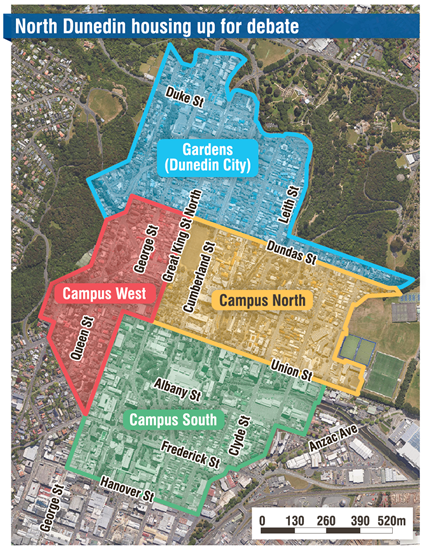
The Dunedin City Council is to consider where more intensive residential development could be encouraged and which areas should instead have emphasis on retaining built character.
Several council by-election candidates said it was important to strike the right balance around the University of Otago and Otago Polytechnic, as the education institutions drew people to Dunedin.
The council’s North Dunedin spatial plan project is aimed at ensuring there will be enough of the right types of housing over the next 30 years, in a way that enhances the student experience of living in Dunedin while studying.

The project area has been broken up into four zones — Campus North, West and South, and Gardens (Dunedin City).
Questionnaires — including some targeted at students, developers and landowners — are open until May 22.
Aaron Hawkins was one by-election candidate who said higher-density residential development was needed where this made sense.
"The tertiary precinct is absolutely one of those areas," he said.

"We know that prospective students are rejecting the University of Otago because of the poor quality of flats, and the demand for university colleges is well ahead of current supply."
Carmen Houlahan said some older housing stock needed to be knocked down and replaced.
The council also needed to keep working with investors and developers to preserve heritage, she said.
Mrs Houlahan said students being able to live close to the university and polytechnic was a key advantage for Dunedin.
She felt there was particular potential for intensification in areas such as Forth St, Parry St and Harrow St.
Jo Galer had some reservations.
She cautioned against people thinking "they’re old flats, let’s just bowl them and everyone’s going to want lovely new modern facilities".
"Before you know it, you’ve changed the look and feel of the university and the surrounding area of the university that students love," she said.
"Otago’s point of difference has always been its tightly knit nucleus of housing and wonderful student atmosphere in the North End that is partly driven by flats with back yards ... and also character flats."

Intensification had to be done in the right places and character protected "where it matters".
"There’s a place for preserving villas and historic areas, particularly where they contribute to the look and feel of the city."
Richard Knights said a tricky line had to be walked to deliver the best results for the city.
Housing supply — including the need for more warm, dry houses — was an issue for the whole city.
Urban sprawl was not the answer — "we need to use our available space better and with more ingenuity", he said.

Andrew Whiley said he supported greater intensification, especially on the main arterial routes.
Existing regulations were sometimes unhelpful, he said.
Dr Angus Mackay said student welfare should be paramount and this included Healthy Homes standards being met.
Heritage housing should be preserved where possible, he said.


