
PHOTO
A plot to subvert the will of the people was how at least one councillor saw it.
A once-in-a-generation opportunity to effect positive change was how at least one scholar framed the matter.
At issue is the future of State Highway 1 through central Dunedin.
Should construction of a new hospital in the vicinity be a catalyst for reconfiguring the heart of the city and rebalancing the transport order?
Should the one-way system be dumped?
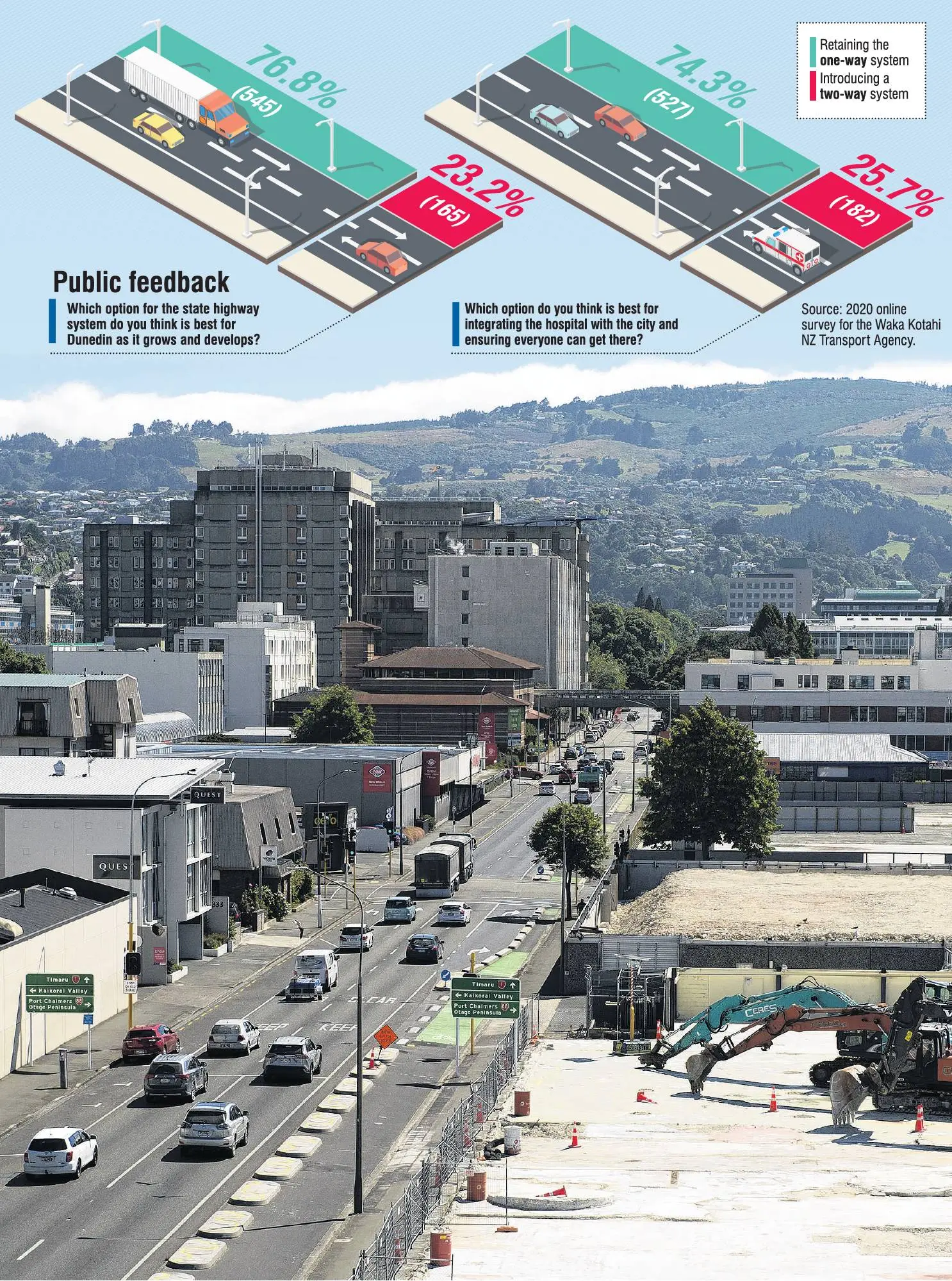
Dunedin city councillor Jules Radich, among others, thinks not. Lopsided survey results support his contention Dunedin residents are firmly of the view the one-way system should stay.
Grey Power Otago started a petition calling for Parliament to make sure of it.
A colleague of Cr Radich, Cr Carmen Houlahan, fears introducing two-way traffic to the one-way pair of routes around the planned new hospital would fuel traffic congestion.
They were outvoted, however, by a majority who decided to take issue with Waka Kotahi NZ Transport Agency’s board, which had endorsed a work programme that would retain the one-way system.
Swimming against the tide of popular opinion — and speaking up when others, including several councillors, have been reticent — is Associate Prof Alex Macmillan, of the University of Otago.
The one-way system hampers access to the hospital and university and it is a major barrier to ways people want to get around, the public health physician and researcher says.
The transport agency’s backing of the one-way system runs counter to its own strategic direction, she says.
Mayor Aaron Hawkins has said the preferred option of Waka Kotahi fails to deliver the potential benefits of rethinking SH1 through the centre of the city.
Cr David Benson-Pope says this option is suboptimal and he cites the findings of two reports — a health impact assessment and the business case endorsed by the transport agency.
The business case does indeed conclude an alternative option — known as programme 2 version 3 (P2v3) — would be a better fit with project objectives.
It would do a better job of promoting a sense of place — a place where people want to live and do business, cycle and walk.
This programme was associated with substantially more health and wellbeing benefits than the one favoured by Waka Kotahi, the health impact assessment concluded. This would be partly down to potential changes affecting so many people, such as 25,000 tertiary students.
Waka Kotahi concluded that, although P2v3 registered a better technical score, it came with additional risk, complexity and cost.
The scores between the two options were close and this — as well as public sentiment — meant the case for P2v3 was not compelling enough.
The city council signalled it did not agree and the matter required further discussion.
What is the problem?
Here is how the transport agency’s business case explains the situation.
The SH1 one-way system and SH88 are nationally important transport routes, providing key north-south connections and the route to Port Otago.
However, high traffic volumes and dominant north-south traffic flows along the SH1 one-way pair divide Dunedin’s geographically constrained city centre.
This leads to reduced "pedestrian connectivity" and problems such as noise and air pollution.
The new Dunedin Hospital site chosen in 2018 fronts the busiest roads in the central city.
About 15,600 a vehicles a day use northbound Cumberland St, of which about 600 are trucks. About 14,200 vehicles use southbound Castle St, of which about 500 are trucks.
The Ministry of Health has some concerns about its ability to integrate the hospital with the city and tertiary education area. Safe and easy pedestrian access to the hospital could be compromised.
Construction of the hospital will also cause traffic delays.
What can be done?
Many things people have asked for will be achieved whether or not the one-way system stays.
The two programmes have substantial overlap. Cycling and bus facilities will get an upgrade in either programme. Park-and-ride facilities are set to be set up.
Work on the harbour arterial route bypassing the central city will continue to proceed.
SH88 will finish in Frederick St, rather than St Andrew St.
Most matters have been settled, more or less, but the one-way/two-way question has lingered.
Heading one way could cost ratepayers and taxpayers about $103million. An alternative approach could cost them $127million. But which way is best?

The case for one-way
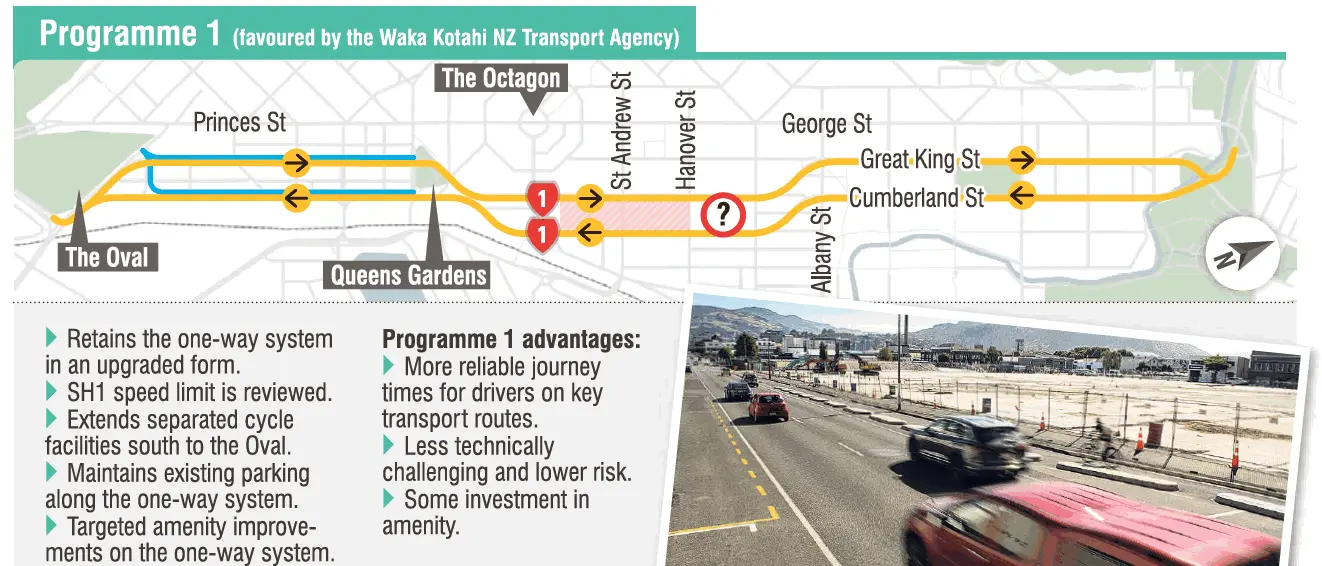
The package favoured by the transport agency is called programme 1 (P1), retaining the one-way system in an upgraded form.
A notable virtue is more reliable journey times for drivers on key transport routes.
P2v3 is expected to lead to a minor level of increased travel time and delay, which could be most noticeable in the weekday evening peak period and more so on SH1.
Under P1, reduced traffic speeds would be needed around the hospital and there would be some investment in amenity.
It is essentially the status quo, enhanced.
A survey for the agency in 2020 was unambiguous. About three-quarters of respondents favoured keeping the one-way system.
The case for two-way
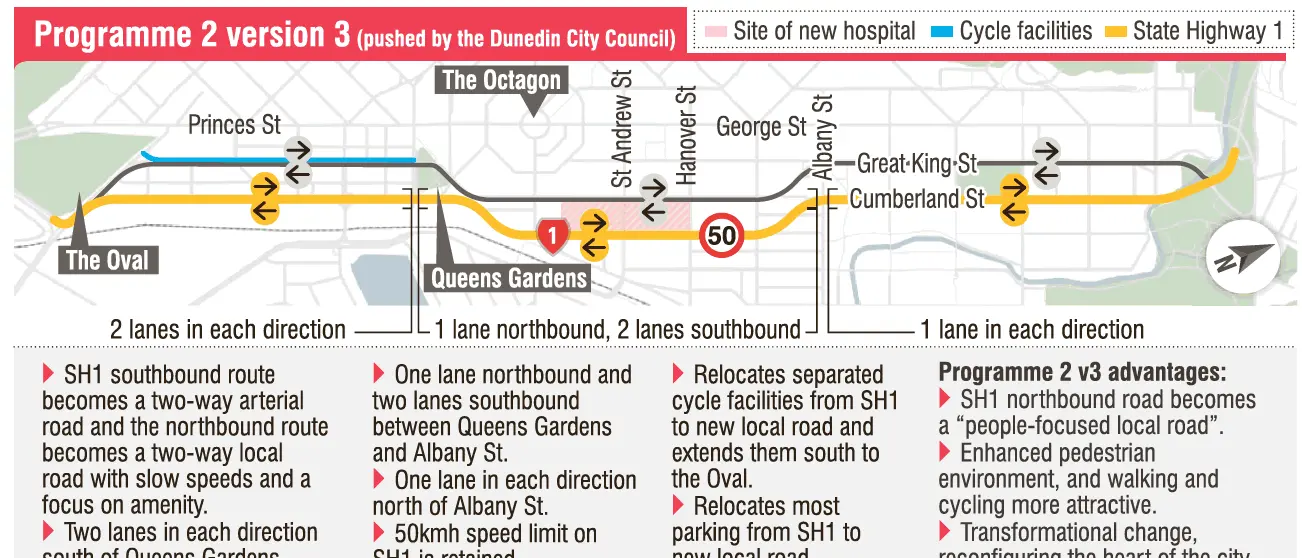
P2v3 would turn Cumberland St into a two-way local road. SH1 would continue to run in Castle St and with a northbound lane.
It would mean more of the central city is under the city council’s watch.
"This significantly increases opportunities for residential living and supportive business environments all the way back to the city core," the health impact assessment comments.
Pedestrian connection between the Great King St bus hub and the new hospital would be greatly improved.
Under P1, the percentage of people driving to work is expected to drop from 74% in 2018 to 60% in 2030. Under P2v3, the drop could be a further 10 points. That could help the council achieve carbon zero aspirations.
It would also deal with one of the University of Otago’s bugbears — severance.
"We currently have the main campus divided from the health precinct by two one-way crossings and of the options presented we see benefit in moving away from the one-way alignment," university chief operating officer Stephen Willis says.
Travel issues affect more than just road vehicle users, he points out.
On the fence?
The Ministry of Health’s project team developing the new Dunedin Hospital seems to favour one-way traffic. Or does it?
Traffic modelling and analysis indicates the system produces the best outcomes for safety and efficient transport movement, a spokeswoman says.
"The project team considers that, with effective traffic calming and design, either option can be made to work satisfactorily."
Where to from here?
The matter has been escalated.
City council arguments sit both with the transport agency and Minister of Transport Michael Wood.
Mr Wood is due to visit Dunedin in April and his office has said discussion of SH1 will be on his agenda.
The business case summarises that P1 provides some improvements, while P2v3 provides transformational change.
Some change is necessary and the siting of the planned hospital between the pair of one-way roads forces the issue.
What has yet to be confirmed is precisely how much.