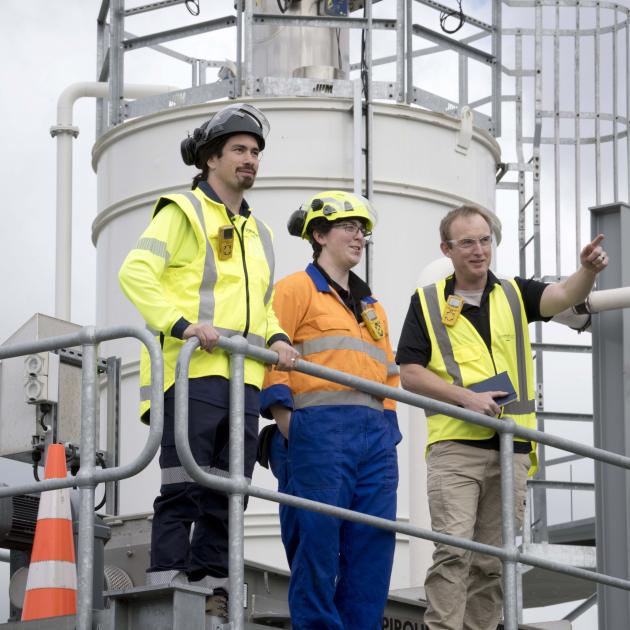
If Blair Tucker, Harriet Fahey and Anthony Keenan would rather be at the beach than the Tahuna wastewater treatment plant, they did not really let on when the Otago Daily Times visited this week.
Mr Tucker used to be part of the Dunedin City Council team that makes sure drinking water is fit for consumption and he is now the council’s wastewater treatment team leader.
"People don't really think about it, whether they turn the tap on or flush the toilet, that's it for them," he said.
"The people on the other side of it — they have to either treat the water or deal with the wastewater.
"There's a hidden group of heroes on either side of that. And it's awesome to be a part of it."
Ms Fahey has been on the job as a trainee operator since September and has appreciated the variety of her duties, such as sampling and checking instruments.
"I really enjoy it," she said.
Mr Keenan had attended school near the Tahuna plant.
"I didn't even know what the place was until I was skating past and one of my friends said ‘hey, do you want to do an ollie down the poo plant stairs?’.
"So I thought, ‘oh, is that what it is?’."
That was about all he knew of it until he accepted a job as a trainee.
Mr Keenan used to work at the other end of food consumption, for Hell Pizza.
"So, yeah, that was the start of the process and then, you know, you see it down the end of the line."
He opted for the switch to wastewater management because he felt it offered more of a career path, a bit more money and reasonable hours.
Mr Keenan supervises treatment plants in the north zone of the territorial authority.
The trio were not too perturbed about odours, although Ms Fahey felt she could not get used to the smell of fats, oil and grease, and Mr Keenan said he would be affected if there was something new.
"Also, when you go away on holiday for two weeks and you come back, then you're not used to it," he said.
Some people instinctively did not want to hear about the job, but most became quite interested when he sought to explain the treatment process, he said.
"All the processes are quite interesting, like the mechanical side of it, whether it’s sludge getting passed through the conveyors ... dewatering ... and we’ve got an incinerator as well that burns about 15 to 20 tonnes a day."
Part of the operation was about separating out water and the leftover clay-like substance could be burnt or disposed of at a landfill.
It could all get rather technical and Mr Tucker reached for an analogy.
"When you're working in wastewater, you're essentially a bug farmer," he said.
"So it's about getting the right balance for the right bugs that you're trying to produce to help break down the organic and inorganic matter that you're treating."
Things could go wrong — such as unwanted substances getting into the system — and it was a finely balanced operation even if all went well.
"Definitely, it’s a job that never sleeps."