

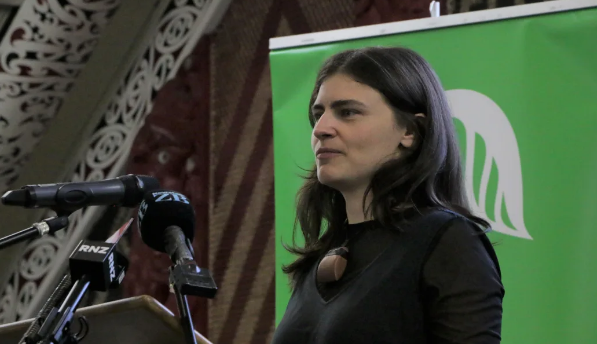
At a media stand-up in Christchurch today, where the party is holding its AGM, Swarbrick said she expected to have a 'far larger' Green movement going into 2026 general election.
She said she did not expect the coalition government to be so anti-environment.
"You're talking about a government that is talking about rewriting the founding document of New Zealand, it's absolutely bonkers that this is the stuff on their agenda."
MP Darleen Tana was ousted by the Greens and asked to quit politics altogether this month after an independent investigation found it was likely that she knew about allegations of worker exploitation at husband Christian Hoff-Nielsen's business, and did not disclose them to the party until after the 2023 election.
Swarbrick said the party is considering the Tana's future but would not say if waka-jumping legislation would be invoked.
The Electoral (Integrity) Amendment Bill passed in September 2018. Despite voting for it, the Greens have long made their opposition to the legislation clear.
The controversial legislation, more commonly referred to as the "waka-jumping" law, is designed to prevent MPs from ditching their party during a parliamentary term. It automatically vacates an MP's seat if they deliver a signed, written notice to the Speaker resigning from the party they were elected for. The reasoning is this maintains the proportionality of representation in Parliament.
"Our caucus has come to the unanimous position that Darleen Tana is not fit to be a member of Parliament," Swarbrick said today.
"It's not a personal thing," she said, citing the executive summary of their investigation into her business affairs.
However, with Tana determined to stay in Parliament, and the Greens' proportionality now affected, Swarbrick said the party would formally explore other avenues at the AGM.
Swarbrick said she hopes to make the Greens the major party on the left and was looking to South Auckland to be a big part of that push.
The Greens need to "win trust," she said.
"The Greens aren't here just to get into power. We are here to redistribute power. That's the difference between real representation and mere tokenism."
Since becoming co-leader in March this year, Swarbrick has spoken of her belief the Greens can become the leading party on the left, and that the see-sawing of "legacy parties" had disenfranchised voters.
She re-iterated those points at the AGM, telling members that while she believed many members aligned themselves with green values, it was up to members to have the conversations to turn that into votes.
"For me, that's not just about more seats in Parliament. It's actually not even just about holding the government benches. It's about a country of citizens equipped with the understanding and the time and the resources to actively participate in our democracy. To hold those who make decisions on their behalf accountable. Even and especially if that's us."
Swarbrick spoke of past mass-movements such as the women winning the right to vote, the revitalisation of te reo Māori and the introduction of MMP.
She told members that Green values, too, could be an unstoppable movement.
"If that's what we in the Greens want to be, we've got to be brave enough to look at ourselves in the mirror and consider whether we want to evolve as a party."
She acknowledged many members of the public had become jaded with politics, and the Greens' opponents were relying on people being too tired to engage.
"Trust is broken when someone doesn't come through with what they've promised. You don't have to be a psychologist to understand this is why many communities across our country long ago gave up their trust in politicians," she said.
"If we believe we're different from the other guys, we can't just say it. We've got to prove it. Again, and again, and again."
She believed the Greens needed to go through some growing pains and reflect on what it used to be and what it wants to be.


