

The Greens’ tax and incomes policy, released on Sunday morning, brings back an adjusted form of the party’s 2020 wealth tax - one of the most hotly contested policies from the last election.
That policy had a far lower threshold - assets over $1m - a threshold the party thought would hit the wealthiest 6% of New Zealanders. The higher threshold means only the wealthiest 0.7% of households will be targeted. The $2m threshold is a net figure, meaning people with mortgages and other debts would need $2m of equity before they began paying the tax.
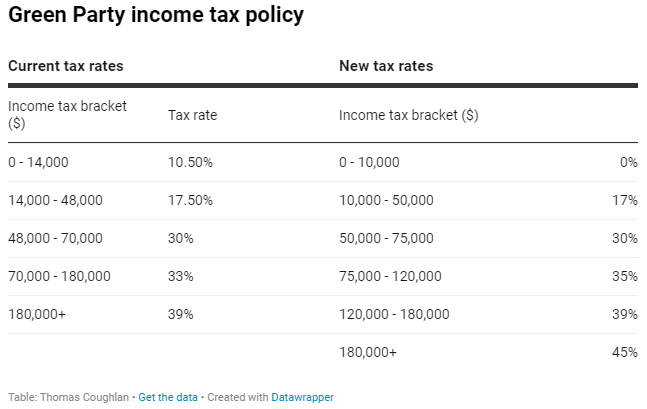
The tax plan also included a 1.5% tax on trust assets, and an increase in the top rate of income tax from 39% to 45% paid on income over $180,000.
The party hiked other income taxes too, although these are paired with income tax cuts at the lower end of the scale. People earning less than $125,000 would pay less tax, those who earn more than $125,000 would pay more.
The 33% tax rate would be hiked to 35%, although the threshold for paying that rate would be $75,000, rather than $70,000 as currently.
The party would drop the 39% threshold to income earned above $120,000, meaning far more income earners would begin paying it.
The tax changes also included tax cuts for people on more modest incomes. Income earned up to $10,000 would not be taxed at all, which would give most income earners a $1500 tax cut.
The party will also hike the corporate tax rate from 28% to 33%, which is where the rate stood under the last Labour Government. New Zealand already has one of the highest taxes on corporate profits in the world - although it is still lower than Australia’s, which is currently 30%.
Co-leader James Shaw said believed New Zealand had sufficient wealth to end poverty.
"I am sick of the politics of excuses. Everything we need to make life better for people in Aotearoa exists," Shaw said.
"What’s missing is the political willpower to use it. The time is now to lift every single family out of poverty and to pay for it with a fair tax system.
"Our fully costed plan will make sure everyone can pay the bills, put food on the table, and keep the house warm," he said.
The tax changes were paired with an "Income Guarantee", which the party said would create a minimum level of income of at least $385 per week for individuals, $770 for couples, and $735 for a single parent.
This would be achieved by a radical overhaul of Working for Families, which would be replaced with a single payment for parents or caregivers of $215 every week for the first child, and $135 a week for every other child, with an extra $140 a week for every child under three years.
Like Working for Families, the Income Guarantee payments would abate once people began earning a certain level of income, but the threshold at which the payments abated would be much higher, meaning people kept more income support for longer.
The rate at which the payment abated would also be lower, meaning a smoother transition out of income support.
The Working for Families abatement threshold will be increased from the current $42,700 to $60,000. This is higher, in real terms, than when the threshold was last adjusted in 2017-18.
The abatement rate will change to 18% from the current 27% to ensure the payments reduce at a much slower rate.
The party promises to overhaul ACC into what it calls an "Agency of Comprehensive Care" which would offer far broader coverage.
The Greens say if anyone has to stop working, they will receive a minimum payment of 80% of the full-time minimum wage.
Co-leader Marama Davidson said the income guarantee policy "will give everyone peace of mind that they can always afford the weekly shop, pay the rent, or cover unexpected costs – even when times are tough".


