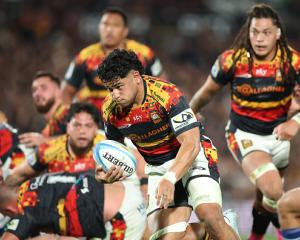
Here we present a series on some of the lesser-known members of the New Zealand Sports Hall of Fame. Today, Ron Palenski looks at All Black fullback Robert Scott.

There was also a time when Scott was not even eligible for the All Blacks and it took the intervention of a politician to ensure he could play.
Robert William Henry Scott was a phenomenon of his era.
He was a fullback ahead of his time, a player who loved to enter the back line and run with the ball at a time when fullbacks were supposed to be just the last line of defence. When the time comes to compile a short list of New Zealand's greatest fullbacks, flicking through the eras, Scott's name will still be to the forefront.
League was his sport of choice before he became an army driver in World War II. At the end of the war, various people began to put into practice the wish of the division commander, Bernard Freyberg, for an army team to tour Britain to revive interest in rugby. Scott had played a few unit matches during the war and he and a prop, Johnny Simpson - later to be known as "the iron man" - were obvious contenders for the team that came to be known as the 2nd New Zealand Expeditionary Force Kiwis.
But the league backgrounds of Scott and Simpson were well known and, as the Kiwis' tour began, it was assumed neither could play in "test" matches against England, Wales, Scotland and France, because they were supposed to be professionals, even though they had played in rugby matches during the war.
The New Zealand Rugby League protested to the Minister of Defence, Fred Jones, about the prospect of the pair being on just restricted rugby duty. Jones got word to officials in Britain to have a word with the British organisers of the tour, the Army Sports Council, and Scott and Simpson were cleared to play. (Neither the various British rugby unions nor the New Zealand union had anything to do with the tour).
The other fullback in the Kiwis was Herb Cook from Hawke's Bay and he was so highly rated that the broadcaster who toured with the team, Winston McCarthy, put him ahead of Scott. Cook played 20 matches on tour and scored 138 points; Scott played 19 and scored 129. McCarthy's opinion could not have been shared by Cook because, at the end of the tour, he could guess the first post-war fullback would be Scott, so he switched to a league career in England.
Scott met his future wife, Irene, at the Fernleaf Club, a haven for soldiers in the fashionable Belgravia area of London. She was one of several English women working at the club and, when the Kiwis stayed there, Scott asked one of the other staff to tell Irene he wanted a word. She went to the table where Scott was sitting and said: "I understand someone wanted to speak to me." "Yes," Scott replied, "it was me and I'd like to take you out." "But I don't even know you," Irene protested.
By this time, Scott's rugby-playing mates were guffawing and one of them, Bill Meates, called out: "It's OK, he's quite safe."
Irene protested she had this to do and that to do and didn't know when she and Scott could meet. He also had the small matter of rugby commitments and, while he may have been a star player, he couldn't forget he was still in the army and was a mere driver compared with his team captain, Charlie Saxton, who was a major, and manager, Les Andrew, a colonel. A date was eventually sorted out and a lifetime partnership was formed.
Scott returned to New Zealand with the Kiwis in 1946 and was named, to no-one's surprise, in the first peacetime All Black team to play Australia at Carisbrook. Scott sent a cable to Irene, who was still in London, with the good news. "What's an All Black?" she cabled back.
They were married by the end of 1946 and Irene came to appreciate not just who and what the All Blacks were, but how significant her husband was. The tours and the accolades followed and, while the All Blacks were beaten in all four tests in South Africa in 1949, and Scott blamed himself for uncharacteristically wayward goalkicking, others told him not to be so stupid.
The All Blacks' bete noir, loose forward Hennie Muller, said the Springboks thought Scott supreme and he called him "the greatest footballer I've played against, in any position."
Scott was a fullback for the ages.
Norman McKenzie, one of the great rugby men of the mid-20th century, caused a bit of a fuss in 1954 when he placed Scott higher on the fullbacks' pedestal than George Nepia.
"Nepia was a truly great player," McKenzie wrote. "He stopped the other team from scoring. Scott has brought a new dimension to rugby by not only defending his goal, but also by attacking the other side's. I used to say Nepia was not a Scott and Scott not a Nepia, but now I am quite satisfied that Scott is the greatest fullback I have ever seen."
Scott was once asked what it felt like to be dropped from the All Blacks. "I don't know," he said, "I never have been." Not only was he never dropped, he was twice asked to come out of retirement. He "retired" in 1951 at the age of 30 and amid the telegrams of best wishes that poured into Eden Park for him was one that read: "Good luck and God bless you. George Nepia."
Another tribute was written by the sports editor of the Auckland 8 O'Clock sports paper, Esmond Doherty. "His spirit of adventure on attack, resourcefulness on defence and the sheer artistry of other aspects of his play have gone a long way towards revolutionising previously recognised ideas of fullback play."
Towards the end of 1952, a couple of senior New Zealand rugby officials went to Scott and urged him to make himself available for the British tour of 1953-54. Scott recalled how he was "astounded and jolted" by the entreaties. He eventually agreed and became one of the outstanding players of the tour.
Scott went back into his retirement, only to be asked back again. In early 1956, with the country reaching inflammation point about the visit by South Africa, rugby's grand old man, Stan Dean, went calling on Scott, who then ran a menswear shop in Petone. Dean, who managed the Invincibles of 1924-25 and had been chairman of the New Zealand union for 25 years, acted as an emissary for the All Black coach, Tom Morrison. He told Scott, who was then 35, how important it was for the All Blacks to beat the Springboks in a series for the first time.
But Scott had to say disappoint him.
"I hadn't played any series rugby since 1954," he recalled. "It's hard to say `No' when your country calls you, but I'm afraid I had to."
Scott's absence meant the selectors had to look elsewhere and the man they eventually settled on for the third and fourth tests was Don Clarke, so the succession problem was solved.
Wilfred Wooller, who played rugby for Wales, cricket for Glamorgan and was an England cricket selector, became a journalist in his sporting afterlife. He wrote of Scott: "I have never seen his equal. His positional timing was perfection in person. He typified all the qualities that thrill a rugby follower."