


Not satisfied with just doing a good job, Josh Olley wanted more.
His job as a qualified carpenter called for him to do his work to a good standard.
Spending more time to make something great was not welcomed.
‘‘I was getting little satisfaction from being a carpenter in the trades because no-one required you to find excellence.’’

‘‘I wanted to find my potential as an artist. So that’s what led me into this world of art.’’
That was 25 years ago and nothing has changed; Olley is still seeking excellence in his work, except now he is working on stone sculptures that are more than life-size — although he started out much smaller, carving bone using the basic tools he had as a carpenter.
Then people began to bring him stone, greenstone, river stone, stone sourced from the waters and fields of the South Island, asking him to carve it.
‘‘I started to go, well, I better figure out how to do that. And I did. But once I got working with the stone, I kind of realised that for me it was like the ultimate material because of its longevity.’’

‘‘To me, in stone you can get the finest finish and finest detail.’’
However, it is not an easy process.
‘‘But that challenge kind of bit me and it was the challenge of creating stone and getting it to this high-quality detail and finish [that] was alluring to me, that challenge.’’
Soon Olley was finding stone serendipitously. Even his daughters have found him stone as they know what to look for.
‘‘I had an eye for the stone. I started to notice it — whereas others perhaps wouldn’t — because I started to tune into it.’’

‘‘All the while I had no idea if there was a market for what I was going to do because I had no-one I was following.
‘‘But I was following this determination and kind of vision I had in my mind of what I thought I could create.’’
He is particular about the stone he sculpts and the size of the rock influences the work itself.
‘‘When a rock comes to me that was, say, two tonne, I don’t want to cut it up into lots of pieces. I want to make a two-tonne piece of art because I want to honour that size because it makes practical sense.
‘‘It’s kind of like a respect to the stone but it’s also very practical because one of the hardest things for me is to remove the waste.’’
The less Olley has to remove from the rock, the less time and energy he has to put into it.
‘‘So it’s also very practical but you’re only going to get given that rock once. I try to make as much as I can from that one rock.’’
He also believes the stone has its own will.
‘‘There’s a real art in itself to collaborating with the stone and finding the stone’s will and your will. If it can be calibrated together, that’s where the magic happens. I have experienced that feeling and so I’m always trying to look for that.’’

‘‘So if I work six months on a work, buying diamond tools and then there’s a fracture, therefore the stone never really had the ability to become what I wanted it to become, I lose everything. I can’t afford that. ’’
From the very beginning he has been determined to create works to a really high standard.
‘‘So the quality, I reckon, has remained the same but my detail and my ability to carve form has evolved out of practice.’’
It is the really large works that are his passion. Hands are an ongoing theme in his works tying back to the reason he started.
‘‘The reason I wanted to be an artist is I have something to say and my work is really a medium to say it and the hands are us, the people.
‘‘What I am passionate about is people and reaching our potential. The welfare of people is what I really care about.’’
It has taken a long time to develop the skills to carve the wrinkles, creases, veins and tendons that give his work life.
He says it takes tenacity to carve those details out of stone such as argillite, from which knives and blades for tools were carved historically.
‘‘Because it can hold an edge, it has a semi-crystalline structure that when it breaks it is extremely sharp, so therefore extremely hard and durable.’’
Carving it requires the use of diamond tools and often he finds his diamond blades melt, ‘‘becoming a ring of fire’’, when he tries to cut it.
‘‘In the early stages of each work, it seems like I’m not going to be able to to do it ... the blades melt and then become useless. It takes a lot of determination.’’
It has meant he often has to search out tools or make his own to accomplish what he wants.
‘‘I’ve developed this notion that there is always a way.’’
Olley, who has been interested in art since he was a child, but was told there was no career in it, often asks himself why he chose this path.
‘‘But when you get towards the finishing of it, it all seems to become worthwhile and because it’s such a hard make-up, when you come to finishing, it’s just all that more rewarding.’’
Finding a softer stone has never been an option because of his love of a challenge.
‘‘What I’m trying to do is encourage people to do what seemingly is impossible because I haven’t found things to be impossible, even though they do seem impossible.’’
He believes people’s natural inclination to avoid the hard path brings their overall potential and abilities down. So he hopes his work encourages people to trust in themselves.
‘‘Don’t be afraid to give it a go even if it seems impossible.’’
His latest work, Blood from Stone, which is on display in Auckland’s Viaduct Harbour as part of the Aotearoa Art Fair Sculpture Trail, has parts that are some of the most challenging sculpting Olley has ever done.
‘‘There were areas that were more challenging to get tools into and actually accomplish.’’
Blood from Stone, which sits alongside pieces such as Lisa Reihana’s ANZAC, Reuben Paterson’s Koro and Gregor Kregar’s T-Rex Reflection, is also an example of a new approach to finishing his work. In the past, it has often been highly finished such as Hand Down (2.1m×1.5m) which won the Auckland Botanic Gardens Friends of the Gardens Acquisition Award and the People’s Choice Award.
‘‘I’m enjoying the different textures, because it pulls the eye.
‘‘People see one texture and then another texture and think of two different stones, but these stones you can texture. So, they have a different feeling, which is adding to the feeling of the finished work.’’
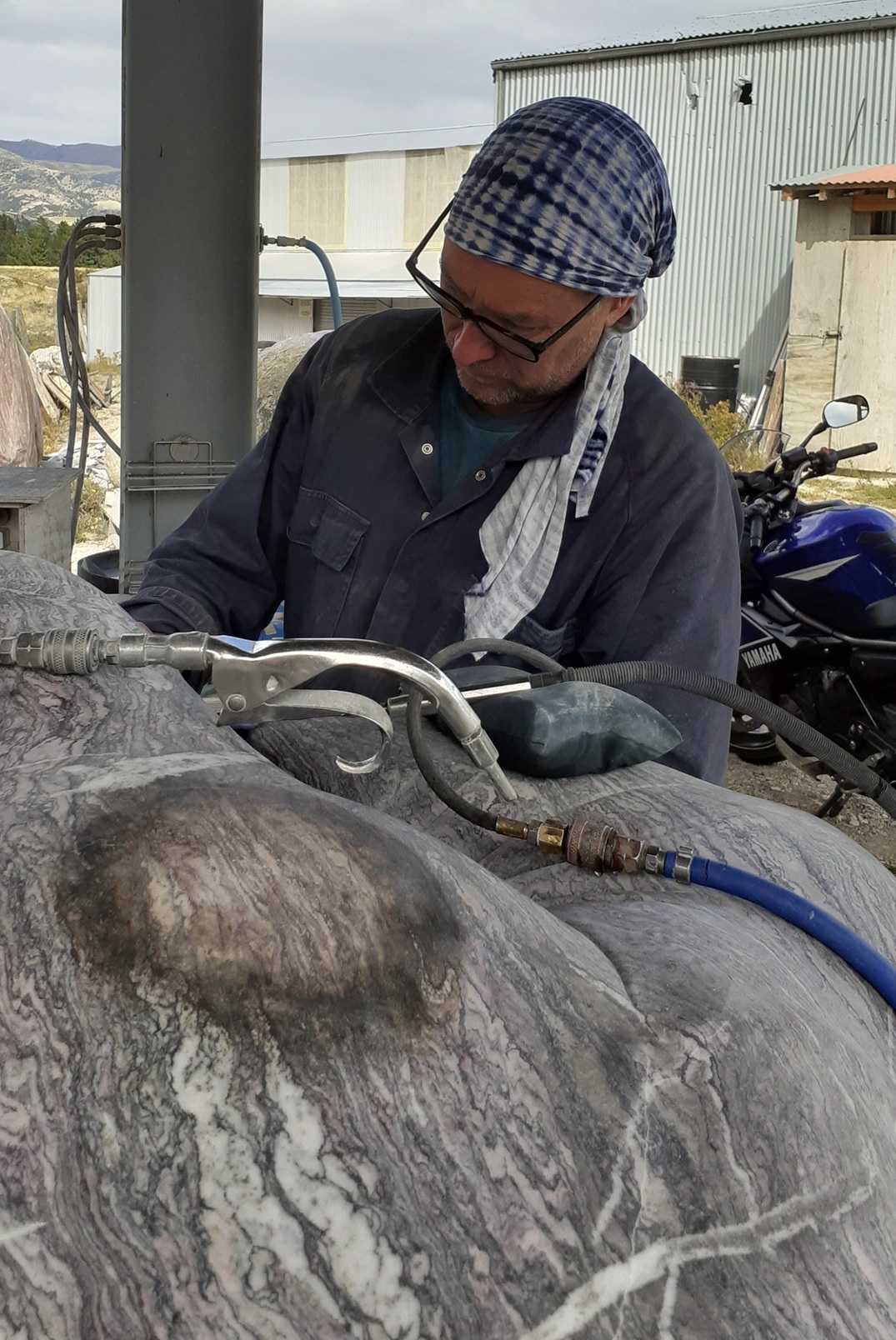
‘‘A tactile finish has been a core principle from the beginning. We’ve always encouraged people to touch the stone.’’
Each of his works takes months to make. In the early stages, partner Amelia works with him on the conceptual side of the piece.
‘‘We’re very much right there together.’’
Olley focuses on one work at a time, working full-time, but does listen to his body when he needs a break. He works outside under a roof to shelter him from the sun and rain, but it has no walls, allowing the dust from the carving to dissipate with the help of a blower. He wears eye, ear and dust protection.
‘‘I blow the dust so it’s always moving away from me. I don’t like it to be clouding around me.’’
He admits winters in Luggate are cold and difficult to handle, but he dresses for the conditions.
‘‘The dust all goes away and I have pressurised air to clean it all up and so it’s kind of just a necessary hardship that I endure. But I have a decent space to do it and the lifting gear to lift these big rocks, some of them four, five tonnes.’’
These days there is no music going through his protective earmuffs; instead, he concentrates on the task at hand.
‘‘I cannot make a mistake, I can’t. I’ve learnt to work without really making [them]. I mean, to me, I always make mistakes; there’s not a work I have that I couldn’t have done better — you could never reach the very pinnacle, you can always do better.
‘‘I can’t afford to cut off a fingertip or a major part because you can’t put it back on, I can’t just glue it on. I wouldn’t be happy with that, so I like to work with that strictness of focus because, when you finish it, you’re just so satisfied that you’ve done it.’’
• Olley is one of four Otago artists exhibiting at the Aotearoa Art Fair from April 30-May 3 at the Auckland Viaduct Events Centre, alongside Nicola Bennett, from Alexandra, and Dunedin artists Nigel Brown and Jackson Harry. Dunedin’s Milford Gallery is also showing multiple artists.


