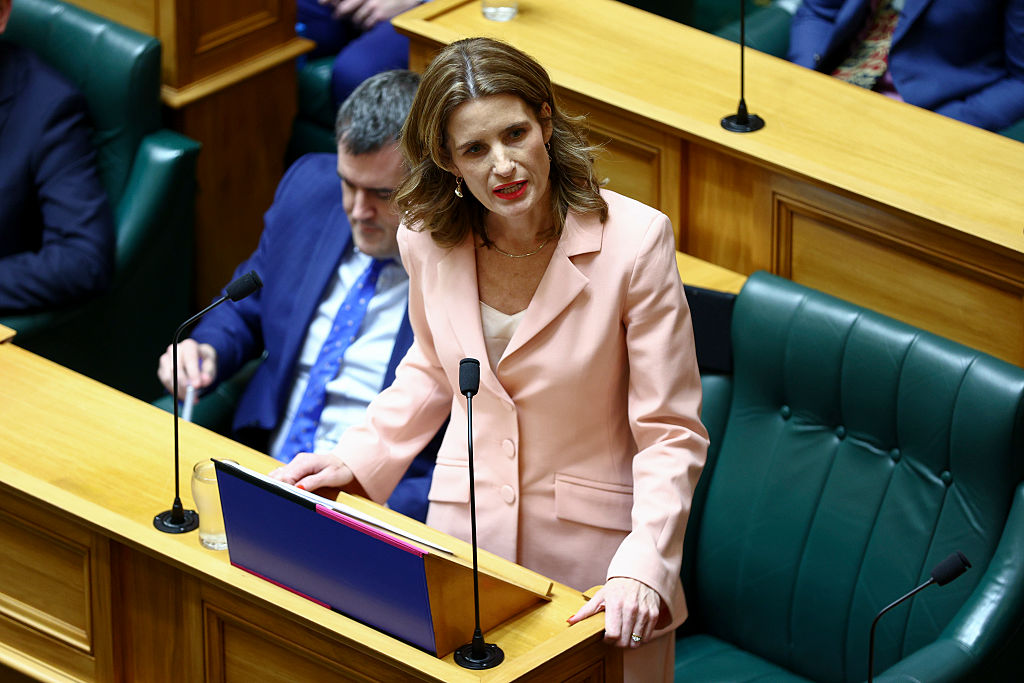
Finance Minister Nicola Willis has used her election-year Budget to preach prudence and discipline, with the books now forecast to be back in black a year earlier than picked.
As heavily foreshadowed, the Budget contained no "sugar hits" for voters, with a focus instead on core health and infrastructure spending, as well as a near half billion-dollar rainy day fund tagged to the fuel crisis.
Willis arrived at the Budget's official release to address reporters and analysts slightly earlier than usual on Thursday.
"Just like the surplus," she quipped.
Later she said she refused to bribe New Zealanders with their own money, even if it might be "politically expedient".
"It is a lot easier to say yes than no," Willis said. "But it is my responsibility to be careful and prudent now to protect New Zealand's future."
Overall, the Budget put an extra $3.8b in day-to-day spending into new initiatives, offset by $1.7b in cuts, including across the public service and to the Fees-Free scheme.
Back in black? A precarious balancing act
Ministers made much of Treasury's latest forecasts, which showed the country returning to surplus by 2028-29, under the coalition's preferred calculation, excluding ACC.
Treasury also expected debt to start reducing as a percentage of GDP that same year.
It was only in December that Treasury pushed back the surplus date to 2029/30, though at the time Willis said she would continue to aim for the year earlier.
She also offered a caveat: "Numbers can always change."
The forecasts were reliant on some significant assumptions, including that the impact of the fuel crisis would be "temporary".
Officials expected economic growth would average 2.7 percent over the next four years, despite global volatility.
The 2028/29 timeframe is still considerably later than National promised ahead of the last election.
Break glass in case of worsening fuel crisis
The ongoing fuel crisis cast a shadow over the government's plans, with a one-off temporary funding injection for emergency services to help them cope with fuel pressures.
The inherent uncertainty was also reflected in a $450m contingency fund set aside for "additional temporary targeted support" if the crisis worsened.
"This is a reserve, much like some households have an emergency savings account," Willis said.
"You hope you don't have to dip into it, but if you do, it's there."
Willis had already earlier announced a $50 a week cost-of-living payment for about 150,000 families.
"The situation in the Middle East remains uncertain, so it is prudent to be ready should fuel prices rise further and add more pressure to households and businesses," Willis said.
Bricks and mortar; Hospitals and roads
As always, the single biggest item in the Budget was support for frontline health services, up an extra $5.5b in this year's Budget.
Willis also announced funding for a range of targeted initiatives, including lowering the age of bowel screening to 56 and allowing new mothers longer post-natal stays in hospital.
More than $680m was set aside in capital spending for health, including a new 158-bed ward tower at Whangārei Hospital.
Infrastructure spending was a major feature, with Willis naming "security and resilience" as key themes for the Budget.
About $1.8b was set aside to extend the Waikato Expressway from Cambridge to the turnoff to Tauranga.
And just over $1b had been committed to KiwiRail's network improvement programme.
Some $400 million was tagged to state highway resilience projects to keep critical routes open during and after severe weather events.
No new taxes?
Though Willis said the Budget kept her promise of "no new taxes", it did contain a new "levy" on banks, non-bank deposit takers, insurers and some other financial institutions.
It was picked to raise just over $200m over the four-year forecast period.
Willis said similar levies existed in Australia and the United Kingdom. She indicated she had wanted to go further but could not get consensus at the Cabinet table.
The government would also tweak rules around charities, including capping the donation tax credits on eligible donations at $100,000 a year.
Despite the ACT-National coalition agreement committing the government to look into GST-sharing with councils, ministers have instead settled on a new $400m Incentives for Growth Fund.
Councils would receive payments based on how many houses they consented.