
PHOTO
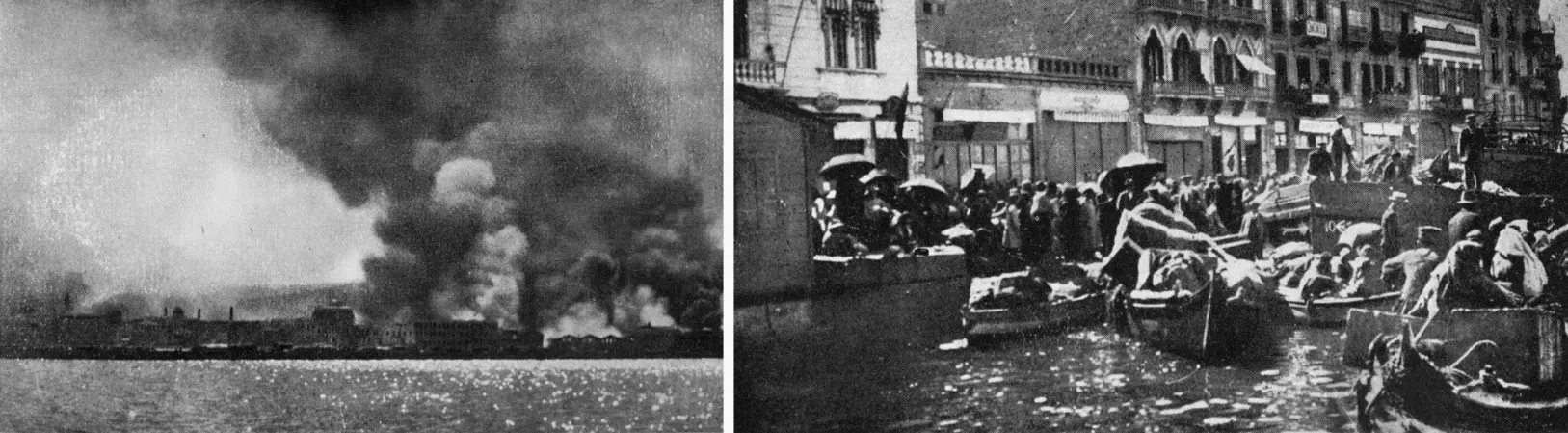
Mr Ward Price in the Daily Mail gives a graphic story of the Greeks’ panicky flight from Smyrna on the approach of the Turks.He says that the remnants of Constantine’s army have been shipped to Chios, from whence they are returning to Athens for demobilisation.
Steaming up the Gulf of Smyrna, there was abundant evidence of the Greeks’ terrorised flight.
The whole of the population (civil and military) were trying to get away.
Steaming down the gulf was a succession of Greek transports, shabby steamships of all sizes, which had been hastily requisitioned.
Greek soldiers were clustering on them like swarms of bees. Little sailing boats laboured along heavily laden with refugees.
The coastal steamers were packed with civilians, and they were towing more civilians in lighters.
Along the road on the south side of the gulf the Greek army (infantry, cavalry, and motor transport) were streaming westward towards Chesme, whence they were ferried across to Chios.
A confused khaki column stretched for miles.
Smyrna itself, was in great confusion.
The quays were densely packed with Greeks, alternately weeping and shouting in panic, and offering high prices for places in the boats.
The advance guard of the Turks entered without opposition.
Cars becoming indispensable
In a comparatively short space of time the motor industry has advanced to a leading position.
In America it ranks third in the list of the great manufactures.
Already it has proved a serious competitor of established railway and tramway systems, and it is generally felt that this phase of its development is in its comparative infancy.
At present two questions are exercising the minds of those engaged in the industry, and the satisfactory solution of them will have an important influence on future progress.
Good roads and reasonable taxation are necessary to the fullest enjoyment of the benefits which modem motor invention has made possible.
Sensible observers no longer see in the possession of a motor car another proof of extravagance.
To business men and rural dwellers the car is an indispensable necessity, and in the field of transport it performs a highly valuable function.
While the motor industry provides employment for a large number of persons and ministers to the convenience of a very much larger number it is an important source of public revenue.
It has been estimated that the Government taxes on an ordinary touring car which is sold by the manufacturers in America at £300 amount to £100.
The annual tax is estimated to amount to about £15 per car per annum.
Grave concern is felt over the prospect of increased motor taxation, which would necessarily fall on the users of the most modern method of transport.
In other countries excessive taxation has discouraged enterprise and it would doubtless have the same effect in this dominion.
Pig yields 358 pounds of pork
What must certainly be considered a record in the way of pig-raising in the Strath-Taieri district has (a correspondent writes) been achieved by Mr Angus McIvor, of the Railway Hotel, Middlemarch, when a seven-months-old pig, belonging to him, was recently slaughtered, and the dressed weight was found to be in the vicinity of 358 pounds.
— ODT, 15.9.1922