


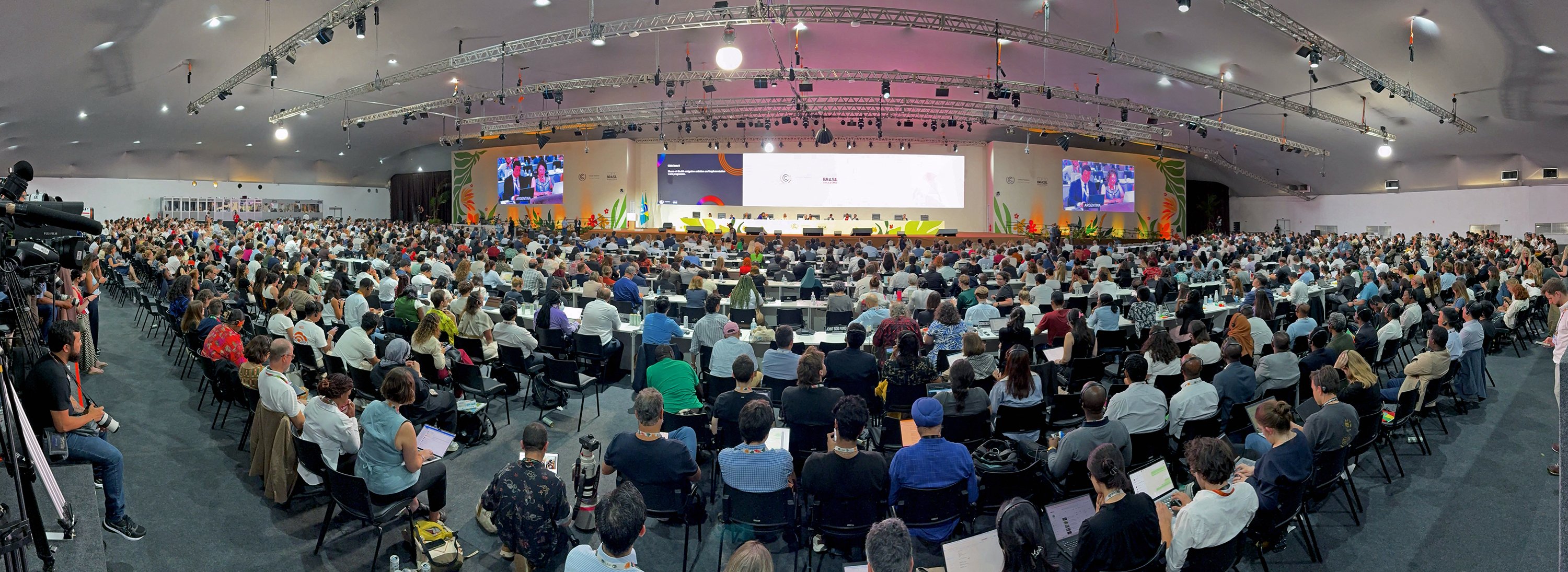
The environmentalists, the policy wonks, the fossil-fuel lobbyists (whoops, don’t mention the words "fossil fuel") have left Belem and the Brazilian rainforest, dragging their wheelie-suitcases behind them.
After the usual hype, big talk and symbolism, and the habitual and increasingly poor showing by the New Zealand government when it comes to doing our bit, can we judge whether Cop30 was a success of failure? Did it make progress or just kick the climate can down the road again?
As usual, that depends to some extent on who you listen to. The Guardian says that, beyond the negative headlines, there are some achievements worth celebrating. A different view, from End Climate Silence founding director Genevieve Guenther also writing in The Guardian, is that the summit was wrecked by petrostates such as Saudi Arabia and Russia and by other fossil-fuel interests.
In a kind of emperor’s new clothes moment, the final Cop30 deal has no direct mention of "fossil fuels", as if they don’t exist. Yet an earlier draft had agreement from 89 countries on a roadmap to phasing out fossil fuels.
As Ms Guenther points out, perhaps oil producers in the Middle East should think about how extreme warming is already affecting the region, highlighted by the announcement that Iran’s capital of 16 million people, Tehran, is likely to be abandoned because its water supply has run out after years of drought.
So, what was achieved by Cop30? One outcome is that the conference agreed to treble to $US300 billion annually the amount developing nations should receive to help protect lives and livelihoods against climate-change disasters. However, the deadline for that amount of insurance money has been pushed back to 2035.
Also, despite disappointments over fossil-fuel action this time, there appears to be genuine enthusiasm for an initiative for governments, planners, the energy sector, scientists and environmentalists to bring to next year’s meeting a plan for moving away from fossil fuels.
Members of New Zealand’s delegation were always going to face a tough time at Cop30, given the government’s ongoing erosion of earlier initiatives to reduce emissions.
For such misguided leadership, the Kiwi team brought home yet another "Fossil of the Day" award, its fourth in the last five years, this time for weakening methane-emission targets.
It’s yet another embarrassment for those who once held high hopes for our continuing efforts.
No doubt the award will go straight to the government’s pool room, where it can hang proudly next to the "Dirty Ashtray" accolade just won for reversing acclaimed tobacco reforms.
The 46-year wait
IT has been an awfully long time coming, but finally there is a preferred site for a memorial for the 257 people killed when Air New Zealand flight TE901 crashed into Mt Erebus 46 years ago yesterday. After earlier plans to build it in Auckland were scuppered, the Ministry for Culture and Heritage announced the National Erebus Memorial will now be in Christchurch.
The Christchurch City Council formally offered two locations as possibilities, one by the banks of the Avon River and the other in the Cracroft Reserve on the Port Hills. The Cracroft site, looking across the Canterbury Plains to the Southern Alps, has been selected as the ministry’s preference. Since the government committed in 2017 to a national memorial to those lost in the Antarctic in 1979, more than 50 sites in Auckland have been explored and rejected amid various issues and controversies.
When it comes to siting a national memorial for such a tragedy it is nigh-on impossible to please all of those who have been involved in so many different ways.
Locating it in the South Island makes sense, given Christchurch’s long-standing reputation as the gateway to Antarctica, its International Antarctic Centre and its importance as the primary base for the United States’ Operation Deep Freeze. The Erebus disaster is still the country’s worst peacetime disaster. Many can recall the evening newsflash from Bill McCarthy announcing there were concerns for the aircraft and passengers on board after no contact for several hours. There is no current timeframe from the ministry for the memorial’s construction, other than "as soon as possible". But after such a long and upsetting wait for many, this deserves to be built and opened as quickly as possible.


